

Why older cars still make sense for city commuting in India
 Images are not validated/verified
Simple engines, cheap spares and low insurance make old hatchbacks practical urban transport, though safety, emission rules and comfort are trade-offs.
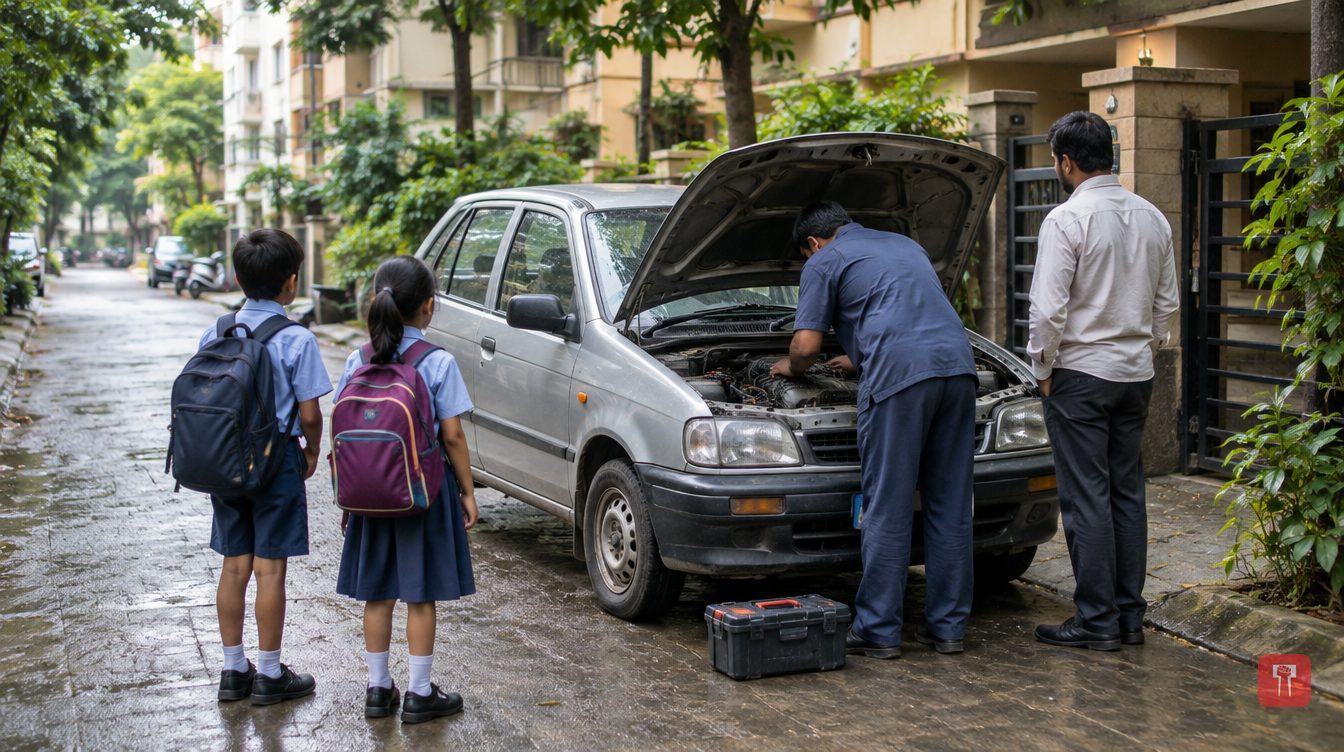
A 12-year-old hatchback parked outside a housing society in Pune starts at the first attempt, handles the daily school run with ease and is relatively cheap to insure. Across the country's cities, cars that left showrooms long ago still carry much of the daily urban commute.
It is important to understand the difference between the car everyone wants in the market and the one that keeps running reliably on potholed roads and through high fuel costs. This matters especially to anyone planning the next purchase on a tight household budget.
The longevity of many older Indian cars is not accidental; it lies in their basic design. These cars have simple naturally aspirated engines, and suspension built to withstand the punishment of everyday use rather than a test track. With fewer electronic control units, the chances of expensive digital faults are also lower. This is felt most ten years after purchase, once the manufacturer's warranty has run out.
Consider the small-capacity petrol engines that powered one generation's popular hatchbacks. Many had sturdy timing chains and a modest compression ratio, and none had a turbocharger.
Anyone looking at the variants and features of an older Alto K10 will quickly notice how little mechanical complexity there is under the bonnet. There are fewer sensors, fewer actuators and fewer parts that can trigger a warning light at 90,000 km. This simplicity was not only about saving cost; it was a deliberate engineering choice for emerging markets.
Easy availability of spare parts is another big advantage. When a car sells in very large numbers for many years, clutch plates, bearings and suspension bushes continue to be made for the market even after the company's assembly line has shut. Because the supply chain is deep and competitive, routine repairs are cheap.
The real debate is over running costs. A ten-year-old car has already taken its depreciation hit, which changes the ownership arithmetic completely. The steepest fall in value occurs in the first three to five years.
A later buyer of the same car is barely affected by that initial loss. If the car is used for another three years and then sold, the gap between the price paid and the amount recovered is often surprisingly small. For well-maintained models with a loyal resale market, the cost of depreciation is sometimes negligible.
Insurance premiums follow the same depreciation curve. The premium for comprehensive cover depends on the Insured Declared Value (IDV), which keeps falling as the car ages. Annual premiums for older small cars are usually at the lowest end. When repair economics no longer justify a comprehensive policy, many older owners eventually move to third-party cover.
If the mechanical basics are not neglected, fuel efficiency also holds up much better than most buyers expect. Those who examine used Alto cars and their running costs generally find that routine servicing bills are only a small fraction of those for a new, feature-loaded car. Local independent garages charge much less for labour, and routine mechanical work usually does not need special diagnostic software.
But it must also be acknowledged where older cars fall short. The strict structural safety norms that today's new models must meet came after these older cars. When it comes to crash protection, good maintenance cannot make up for the shortcomings of an older design. Families that regularly make long highway trips should weigh this point honestly.
Emission rules are another hard limit. Some large cities have imposed strict age limits on petrol and diesel vehicles. This means a car bought cheaply today may have less usable life in those areas than its price suggests. Before closing a purchase, it is essential to check the registration date and local traffic rules.
There are compromises on comfort and convenience too. Automatic climate control, a reverse camera and a modern touchscreen infotainment system were rarely standard on budget cars ten years ago. Some of these can be fitted later, but aftermarket additions do not feel fully part of the car.
None of these points entirely undermines the case for older cars; they only decide where such cars fit best. For short city trips, a second car in a crowded household, teaching learner drivers, or buyers who put dependable travel ahead of style, a well-maintained older hatchback remains a highly practical and financially sensible choice on Indian roads.
Reach readers on the ward they actually live in.
Advertise with Prime Time 24Reach readers on the ward they actually live in.
Advertise with Prime Time 24Reach readers on the ward they actually live in.
Advertise with Prime Time 24
Comments
No comments yet. Be the first.