

Who is Mhasoba, the guardian deity whose shrine stands on the farm boundary in Maharashtra
Mhasoba, a protector of fields, cattle and villages, is worshipped in Maharashtra and parts of the South, with small shrines found on farm boundaries.
 Images are not validated/verified
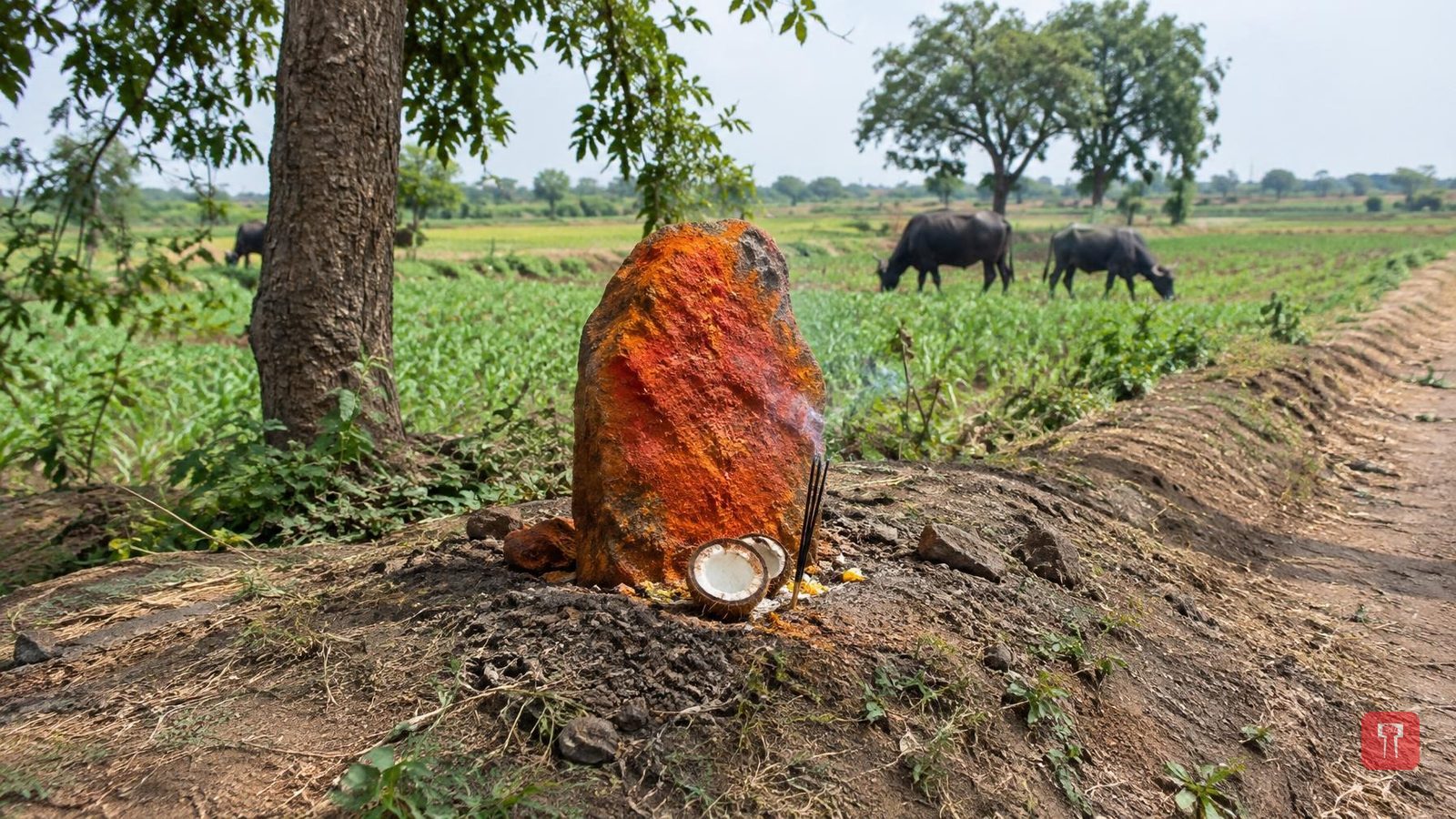
Anyone from rural Maharashtra will have heard the name of Mhasoba. In villages, the deity is found on the boundaries of farms. There may be no large temple, but a small shrine to Mhasoba can be found almost everywhere.
Mhasoba is not confined to Maharashtra. This kshetrapal, or guardian deity of the land, is also found in parts of Karnataka, Tamil Nadu and Andhra Pradesh, where he is known by another name as well. He is somewhat different from the deities of other temples: a rough stone is smeared with red-saffron vermilion. The history of Mhasoba was recorded in the time of Shivaji as well.
The name Mhasoba breaks into "mahish" and "ba", meaning the father of buffaloes, cows and other cattle and of farming, a kshetrapal who keeps watch like an elder. This is why the shrine of Mhasoba stands far away, on the farm boundary.
According to Rosalind O'Hanlon, a professor at the University of Oxford, the traditional worship of Mhasoba has been widely practised among the Maratha community in Maharashtra. Describing the faith of 19th-century Maratha society, she says that for many families it was a tradition to install a stone in the name of Mhasoba in the village precinct, smear it with vermilion and offer incense. She also says it was the practice to invoke Mhasoba's name on important occasions, such as taking seed for sowing at the start of farming, ploughing the field, or measuring the grain after threshing. Mhasoba is worshipped as a deity who guards the village and settlement, watches over cattle and blesses the crop with a good yield.
There are references to the worship of Mhasoba in the Bhosale family as well. There is a shrine to Mhasoba at Purandar fort, and the nearby reservoir is also called "Mhasoba Tank". Mhasoba's shrines are mainly tied to folk tradition, and he finds no special mention in Sanskrit religious literature. He is regarded as the "kshetrapal" deity who protects farming and land. According to some folk beliefs, Mhasoba is also worshipped as the protector brother of the Saptanadi deities, the "Sat Asara".
Some folk traditions hold that Mhasoba is an incarnation of Shri Shankar, and his name is linked to "Mahish" or "Mahesh". In Maharashtra, the worship of Mhasoba includes the worship of his wife, Jogubai. In some traditions Jogubai is linked to goddess Durga. In many places Mhasoba's shrines are outside the village or in the precinct of a cremation ground. According to folk belief, Mhasoba is regarded as a deity who protects against evil forces.
Mhasoba has a special place in the religious traditions of the Dhangar, Mang, Chambhar and other communities. In many places there is a practice of sacrificing a goat when a vow is fulfilled, while in some places only a shrifal, or coconut, is offered. During Mhasoba's yatra, the deity is taken out in a procession in a palanquin, and devotees join it with great devotion. Mhasoba's worship is thus an important part of the tradition of Maharashtra's village deities, farming-linked faith and local folk culture.
