

Thinning hair before 30? Experts say find the cause before choosing a treatment
Experts say hair loss has different causes, from genetics to deficiencies, and that proper diagnosis should come before any medicine, therapy or transplant.
 Images are not validated/verified
Hectic lifestyles, constant stress and too little sleep have increased talk of hair thinning at a young age in the state's urban areas. Experts in the field say the reason is not the same behind every case of hair fall.
For many young people in Mumbai, Pune, Nashik or Nagpur, the picture is no longer new. A problem that once appeared after forty is now being felt between the ages of 25 and 30, many say. Amid the noise of social media reels, home-remedy advice and advertisements promising "new hair in a week", many find it hard to tell what is true and what is not.
According to experts, every hair goes through a fixed cycle. A growth phase comes first and lasts a few years. A short transition phase follows, and finally a resting phase, after which the old hair falls out and a new one grows in its place. Some hairs on the scalp are always in the resting phase, which is why experts say shedding about 50 to 100 hairs a day is considered normal. Concern begins when the amount of hair shed keeps rising, when hair appears thinner in a particular part of the scalp, or when new hair grows back more slowly. The first step then is to identify the type of hair loss.
According to experts, the most common cause in men is considered to be genetic pattern baldness. The hair roots gradually become thinner, the hairline recedes and hair reduces on the central part of the scalp. In women the same problem often shows up as thinning along the parting.
In some cases hair loss is temporary. About two to three months after an event such as intense stress, a major illness, sudden weight loss, strict dieting, childbirth or surgery, a great deal of hair suddenly begins to fall. In medical terms this is called telogen effluvium, and hair often returns to normal once the cause is removed. Deficiencies of iron, vitamin D or B12, thyroid imbalance, hormonal changes such as PCOS in women, fungal infections, and skin conditions such as dandruff or scalp psoriasis can also be causes. Tight hairstyles, frequent chemical treatments and excessive heat can also make hair break near the root.
Experts also pointed to some misconceptions. According to them, wearing a cap or helmet does not cause baldness, although very tight headgear that rubs constantly can put strain on the roots. It is also wrong that washing hair with shampoo daily causes more hair fall, because hairs that fall during washing were already in the process of shedding. There is no scientific basis for the idea that shaving the head makes new hair grow thicker. Experts also say not to trust claims that an expensive oil or any single home remedy works like magic.
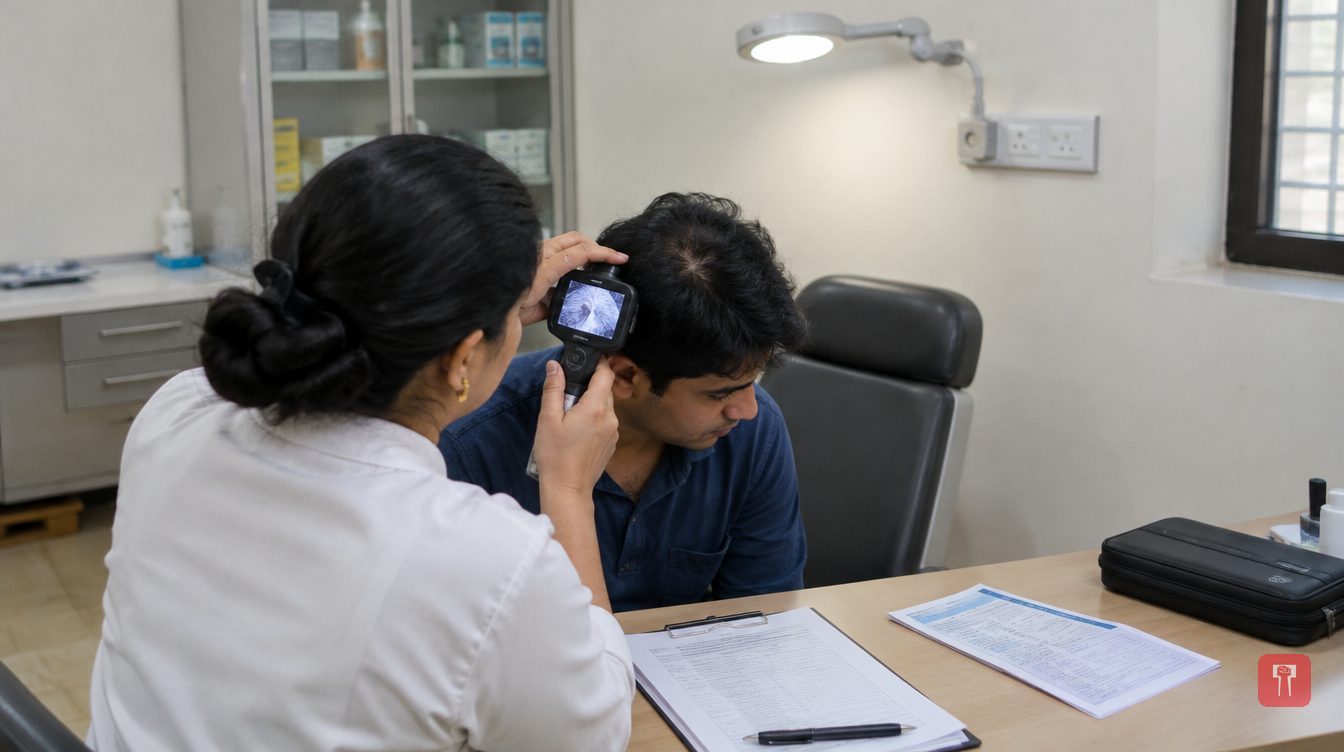
Experts say treatment varies with the cause, which is why diagnosis is the most important step. Dermatologists and hair specialists first take the patient's history, diet, family history of hair loss and details of recent illness or medication. The scalp is examined with a special instrument called a trichoscope, which shows the thickness of the hair and the condition of the roots. Blood tests are also suggested if needed. Only then can the specialist decide whether the way forward is medication, scalp therapy or surgery.
According to experts at Kibo Clinics, a hair restoration clinic in Mumbai, many patients initially lose months on shampoos or home remedies. An expert at the clinic said, "Hair loss should be diagnosed first. Because a deficiency that shows up in a blood test and a genetic pattern are treated completely differently."
According to experts, in the early stage, improvements in diet and lifestyle, correcting deficiencies and medicines prescribed by a doctor can help. Some patients benefit from scalp therapy such as PRP (platelet-rich plasma), in which plasma made from the patient's own blood is applied to the scalp. Experts say these medicines and therapies should be taken only on a specialist's advice, because the effect differs from person to person and some medicines can have side effects. Stopping hair loss and bringing back lost hair are two different things. Where the roots have died completely, medicines are less likely to bring new hair.
This is where the option of surgery comes in. According to experts, the most widely used method today is FUE hair transplant. In it, healthy roots from the back of the scalp are extracted one by one and implanted in the thinning area. Hair at the back is generally not affected by genetic hair loss, which is why it is called the "donor area". Unlike the older strip method, it does not leave a long scar but small dot-like marks, which are often hidden under the hair.
The procedure is done under local anaesthesia. The hairline design is decided first, because a natural-looking hairline is not a straight line; its edges are slightly irregular and soft. Grafts are then extracted from the donor area and placed in the thinning area through tiny incisions. Depending on the number of grafts and the area treated, the procedure takes a few hours and the patient usually goes home the same day.
According to experts, mild swelling and scabbing are seen in the first few days. In the first week, patients are advised to avoid sun, dust, heavy exercise and rubbing the scalp, and to keep the head slightly raised while sleeping. Most people return to office work in about a week. The implanted hairs fall out within two to four weeks, which is expected, and new hair starts showing after three to four months. The full result takes about twelve months, sometimes longer. Experts stress that this is a game of patience.
The surgery is not right for everyone. According to experts, the decision should be taken only after checking three things: whether the hair loss pattern has stabilised, whether there is enough donor hair at the back, and whether expectations are realistic. If the cause is temporary, such as telogen effluvium, surgery is not needed at all. An active scalp infection or an uncontrolled skin condition must be treated first. Having surgery in haste in one's twenties carries the risk that further hair loss later makes the hairline look unnatural. Even after surgery, the person's natural hair can keep falling, so medicines often have to continue.
In women, the causes of hair loss are often hormonal changes, nutritional deficiency, the post-delivery period and thyroid problems. In their case, experts therefore stress finding the cause first and giving medical treatment time. Surgery suits only some selected patients, and it requires a separate evaluation.
The cost depends on the number of grafts, the technique used, the surgeon's actual involvement and what the package includes. It is therefore said to be unwise to decide on the lowest rate alone. Patients are advised to ask the clinic who will actually perform the procedure, why this number of grafts is being suggested, whether real and unaltered results of past patients can be seen, and what will be done if there is a problem and how follow-ups will work. People are advised to be wary of advertisements such as "100 per cent guaranteed results" or "new hair in a week", because nobody can give such a guarantee in medical treatment.
On everyday habits at home, experts say a balanced diet rich in protein, iron and vitamins, full sleep and proper stress management have a good effect on hair health. Keeping the scalp clean, using a mild shampoo, avoiding tight hairstyles on wet hair and not pulling the comb hard are also described as useful habits. If hair loss continues for two to three months without easing, people are advised to consult a dermatologist or hair specialist.
