

Survey of full 231-km Gondia-Jabalpur doubling route completed for Rs 5,235.79 crore project
South East Central Railway says work on the Gondia-Jabalpur doubling project is progressing fast, with the survey of the entire route done.
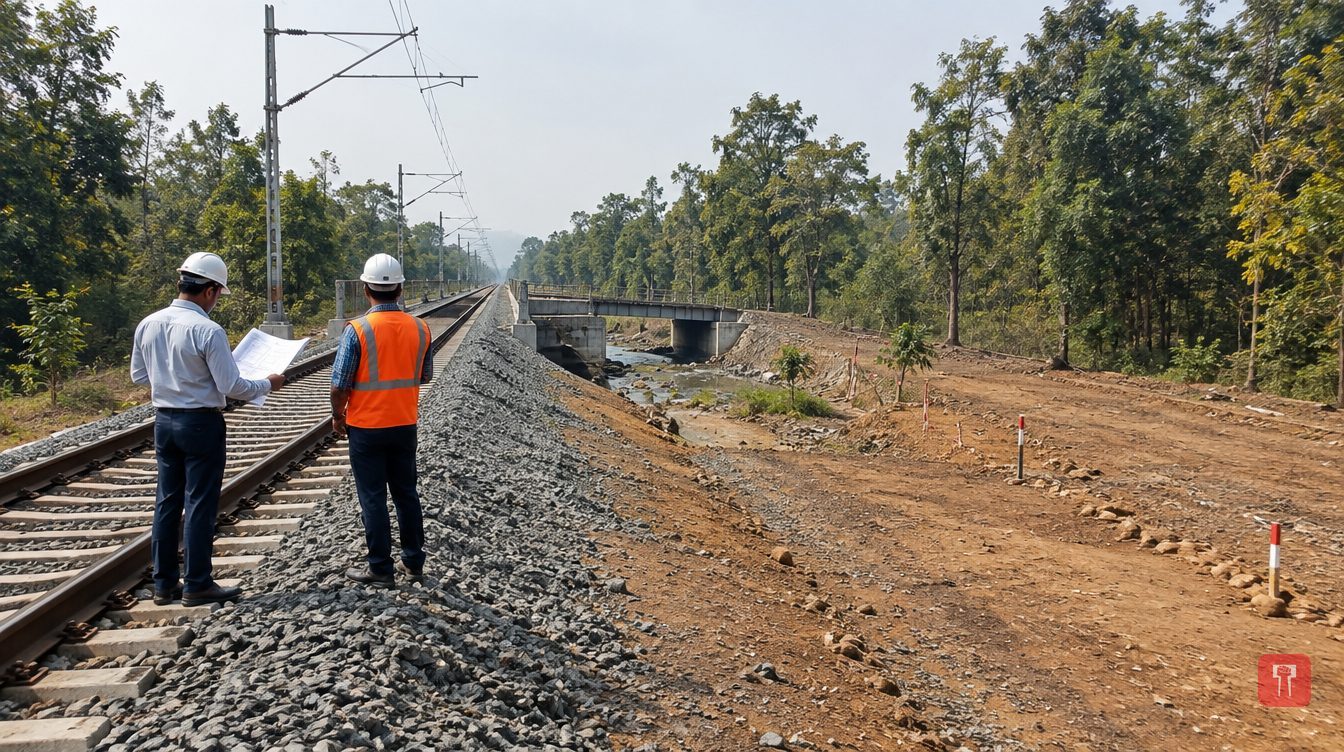 Images are not validated/verified
Gondia, October 17, 2026: Work on the South East Central Railway's Gondia-Jabalpur doubling project is moving ahead rapidly. The project was sanctioned in March 2026 at a cost of Rs 5,235.79 crore. Of the line's total length of 231 km, about 213 km lies in Madhya Pradesh and 18 km in Maharashtra. It will strengthen rail connectivity between the two states.
Chief Public Relations Officer of the South East Central Railway Sheikh Sami Ur Rahman said of the project: "The Gondia-Jabalpur doubling project is an important step towards developing the region's rail infrastructure. It will not only strengthen rail connectivity between north and south India but also benefit passengers, farmers, industries and trading activity in surrounding areas, including Balaghat, Seoni, Mandla and Jabalpur. The railway is committed to taking the project forward in line with the set targets."
The project will be executed in three sections: Gondia-Balaghat (42 km), Balaghat-Nainpur (82.40 km) and Nainpur-Jabalpur (106.80 km). The route has 23 stations: Gondia, Pratapbagh, Birsola, Hatta Road, Balaghat, Dhapewada, Samnapur, Charegaon, Lamta, Nagarwada, Padriganj, Nainpur, Pindrai, Nidhani, Ghansor, Binaiki, Shikara, Sukrimangela, Bargi, Charghat Pipariya, Gwarighat, Garha and Kachpura.
As part of the preparations, the survey of the entire route has been completed. A total of 507 bridges are proposed, and general arrangement drawings have been prepared for almost all of them. Yard plans have been prepared for 21 of the 23 stations, and work is under way on the rest. The project will include 10 new station buildings, and utilities such as electricity and water lines at 31 locations will be removed and shifted elsewhere.
The processes for acquiring private land, transferring government land and obtaining wildlife-related clearances are at different stages. Tenders for work on the Balaghat-Nainpur and Nainpur-Jabalpur sections will be issued after forest and wildlife clearances are received.
Doubling will significantly increase the line's capacity. More passenger and goods trains will be able to run, operations will not be disrupted, and train punctuality will also improve. The section links with the Howrah-Mumbai route at Gondia and the Itarsi-Varanasi route at Jabalpur. It is thus the shortest rail route connecting Varanasi and Prayagraj with Chennai, Bengaluru and Hyderabad.
On completion, the section will gain capacity to carry about 7.6 million tonnes of additional freight a year. As rail transport is economical and environment-friendly, it will help save about Rs 350 crore in logistics costs every year. Carbon dioxide emissions are estimated to fall by about 16 crore kg a year, equivalent to planting about 63 lakh trees. Construction is likely to generate employment of about 78 lakh man-days. The project provides for wildlife underpasses and fencing to protect wildlife.
Gondia in Maharashtra and the Balaghat, Seoni, Mandla and Jabalpur districts of Madhya Pradesh will benefit directly from the project. Better rail connectivity will make it easier to reach Kanha National Park, Pench Tiger Reserve and the Dhuandhar waterfall. Travel to religious sites such as Ayodhya Dham, Varanasi, Prayagraj, Rameswaram and Madurai may also become more convenient. Power plants, an ordnance factory and mines in the region will also get better rail connectivity, boosting industrial activity, freight movement and local economic development.
