

Railway unions question 14 to 17-hour shifts against 9-hour rule for loco pilots
At a Railway Board meeting on the 8th Pay Commission, the AIRF said loco pilots are made to work up to 17 hours despite a 9-hour rule, and that TA and overtime payments are delayed.
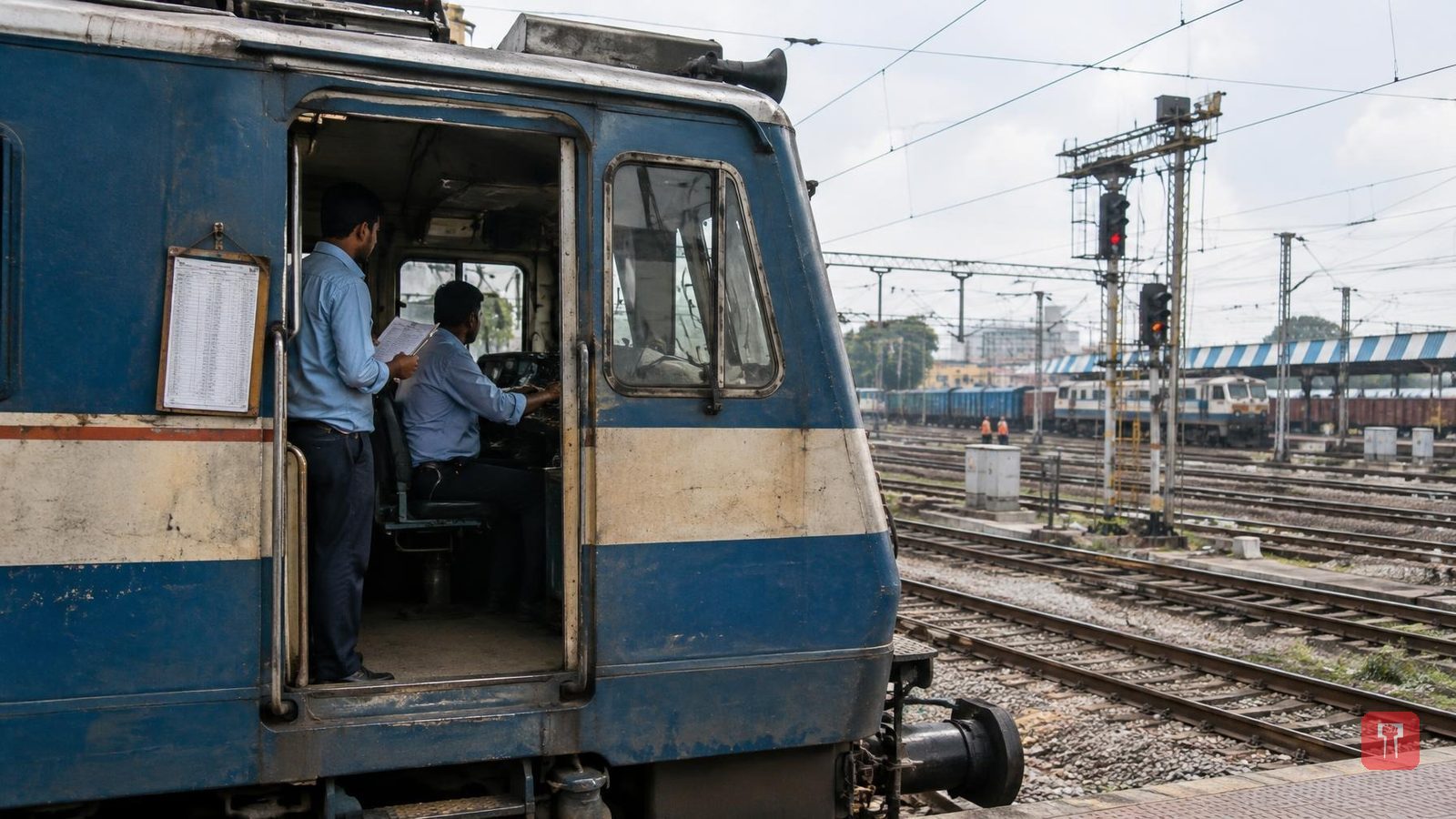 Images are not validated/verified
As expectation builds over a possible pay rise for central government employees, railway workers say their demands go beyond basic pay and allowances. Duty hours beyond the stipulated limit, delayed overtime payments and heavy work pressure have brought the daily difficulties of the job to the fore. At a recent Railway Board meeting, railway employee unions pressed the administration on these issues.
The All India Railwaymen's Federation (AIRF) raised the issue of loco pilots' duty hours strongly during the meeting on the 8th Pay Commission. Its representatives said there is a clear written rule that loco pilots should not be made to work more than 9 hours, and asked why they are made to work longer in practice.
The AIRF said that citing exigencies to make loco pilots drive trains for 14, 16 and even 17 hours at a stretch is wrong. It warned that this is not merely a matter of staff hardship but a direct risk to passenger safety and to train operations as a whole.
The issue of employees not receiving Travel Allowance (TA) and Overtime (OT) payments on time was also raised at the meeting. According to the AIRF, the Railway Board said at the meeting that about 95 per cent of the railway budget of roughly Rs 2.90 lakh crore has already been spent.
The union asked why, if employees are performing their duties day and night, the money for their TA and OT is being withheld. It said employees' actual earnings do not rest on basic pay alone, and that allowances and overtime paid on time are a mainstay of their income.
The condition of trackmen's work was also discussed at length. The federation demands that trackmen not be given work covering more than 12 km. The PW Manual currently sets the maximum at 20 km. The AIRF has strongly urged the Railway Board to fix the limit at 12 km. It also claimed that, after sharp struggle by employees, the 12 km condition has been implemented in some places.
Concern was also expressed about the duty hours of running staff. According to the AIRF, citing a railway order, it was pointed out that in emergencies staff may be made to work 11 hours at a stretch, and in certain circumstances the limit can stretch to 12 hours. The union alleged, however, that in many places staff are in practice made to work 17 hours continuously. It said such heavy pressure could prove extremely dangerous for safe train travel.
In the 8th Pay Commission process, railway employees are no longer focused only on a rise in basic pay. They are pressing for limits on working hours, compensation for overtime, timely payment of pending TA and OT, and the right to work in a safe environment. The union said a basic pay rise alone will not be enough to reflect an employee's real earnings and the nature of the job, and that strict adherence to duty hours and timely payment of allowances are just as necessary.
The employee union has put all these ground-level issues before the Railway Board. Attention now turns to what concrete steps the Board takes on these demands. It remains to be seen whether the discussion stays limited to raising pay, or whether a major decision follows to change working hours and conditions.
