

NEERI develops AI dashboard to track vehicle pollution through Nagpur's CCTV cameras
 Images are not validated/verified
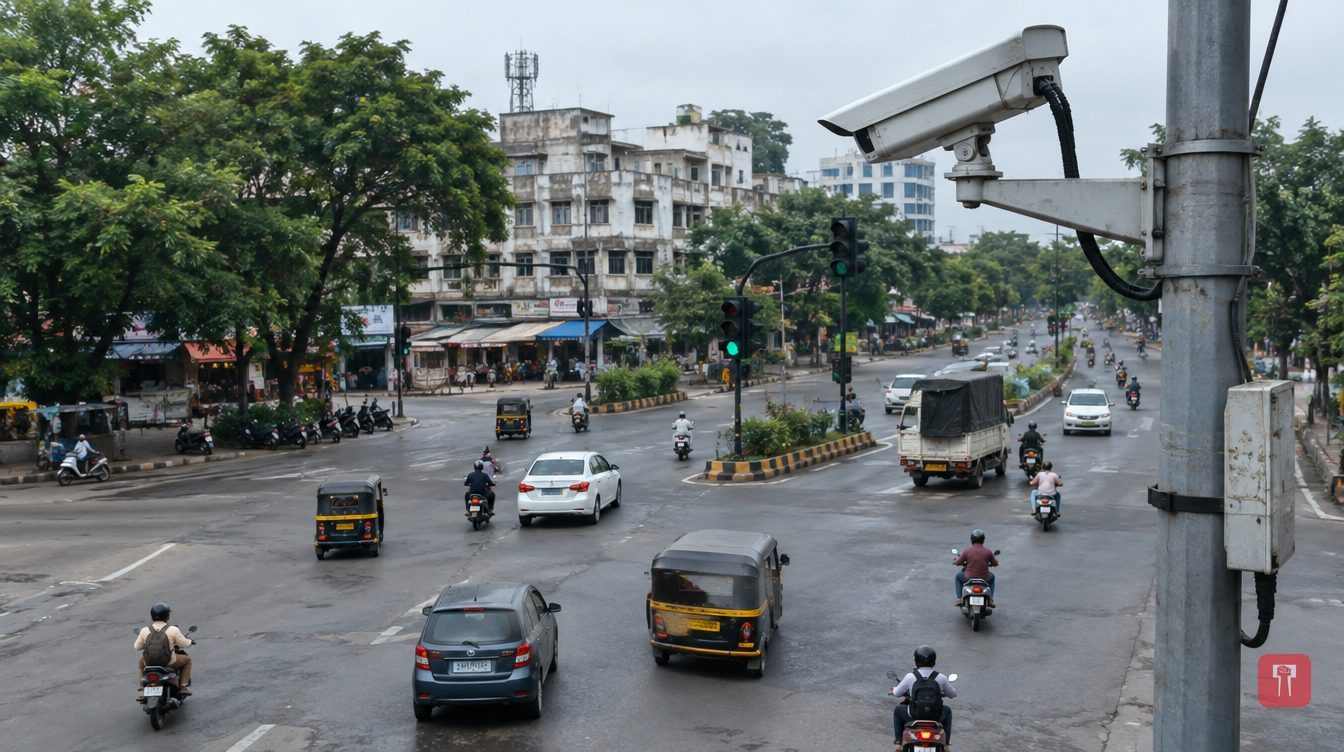
CSIR-NEERI's dashboard counts vehicles on camera footage from existing roadside CCTV and estimates the emissions they produce.
Nagpur, October 31: CSIR-National Environmental Engineering Research Institute (CSIR-NEERI), Nagpur, has developed a dashboard run on artificial intelligence (AI). Its key feature is that it monitors vehicular pollution using only the CCTV cameras already installed on roads. The technology identifies and counts vehicles on the road and estimates the pollution they produce.
The dashboard is called the AI-Integrated Line Source Emission Inventory, or AI-LSEI. It studies CCTV footage to identify different categories of vehicles, records the movement of traffic and works out estimated emissions for every hour.
Based on scientifically established emission factors, the system estimates major pollutants such as particulate matter (PM), nitrogen oxides (NOx), carbon monoxide (CO) and hydrocarbons (HC). The results are shown on GIS-based maps, which mark the locations and road corridors where estimated emissions from vehicles are high.
The technology has been developed by scientists of NEERI's air quality management division under the guidance of Director S. Venkata Mohan. The team includes Senior Scientist Rahul Vyavahare, Chief Scientist K.V. George, Jay Singh Rajput, Atharv Malode, Raj Sonarghare and Pranav V. Nair.
According to a senior NEERI scientist, the AI-LSEI system has already been installed in about 12-13 cities across the country, including Delhi, Mumbai and Hyderabad. In these cities, the dashboard analyses CCTV footage, monitors traffic movement and estimates daily vehicle emissions.
To implement it in Nagpur, NEERI has approached the Nagpur Municipal Corporation (NMC). For now, CCTV data from six different locations in the city is being analysed. The institute plans to talk to the Maharashtra government to get access to the larger network of CCTV cameras across the city. This would allow hotspots of vehicular pollution to be identified almost in real time. The team of scientists is also preparing a preliminary list of pollution hotspots in Nagpur.
The system continuously records the rise and fall of traffic through the day and links vehicle movement to estimated emissions. For example, during the morning rush, when two-wheelers and cars increase on the city's major roads, the dashboard captures the rise in traffic and calculates the emission load accordingly. For this, it uses vehicle details held in the transport database, such as fuel and engine technology, and the set emission factors. The data will let officials know when and where vehicular pollution is highest, so that measures to curb pollution can be taken in the right places.
NEERI scientists have also said that vehicle exhaust is only one part of Nagpur's air problem. Dust from construction, open burning of waste and industrial emissions are also major causes. They believe that to improve the city's air, the administration will have to work on these sources along with vehicles.
Reach readers on the ward they actually live in.
Advertise with Prime Time 24Reach readers on the ward they actually live in.
Advertise with Prime Time 24Reach readers on the ward they actually live in.
Advertise with Prime Time 24
Comments
No comments yet. Be the first.