

Maharashtra's new Class 6 textbooks add ancient Indian scholars, drop varna and caste passages
 Images are not validated/verified
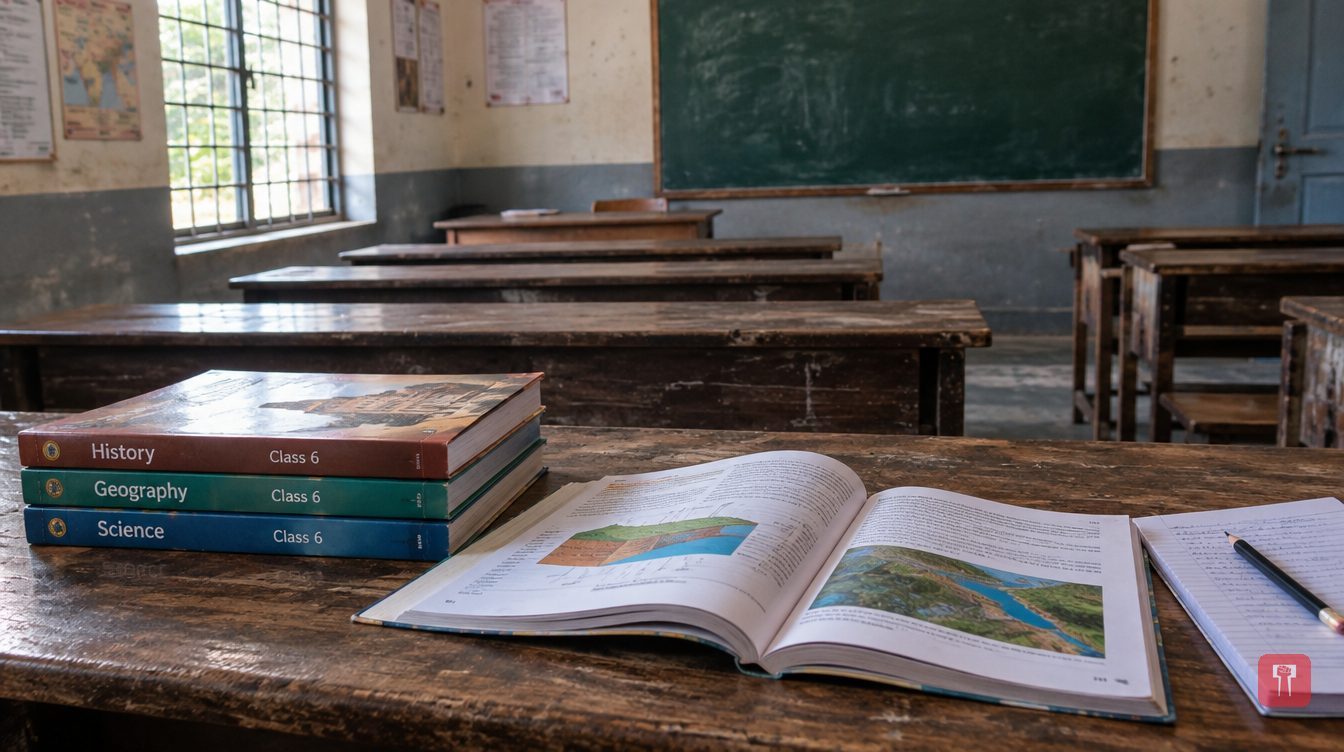
Balbharati's new Class 6 history, geography and science books, modelled on NCERT's, give ancient Indian knowledge a larger place and remove passages on varna and caste inequality.
Major changes have been made to the state's school textbooks under the National Education Policy 2020. Balbharati, the state textbook bureau, has introduced new Class 6 history, geography and science books from this academic session. The books give special space to ancient Indian knowledge texts, scientists and historical scholars. Some social and political portions of history have also been presented afresh. The changes, made on the lines of NCERT's, mainly concern three directions and certain portions of history.
The new science books include the contribution of ancient Indian scholars alongside modern scientific theories. In the lesson 'Force and Pressure', the discussion of gravitation mentions Bhaskaracharya II along with Isaac Newton. According to the book, Bhaskaracharya II stated about 950 years ago in his work 'Siddhanta Shiromani' that the earth pulls things towards itself. In the lesson 'Beyond the Sky', a special box says Aryabhata was the first person to explain that the earth revolves around the sun.
Maharshi Charaka, regarded as the founder of Ayurveda, has been added for his contribution to the classification of living beings. Chandrayaan-1, Mangalyaan, Chandrayaan-3, Aditya L-1 and the NISAR satellite have been included to show India's achievements in space research. The books also include meteorologist Anna Mani, known as the 'Weather Woman of India', and Gaura Devi's role in the Chipko movement to save the environment.
The new geography book gives space to Indian geographical history. A new section on the history of Indian geography cites the Vedas, Puranas, Upanishads and the Surya Siddhanta. Describing the earth as 'Saptadvipa', it compares Vedic ideas on the origin of the universe with the 'Big Bang theory'.
Earlier books mentioned only the Greenwich meridian. The new book says ancient Indian astronomers regarded Ujjain as the central point of the earth and were the first to give the concept of the base longitude.
In the history book, changes have been made in the treatment of ancient medicine, major historical figures and social-political issues. Sushruta, regarded as the 'Father of Surgery', his nose reconstruction technique and the 'Sushruta Samhita' are covered in detail. Chanakya's 'Arthashastra' and his role in the rise of Chandragupta Maurya have also been added in detail.
Earlier books gave a detailed account of the development of the varna system and caste inequality. A passage on the rituals of sacrifice and the privileges of the priestly class in the Later Vedic period, which said social position was based on birth, has been removed. In its place, the emphasis is now on Vedic values, moral duties and nature worship.
The teachings of Vardhaman Mahavira and Gautam Buddha have been retained. However, the earlier passage linking the rise of new religions in the sixth century BCE to caste discrimination and social conditions has been removed and recast as India's 'religious diversity'. The issue of 'invasion by foreign groups' has also been dropped entirely from the causes of the decline of the Harappan culture. The decline is now attributed only to changes in river courses, natural disasters and a fall in trade with Sumerian culture.

Comments
No comments yet. Be the first.