

How much it really costs to fully charge your electric scooter or bike
The cost of charging an electric two-wheeler depends on battery size, power tariff and charging losses, and can range from Rs 15 to Rs 85 at home.
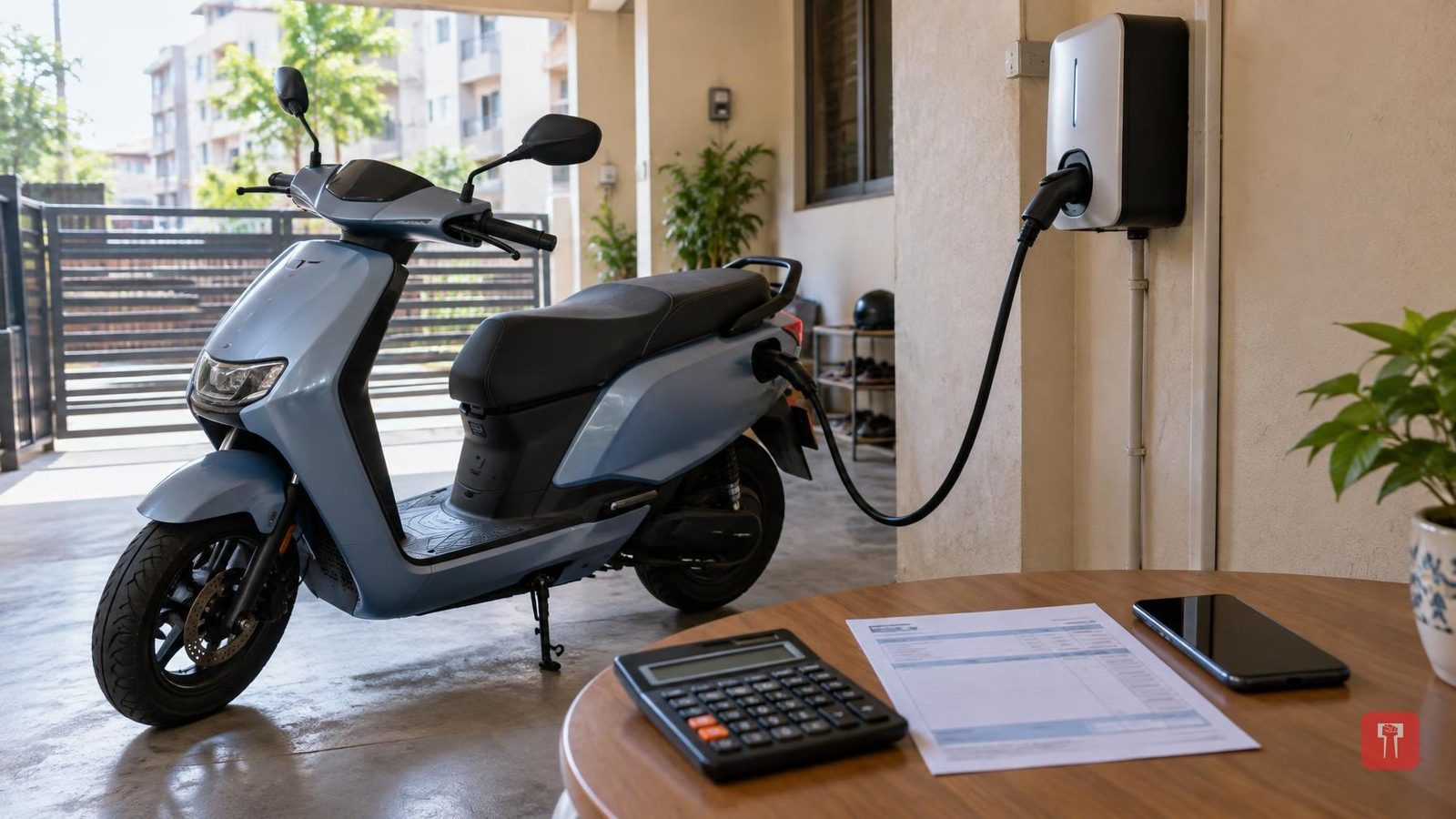
People buy electric bikes or scooters to save on petrol costs, but many are unsure how much charging them actually costs. The expense depends on three things: the battery's capacity, the household electricity rate, and the power lost during charging. Charging at home, a full charge for an electric two-wheeler can cost anywhere between Rs 15 and Rs 85.
It helps to understand how the charging cost is worked out. Battery capacity is given in kWh, but slightly more electricity is drawn from the socket than the battery's actual capacity, since some energy is lost during charging. Assuming a charging efficiency of about 90 percent, fully charging a 3.5kWh battery could require around 3.89kWh of electricity. At a rate of Rs 7 per unit, this comes to about Rs 27.22, and at Rs 10 per unit, the cost rises to about Rs 38.89.
Among popular electric two-wheelers in the market, fully charging the TVS iQube's 3.5kWh battery costs about Rs 27, the Ather Rizta's 2.9kWh battery about Rs 23, the Oben Rorr EZ's 3.4kWh battery about Rs 26, and the Revolt RV400's 3.24kWh battery about Rs 25. These figures are based on an electricity rate of Rs 7 per unit and 90 percent charging efficiency.
There is also an example of what the total monthly cost could look like. If someone commuting daily to office covers 1,000km a month and the scooter consumes 30Wh per km, it would need about 30kWh of electricity in a month. At Rs 7 per unit, this works out to about Rs 210. However, actual consumption varies with traffic, speed, the rider's weight and weather. This is why it is more useful to calculate cost based on one's own monthly usage rather than relying only on the range stated by the company.
A bigger battery does not always mean a higher running cost. A larger battery does take more electricity to fully charge, but that does not mean the cost per kilometre will always be higher too. If the range is longer and energy efficiency is good, a bigger battery can actually work out cheaper. So when buying an EV, it is more important to check the electricity cost per kilometre rather than the cost of a full charge.
The cost of charging at home and at public charging points can differ. Some networks charge by time, while others charge by the amount of electricity used. For instance, Ather Grid is reported to charge Rs 1.20 per minute, with 18 percent GST added on top, and this rate can also vary by location. It is worth keeping this difference in mind: home charging for daily commutes and public charging for longer rides.
