

What is Bodan, the Konkanastha Chitpavan Brahmin family ritual honouring Annapurna and the clan goddess
 Images are not validated/verified
Bodan is a traditional kuladharma of the Konkanastha (Chitpavan) Brahmin community, performed for the blessings of Annapurna and the kuladevi, with rules that vary by household.
Bodan is a highly significant traditional kuladharma, or family ritual, of the Konkanastha (Chitpavan) Brahmin community. It is performed to seek the grace and blessings of Annapurna and the kuladevi (Adishakti), and to express gratitude to them.
The word "bodan" is believed to be a corrupted form of the Sanskrit "brahmodan" or "bahudhan". In the view of etymologist K. P. Kulkarni, "bodan" or "bodan" derives from the word "motan", meaning the crushing of obstacles.
The ritual is performed in remembrance of Adishakti, the slayer of demons such as Mahishasura, and of Annapurna, so that happiness, prosperity, the continuation of the family line and good health remain in the home. Respect for womanhood is its main basis.
The rules of bodan may differ slightly according to each family's kulachar. It is performed to thank the kuladevi after a major auspicious event in the household, such as a wedding, upanayana (munja), vastushanti or the birth of a child. There is also a practice of performing it every year or every three years. Some households do it annually, for instance on Dussehra during Navratri or in the month of Margashirsha, while others do it every three years.
Tuesday, Friday and Sunday, the days of the goddess, are considered auspicious for bodan. The Chaturmas period (Ashadha to Kartik), Pausha and Chaitra are considered prohibited. In exceptional cases, some people perform it during Navratri as their kulachar allows. By tradition, the entire rite and the cooking of the meal are done with purity and completed before 12 noon.
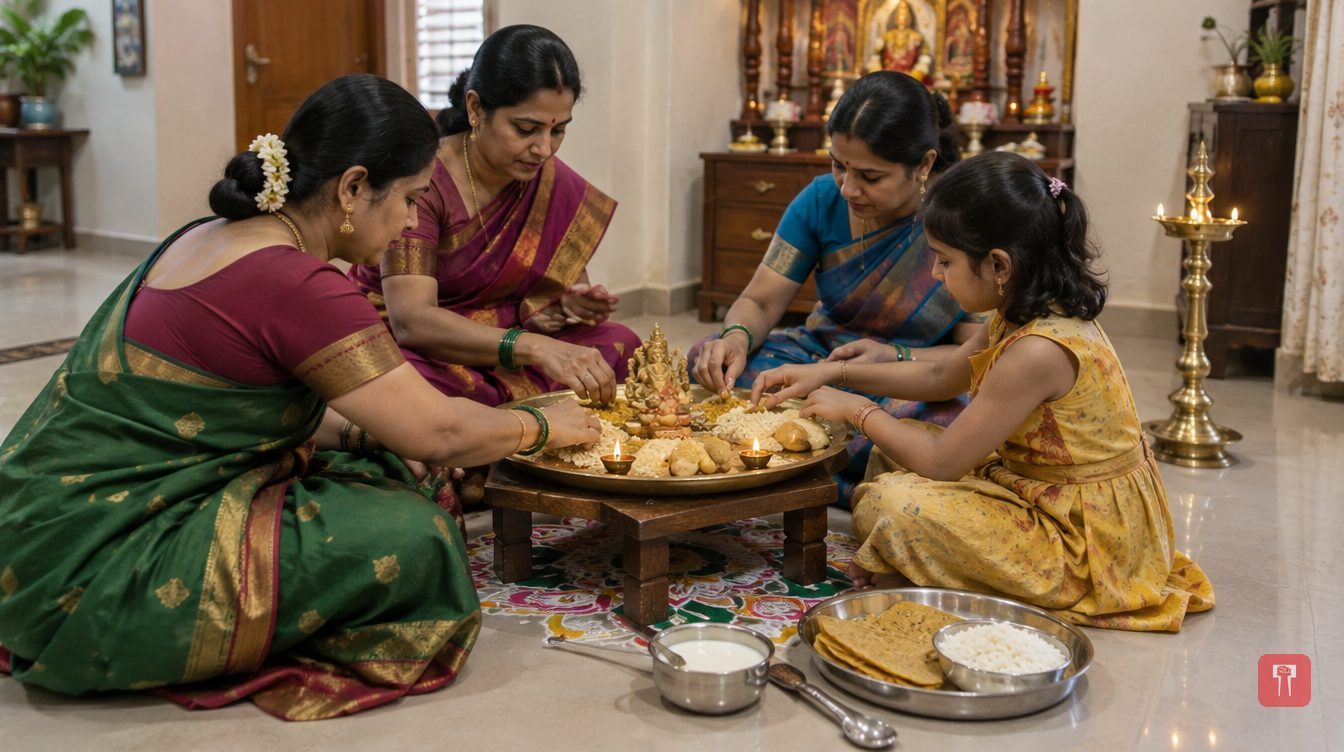
Bodan is a beautiful and sattvic observance that begins with the initiative of women. Four married women, one from the household and three from outside, and one kumarika, a girl of about 4 to 9 years, are invited with respect. In some households, five married women from outside are invited. The invited women and the girl are offered oil and shikakai for a bath, or are welcomed at the house by washing their feet with lukewarm water and milk near the tulsi plant, performing aarti and filling their laps with a blouse piece and coconut.
A special rangoli for bodan is drawn on a low wooden seat or platform. A wooden tub or a large, well-tinned brass platter is placed on it. The Annapurna idol from the household shrine is placed in the middle, with a Ganapati made of betel nut beside it. A throne for the goddess, ornaments (nose ring, mangalsutra, bangles, hair braid ornament and so on) and five small lamps are shaped from wheat flour and arranged in the platter.
The woman of the house worships Ganapati and Annapurna with panchamrit and shodashopachar. On this day, in keeping with the rules of purity, a meal of five dishes is cooked, including puran poli, dal-rice, vadas made from mixed-grain flour and pumpkin gulgule, and five naivedya offerings are shown to the goddess in the platter. After the aarti, milk is poured in a stream over the lamps in the platter with a silver sandhya spoon, with a gold ornament or chain attached to the spoon, to calm them. The panchamrit, milk, ghee, puran, rice, vadas and all the flour ornaments and lamps in the platter are then mixed together.
All the married women and the kumarika mix these items together while chanting mantras or hailing the goddess. A small portion of the mixed bodan is applied on the forehead as "angara" or prasad, or tasted. The rest of the bodan is considered extremely sacred. There is a strict tradition that it is not given to any other animal but is fed only to a cow or immersed in clean flowing water.
According to the source, the bodan kulachar is found across India only among the Konkanastha (Chitpavan) Brahmin community. It is not practised among Deshastha, Karhade, Saraswat or any other Brahmin sub-caste, or other communities. Even so, not every Chitpavan Brahmin household performs bodan.
Among Konkanastha Brahmins, some households have bodan as their kuladharma, while others have "jagaran" or "Mahalakshmi puja". A daughter who goes to her in-laws after marriage therefore performs the ritual according to the tradition of her in-laws' household. Although no ritual like bodan exists in other communities, other practices honouring the goddess are seen there. For example, Deshastha Brahmins and the Maratha community have the practice of performing jagaran or jagrata for the kuladevta, while some communities observe a Mahalakshmi vrat in Margashirsha or worship kumarikas and married women during Navratri.
Reach readers on the ward they actually live in.
Advertise with Prime Time 24Reach readers on the ward they actually live in.
Advertise with Prime Time 24Reach readers on the ward they actually live in.
Advertise with Prime Time 24Choose primetime24.com as a preferred source on Google Google shows more stories from your preferred sources in Top Stories.
Reach readers on the ward they actually live in.
Advertise with Prime Time 24
Comments
No comments yet. Be the first.