

Washim collector orders joint water conservation plan to counter looming shortage
 Images are not validated/verified
Collector Yogesh Kumbhejkar asked government departments, NGOs and CSR partners to implement one integrated plan, as 247 villages in Washim district are listed as likely to face scarcity.
Government departments, voluntary organisations and corporate social responsibility (CSR) partners in Washim district should together implement an integrated water conservation plan to deal with a possible water shortage, Collector Yogesh Kumbhejkar has directed. He said all agencies concerned should work in coordination to raise the capacity of water sources, recharge groundwater and plan for sustainable water supply.
Kumbhejkar was speaking at a review meeting of the "Dushkal Mukt Washim" (drought-free Washim) initiative, held on November 13 in the revenue hall of the Collector's office, with the district administration, voluntary organisations and CSR partners. Resident Deputy Collector Vishwanath Ghuge, Soil and Water Conservation Department Executive Engineer Harendra Prabhudas Waghmare, social worker Dr Harish Baheti, Jalmitra Subhash Nanwate and Primary Education Officer Vitthal Bhusare were present. Officials of the departments concerned and representatives of the organisations also attended. They gave presentations on the likely water shortage, the proposed water conservation works and the measures to be taken with the organisations' participation.
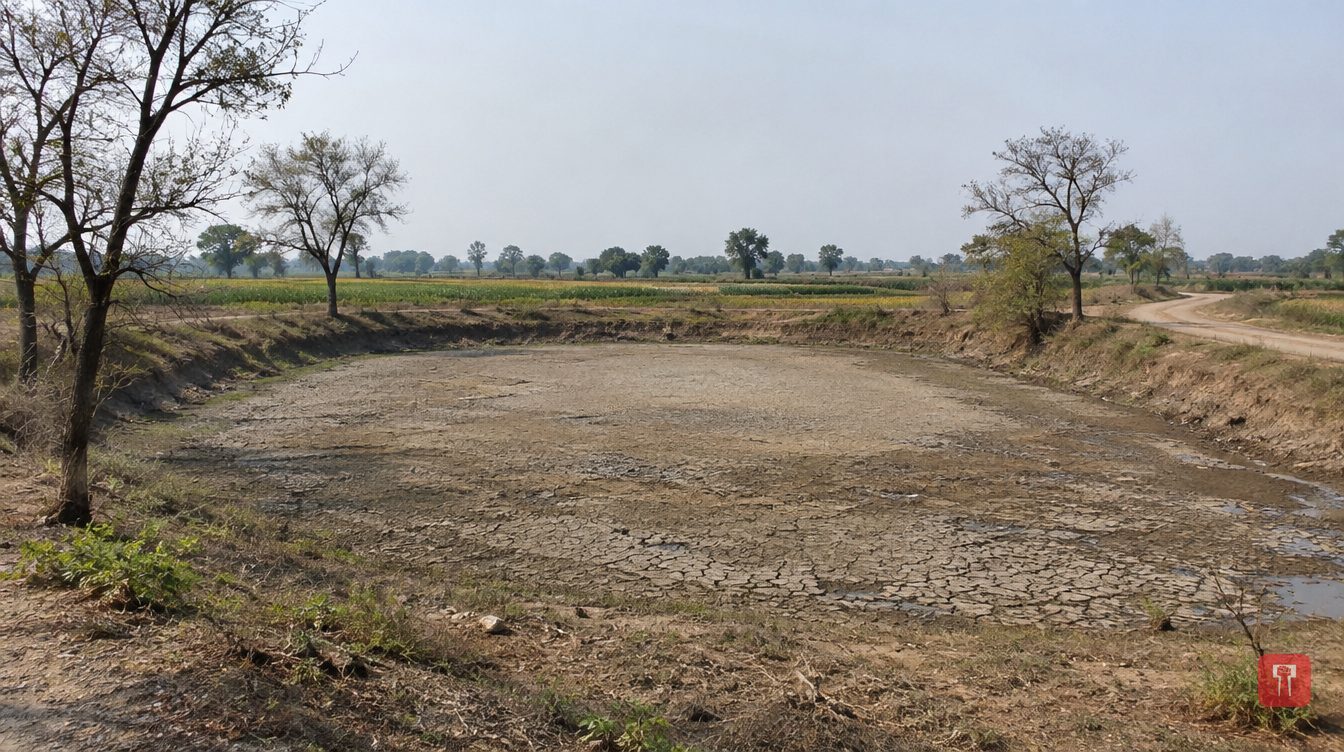
According to the probable water scarcity report of the Groundwater Surveys and Development Agency, the district received 485.78 mm of rain between June and September 2026. This is 62.63 per cent of the average, a deficit of 37.37 per cent. Groundwater levels have fallen in 77 of the district's 79 observation wells, with an average drop of 1.11 metres. A total of 247 villages in 34 watershed areas have been shown as likely to face scarcity. Against this background, Kumbhejkar said water conservation works should be given priority and completed before the next monsoon.
The Soil and Water Conservation Department has proposed 355 works in all six tehsils of the district, at an estimated cost of Rs 63.02 crore. These include desilting of 174 tanks at Rs 39.33 crore. There are 176 works to deepen and widen streams (nalas) at Rs 21.04 crore, and five cement storage dams at Rs 2.65 crore.
The plan is to remove about 32.5 lakh cubic metres of silt from the tanks. This is expected to help restore about 3.25 million cubic metres of water storage capacity. The fertile silt is expected to be used on about 8,100 acres of farmland. The collector directed that proper planning be done so that the silt removed reaches farmers for use in their fields. He also said desilting would raise the capacity of water sources and also improve the fertility of the fields.
With the support of BAIF and Tata Trusts, a scheme of about Rs 1.32 crore has been drawn up for watershed and livestock development in 15 villages of Malegaon tehsil. Of this, about Rs 1.01 crore is proposed for watershed development and Rs 30.88 lakh for livestock and fodder development. Under watershed development, treatment will be carried out over 150 hectares and 403 water conservation structures will be built. Livestock development covers 159 beneficiaries. The works are planned to begin on November 25 and be completed by May 2027.
With the support of AFPRO and ITC, 38 works in 13 villages under "Mission Sunahra Kal" removed 1,12,152 cubic metres of silt in 2025-26. For 2026-27, 57 works are proposed in 21 villages across all six tehsils of the district. These include desilting of 50 percolation tanks and seven dams, which is expected to add 99,619 cubic metres of water storage capacity.
With the support of the Watershed Organisation Trust (WOTR) and HDFC, works are proposed in 20 villages of Malegaon tehsil under the Vidarbha Water Conservation Project. Kumbhejkar said a detailed work-wise plan for this project should be presented and coordinated with the plans of other agencies. He said that if the work of different organisations is coordinated, available resources will be used effectively and the pace of water conservation works will increase.
In Malegaon tehsil, the areas of work of several organisations overlap. The collector therefore asked for a village-wise common map to be prepared, with a clear division of works among the organisations. For implementation, the plan includes a gram panchayat resolution, a detailed project report for each water source, the necessary approvals, geotagging before work begins and a process for keeping a regular record of progress.
The collector also directed that government agencies, voluntary organisations, CSR partners and villagers keep in regular touch so that the proposed works are implemented effectively. Progress should be reviewed continuously, and emphasis should be laid on completing the works within the set time limit.
Reach readers on the ward they actually live in.
Advertise with Prime Time 24Reach readers on the ward they actually live in.
Advertise with Prime Time 24Reach readers on the ward they actually live in.
Advertise with Prime Time 24Choose primetime24.com as a preferred source on Google Google shows more stories from your preferred sources in Top Stories.
Reach readers on the ward they actually live in.
Advertise with Prime Time 24
Comments
No comments yet. Be the first.