

Rear portion of Nagpur's heritage old High Court building collapses despite ASI warning
 Images are not validated/verified
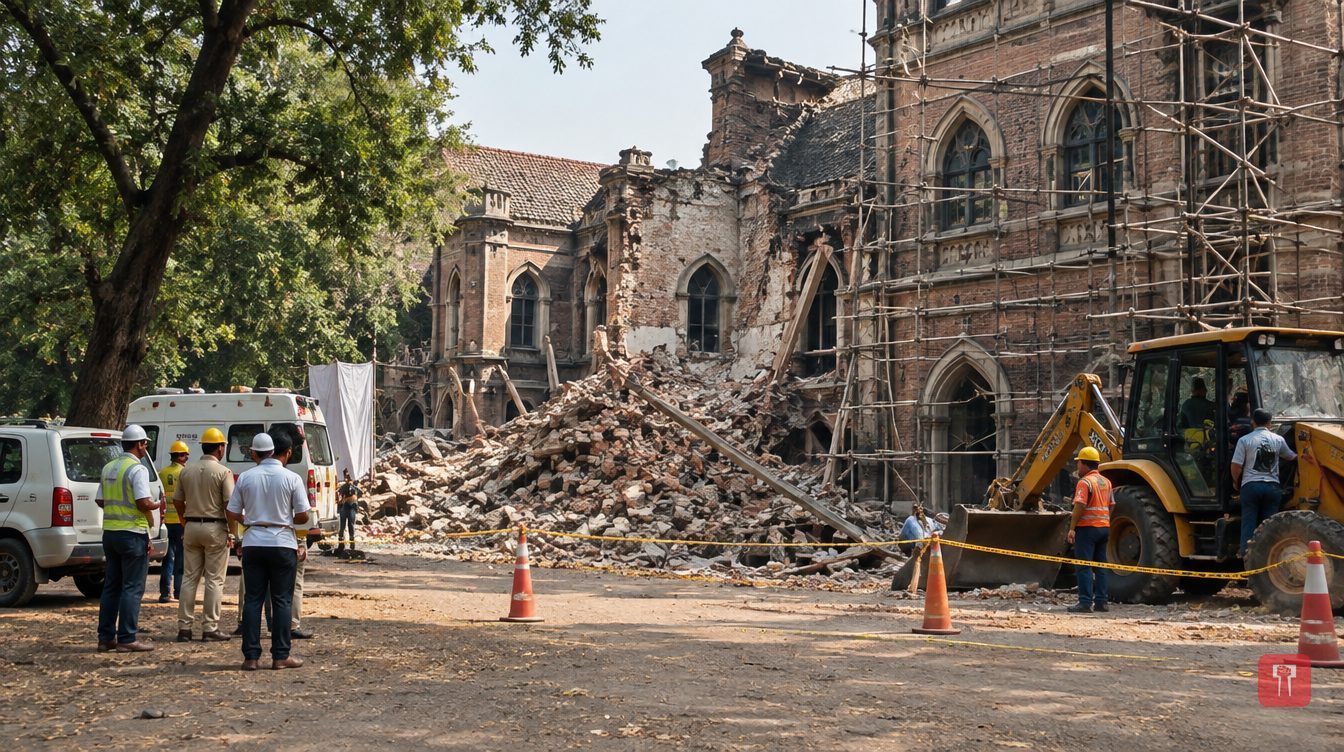
A section of the old High Court building in Civil Lines collapsed on Monday afternoon; workers were away at lunch, and ASI had flagged lapses in conservation work in October.
A portion of the historic old High Court building in Civil Lines, Nagpur, collapsed on Monday afternoon. The fall of the rear section has exposed negligence in the conservation of the heritage structure, and raised questions about how effective the arrangements for inspection and repair are.
A major tragedy was narrowly averted. When the rear section of the old building came down, the labourers working there had gone elsewhere for lunch, so all were safe. Had four or five workers been present, they could have been trapped or buried under the debris.
The deteriorating condition of the building is already before the Nagpur Bench of the Bombay High Court, which has taken suo motu cognisance and initiated a public interest litigation (PIL). The next hearing is scheduled after Diwali.
Most worrying is that the Archaeological Survey of India (ASI) had inspected the premises several times in October. On October 23, the ASI wrote to the Nagpur Chief Engineer of the Public Works Department (PWD), stating clearly that the conservation work was not being carried out in line with the approved estimates and the National Conservation Policy 2014. On October 27, an ASI officer visited again and discussed the conservation work with PWD officials.
Despite these inspections and the written warning, the rear section of the building fell on Monday. The questions are whether the shortcomings pointed out by the ASI were properly attended to, whether corrections were made in time, and whether this fragile building was monitored with the necessary seriousness.
The ASI handed the building over to the PWD on September 30, 2026, after which responsibility for the ongoing conservation work passed to the state agency. But the ASI's October 23 letter shows that objections to the method of work arose within a few weeks of the handover. Attention is therefore also turning to coordination between the ASI and the PWD.
Questions now centre on the system of monitoring, adherence to the prescribed conservation standards, and the response to the heritage agency's technical objections. Another key issue is whether the risk to the structure was properly assessed before labourers were allowed to work on the site, and whether the necessary safety arrangements were in place.
In the High Court, Advocate Ashutosh Dharmadhikari is the amicus curiae assisting the court, and Advocate Deepak Thakare is appearing for the government. As the accident has occurred while the matter is pending, the actual progress of the conservation work, the ASI's objections and the PWD's reply are likely to be examined more seriously at the next hearing.
The PWD had earlier told the High Court that, once the conservation work was completed, the ASI sub-circle office and storeroom would be shifted to the remaining part of the building. With one portion now fallen, fresh concern has arisen over the safety and usability of the surviving sections. It is also unclear whether this arrangement can still be carried out.
The most urgent task for now is to test the strength of the entire building, and to establish why it collapsed and whether earlier warnings were properly acted upon. That another part of a historic building under court monitoring has been reduced to ruin is not merely a construction lapse. It is a serious sign of delayed intervention, inadequate conservation and a possible failure of coordination between institutions.
Reach readers on the ward they actually live in.
Advertise with Prime Time 24Reach readers on the ward they actually live in.
Advertise with Prime Time 24Reach readers on the ward they actually live in.
Advertise with Prime Time 24
Comments
No comments yet. Be the first.