

Nagpur's junctions still run on 30-year-old traffic system even as city expands as a metro
Nagpur's traffic control remains stuck in a structure from three decades ago, with signals, parking and public transport all in need of a rethink.
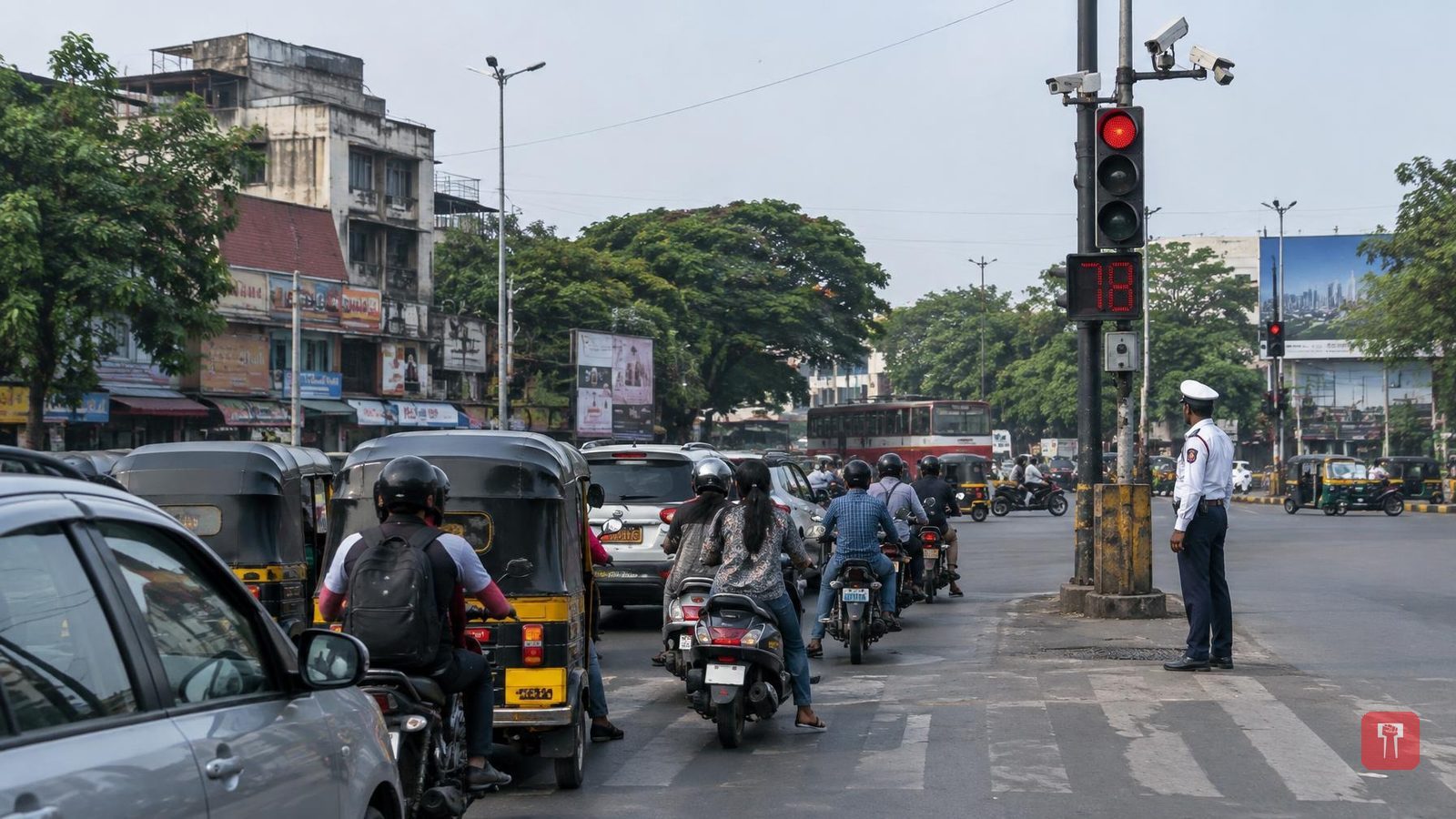
Nagpur is expanding fast as a metro city, but its traffic system has not kept pace. Traffic control is still stuck in a structure from three decades ago. At major junctions such as Variety Chowk, Itwari, Mahal, Agrasen Chowk, Cotton Market and Bardi, the problems of 30 years ago persist.
The Nagpur Improvement Trust, the municipal corporation and the city traffic police continue to rely on old, conventional measures to improve traffic. In these 30 years the city's population has more than doubled and the number of vehicles has crossed 20 lakh. Yet the traffic system has seen neither new technology nor fresh thinking in the same proportion.
Under the Smart City project, CCTV cameras were installed at junctions. But there is criticism that the cameras are being used more to collect fines from rule violators than to smooth traffic.
It is now time to move beyond paper planning and meetings and bring real change to traffic management. Signals currently run on fixed timings. They should be replaced with an AI-based Adaptive Traffic Control System (ATCS) that sets signal timings by looking at actual road conditions.
Strengthening public transport is also under discussion. An effective feeder bus service should be set up to carry people from metro stations to their final destinations. Separate cycle tracks could reduce dependence on private vehicles. Proper implementation of pay-and-park in the city's major commercial areas and more multi-level parking have also been described as necessary. A strict policy on parking and encroachment is being demanded.
Big cities around the world have not sought solutions to traffic jams only in old methods. They have turned to technology, planning and long-term measures. Their experiments show how long a way Nagpur still has to go.
In Tokyo, Japan, vehicles are counted with the help of cameras and sensors, and the green signal time is changed accordingly. In Nagpur too, signals at about 20 junctions have been linked to AI technology in the last few months. But at 99 per cent of the city's signals, motorists still have to wait up to 120 seconds at a red light.
Singapore introduced electronic road pricing, under which vehicles entering very busy areas at peak hours are charged a digital fee. Barcelona in Spain changed the traffic structure of residential areas and barred heavy vehicles from entering them. This made the inner areas safer for pedestrians and cyclists. The experiment there is called Superblocks.
Ravindra Kaskhedikar says there has been no fundamental change in thinking on how to improve the city's traffic. Claims are made that CCTV will curb traffic violations, but challans worth thousands of crores are now pending. Simply increasing the machinery for levying fines will not solve the problem, he says. New technology and modern ideas must be adopted in traffic management.
He cites the example of the passport service, which once had a very poor image in the country. When its responsibility was handed to Tata, the service changed greatly. On similar lines, new experiments should be considered in traffic management too.
