

Nagpur has over 20 lakh vehicles, but its traffic management is still stuck in the 1990s
As Nagpur moves towards metro-city status, junctions still run on old signals, worn zebra crossings and challan books, and the camera network is seen as a revenue tool.
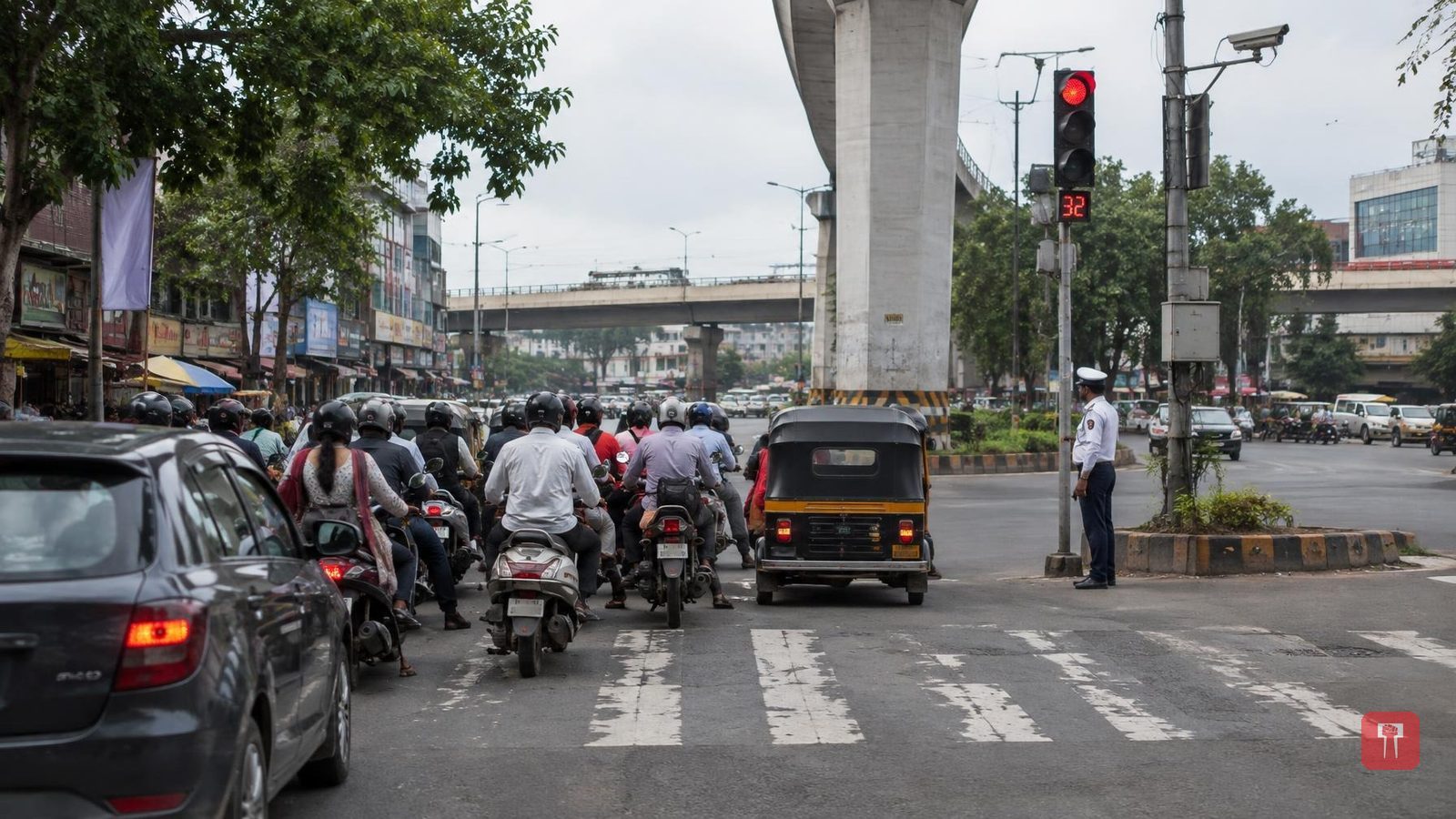
Nagpur is moving towards becoming a metro city, but its traffic management still runs on the pattern of the 1990s. Thirty years ago, poor infrastructure, outdated rules and a lack of civic sense left big junctions such as Variety Chowk, Itwari, Mahal, Agrasen Chowk and Cotton Market in a bad state. The same picture is seen today.
The Nagpur Improvement Trust, the municipal corporation and the city traffic police still have the same old tools to manage the worsening situation: a red-green signal, half-faded zebra crossings on the road, and policemen in white shirts writing out challan receipts at junctions.
In these three decades the city's population has more than doubled and the number of vehicles has crossed 20 lakh. Yet there is still no sign of fresh thinking or innovation in the system. In the name of development, the city got a "cement jungle" and metro pillars. Even after the flyovers were built, these pillars have narrowed the remaining roads further.
Whenever a new officer arrives in the district, the same old tactics are repeated: putting up a barricade at a junction, closing a cut-out with cement, building a speed breaker. Cameras were installed at junctions under the Smart City project, but their purpose has become raising revenue through challans rather than easing traffic. The question is when the city's system will finally change.
A look at the world's busy cities shows how far behind Nagpur is. In Tokyo, Japan, AI cameras and sensors count vehicles and decide in real time how long a signal stays green. Singapore introduced Electronic Road Pricing (ERP), under which vehicles entering congested areas at peak hours pay a digital fee, and non-essential traffic fell on its own. In Barcelona, Spain, superblocks have been created where heavy vehicles are barred from residential areas, and the interior has become safe for pedestrians and cyclists.
Bike boxes, or advanced stop lines (ASL), are widely seen in many cities of Britain, Denmark, the Netherlands, Sweden, Taiwan and the United States. A box is marked after the zebra crossing at a signal, where only cyclists and motorcyclists stand. This keeps two-wheelers from getting caught between cars and larger vehicles and ensures the rider's safety.
A few months ago, the signals at about 20 junctions in Nagpur were made AI-based, but this cannot be called innovation. At 99 per cent of the city's signals, people are still left frustrated by red lights of up to 120 seconds.
Some strict and modern steps will now have to be taken to save the city's traffic system from collapse. Nagpur, which looks "smart" on paper, must be given a 21st-century traffic system on the ground too. Signals with fixed timers should be removed and an AI-based Adaptive Traffic Control System (ATCS) introduced immediately. For public transport, building only the metro will not be enough. Feeder buses and separate cycle tracks will have to be built for last-mile connectivity, so that private vehicles reduce. Pay-and-park and multi-level parking must be strictly enforced in the main commercial areas. No model can succeed without clearing encroachments from roads and footpaths.
Ravindra Kaskhedikar, secretary and chief organiser of the social organisation Jan Aakrosh, which spreads awareness about traffic rules, said there is simply no mindset of improving the traffic system here. He said that after the claim of watching through CCTV cameras, challans worth thousands of crores are pending today, so who will mend their ways. According to him, in this sector "we do not want to adopt new technology and ideas at all".
Kaskhedikar said the country's passport service was once considered the worst, but the scene changed as soon as the responsibility was handed to Tata. He believes a similar experiment should be tried for improving the traffic system.
