

Luxon's coalition edges towards majority in New Zealand election with 14% of votes still to count
 Images are not validated/verified
Prime Minister Christopher Luxon's coalition is on 67 of 131 seats, but special votes could cost it its one-seat margin before final results on November 27.
The results of New Zealand's general election have reached a knife-edge. Prime Minister Christopher Luxon and his coalition partners are very close to a majority. Early figures suggest the governing parties have the required numbers, but a new government cannot be formed immediately, chiefly because about 14 per cent of the votes are yet to be counted. Until the Electoral Commission's final picture is clear, the future of the new government remains uncertain, and forming it could take a few more weeks.
According to the Electoral Commission's preliminary results, Luxon's National Party and its allies ACT and NZ First appear to be reaching 67 seats in the 131-member Parliament. A clear majority needs 66 seats, so the coalition currently holds a very fragile majority of just one seat.
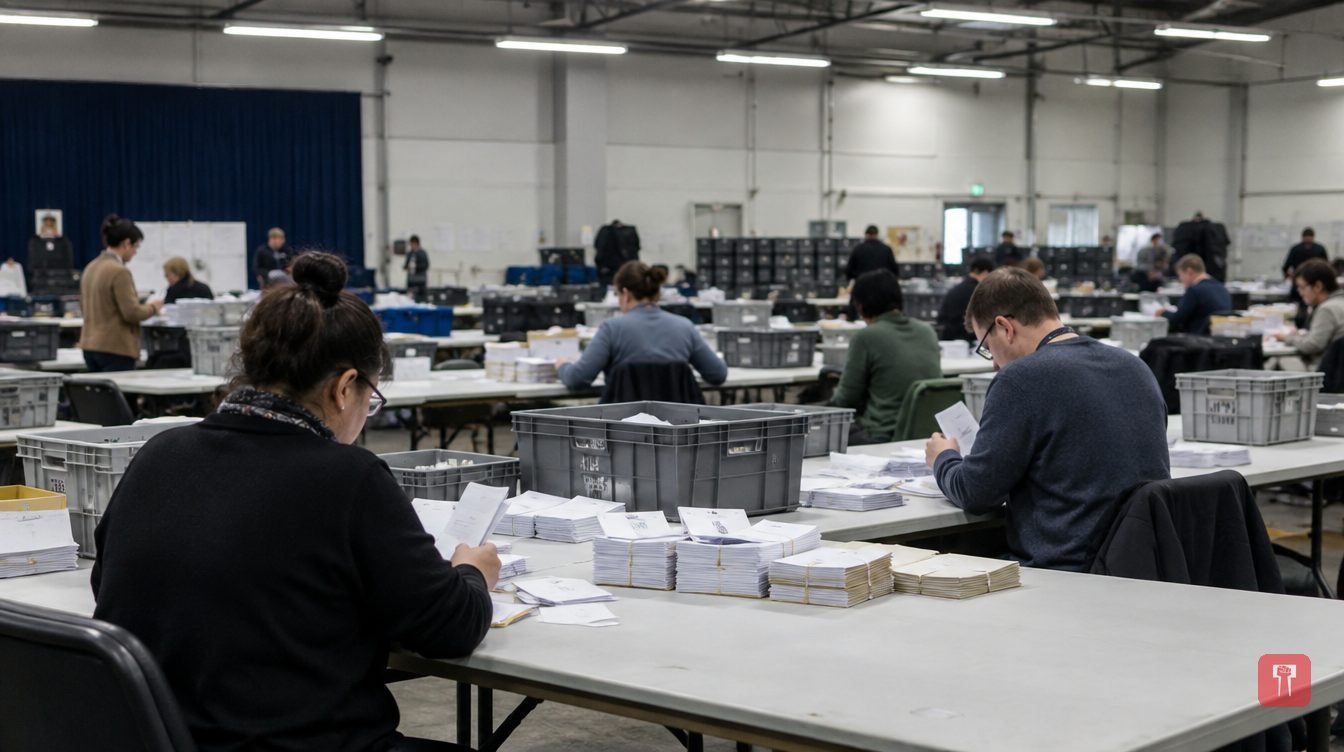
The real twist lies in the final stage of the count. About 14 per cent of all votes fall under the category of "special votes". These include votes of New Zealand citizens living abroad and votes cast by people outside their own electorate. In New Zealand's political history, such postal or special votes have often leaned towards left-leaning parties such as Labour and the Greens. If these votes cost Luxon's coalition even one seat, its majority could be in danger. The Electoral Commission will announce the final official result on November 27. Until then, Luxon will have to work as "Caretaker Prime Minister".
Amid these results, the centrist The Opportunities Party has suddenly come into focus. If the coalition's majority slips in the final result on November 27, the party's role in forming a government will be crucial. It is entering Parliament for the first time, and its stance could decide the next prime minister.
Before the election, Prime Minister Luxon had firmly ruled out any kind of arrangement with this party. After the changed equations, however, he has shown flexibility. According to Mona Krewel, senior professor of political science at Victoria University, The Opportunities Party is highly pragmatic and takes a middle path, so either Luxon or Labour Party leader Chris Hipkins could join hands with it to ease the route to power.
This has been described as the most unusual election since the Mixed Member Proportional (MMP) system came into force in 1996. Under this system, voters cast two votes, one for a party and one for a local candidate. Seventy-one seats in Parliament are decided directly by electorates and 60 seats according to the total votes parties receive. This election has shown deep disenchantment among voters. The country's two main parties, National and Labour, have both received less than 30 per cent of the total votes, which is seen as their worst performance since 1996.
According to political analyst Ben Thomas, voters have delivered a sharp blow to the established parties over the sluggish economy, soaring prices and unemployment. Because of National's low vote share, several senior leaders, including Finance Minister Nicola Willis, now fear losing their place in the next Parliament.
Reacting to the results, senior National Party leader Simon Brown said, "These results are as pleasing for us as they are, in some respects, disappointing." Who will run New Zealand next will be clear only after the final count on November 27.
Reach readers on the ward they actually live in.
Advertise with Prime Time 24Reach readers on the ward they actually live in.
Advertise with Prime Time 24Reach readers on the ward they actually live in.
Advertise with Prime Time 24Reach readers on the ward they actually live in.
Advertise with Prime Time 24
Comments
No comments yet. Be the first.