

Koyna river level falls near Nisare dam, Patan taluka farmers fear water shortage
Rain stopped late in Patan taluka this year, and falling water in the Koyna river has raised fears of a scarcity that could hit drinking water and irrigation.
 Images are not validated/verified
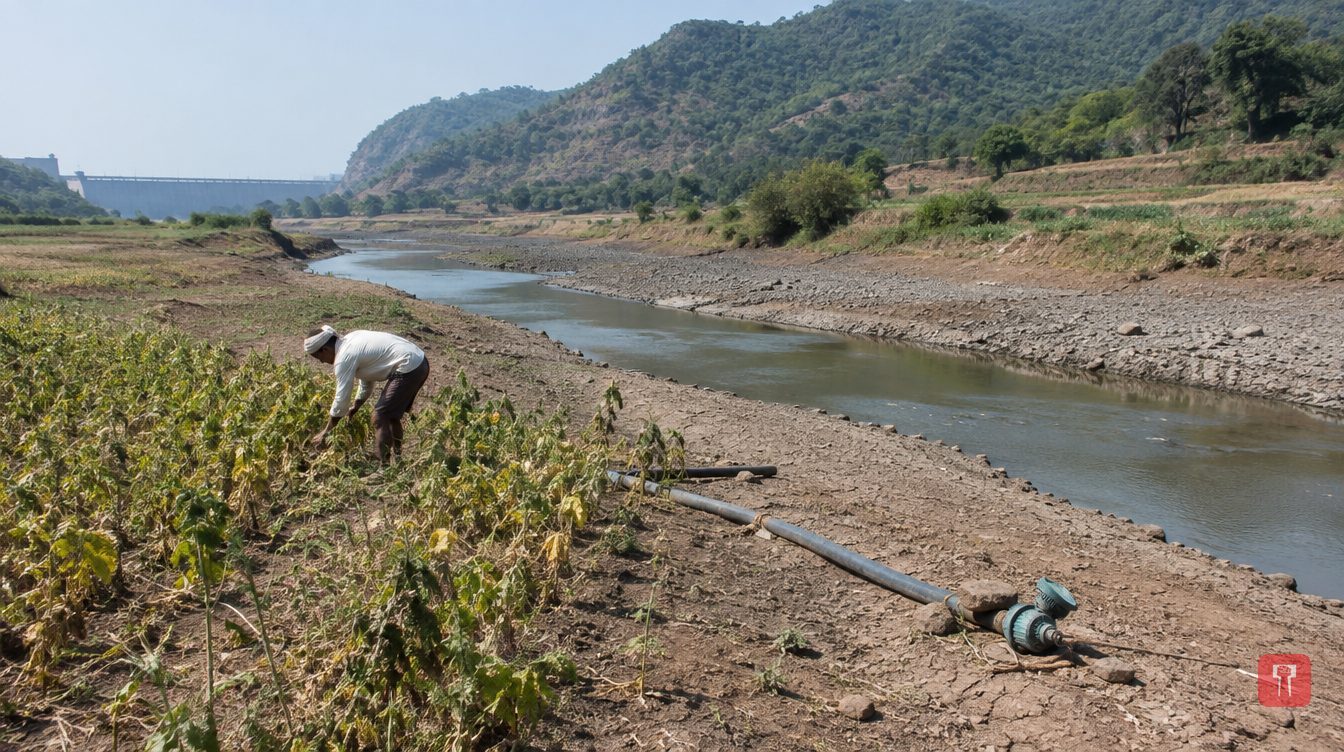
Malharpeth: Rain stopped late in the season in Patan taluka this year, dealing a heavy blow to the kharif crop. Water in the Koyna river near the Nisare dam is now also falling fast. In many places the riverbed has begun to lie exposed and the shortage of water is plainly felt. Farmers are worried because the scarcity is feared to worsen in the coming days. Drinking water must get priority, and farmers are asking where water for irrigating their fields will come from.
Farming in the western part of Patan taluka depends largely on rain. Even villages that rely on the Koyna river and nearby water sources saw the rain turn away, so water now has to be rationed. With rain stopping at the end of the kharif season, the growth of pulses, cereals and other crops has been badly affected. There is a fear that crops will dry up in some areas. Farmers were already short of money, and with the river level dropping, the question of water for the coming rabi season and summer cultivation also looks serious.
Water available in the Koyna dam is used for drinking, farming and other essential needs. But when availability becomes limited, drinking water has to be given priority and a distribution plan drawn up. There is a demand for water to be released from the dam for drinking. Meanwhile, farmers fear that the water they get for irrigation may be stopped.
If farms do not get water on time, standing crops will be lost and the financial calculations for the next season could also go wrong. For farmers already in difficulty because of the rain deficit, irrigation could become a bigger headache. There is therefore a demand for planning that balances the need for drinking water with the water needed for farming.
After the monsoon ends, water in rivers, streams, brooks and wells gradually declines. Because the rain stopped late this year, the effect is feared to be felt more sharply. With the Koyna river falling, concern is being voiced about farming in the riverside villages, water supply schemes and other daily needs.
Given the present situation, water will have to be used sparingly. Along with preventing waste of drinking water, the water available for farming must also be used carefully. If the administration assesses water availability and likely demand and acts in time, the severity of the difficulties ahead can be reduced.
Farmers in Patan taluka face the loss of kharif crops, rising farming costs and the prospect of water scarcity in the coming days. A clear policy on water for farming is needed, based on proper planning of the available water reserves. It will be important for the departments concerned to decide jointly after considering the river level, the stock in the dam and the future need for drinking water.
Before the scarcity worsens, it is necessary to survey villages likely to face a shortage, check the condition of water supply schemes and spread awareness about economical use of water. It is also important that farmers get clear information on how much water for irrigation they can get and for what period. On the whole, the falling water in the Koyna river is being seen as a warning of scarcity ahead for Patan taluka. Farmers are already troubled by the rain deficit and the uncertainty over irrigation water. How severe the scarcity becomes will now depend on proper water planning, economical use and timely administrative action.

Comments
No comments yet. Be the first.