

Inventor Vatsal Soin files new patent for AI training using dark data
Vatsal Soin has filed a patent applying his earlier governance invention to old, unsorted stored data for AI training.
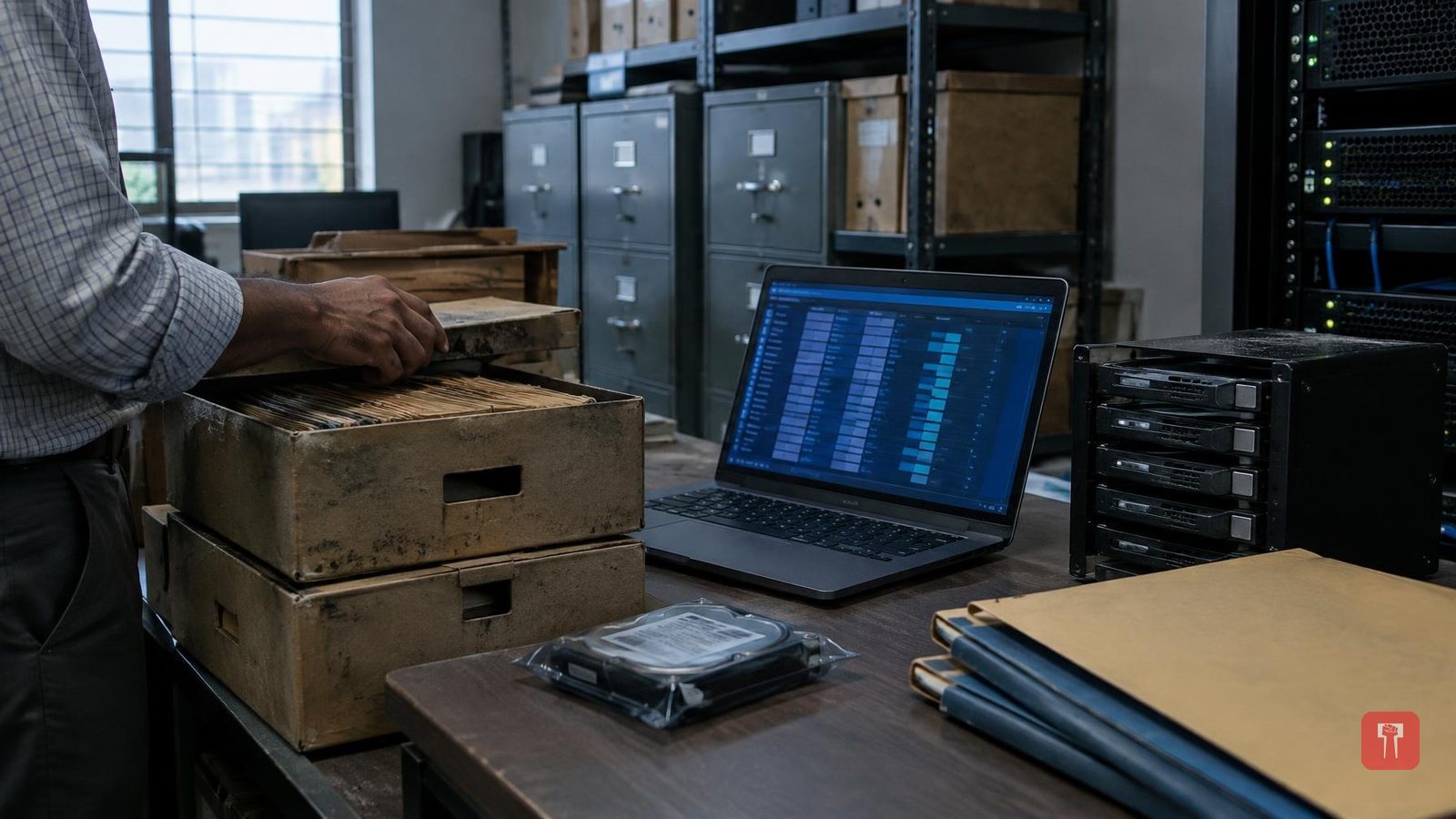
Most debate in the world of AI centers on models, agents, AGI and the singularity, but another issue sits quietly behind all of it: old data piled up over years in companies, hospitals, laboratories, banks, factories and government offices. This archive is often decades old, scattered across different departments, with no single fixed rule for handling it. Storing such data is costly, classifying it is difficult, and reusing it can be risky.
Because of this, dormant data is neither a clear asset nor a clear liability - its value depends on what can legally and technically be done with it. Inventor Vatsal Soin says what is needed here is not a new storage system but a disciplined way of deciding what to do next.
Soin had earlier filed a governance invention called the 0 to 1 Doctrine, under which any proposed AI action is converted into a number between 0 and 1 and tested against a fixed rule to decide whether it should proceed. The new filing, dated September 23, 2026, applies the same thinking to old, unsorted stored data, under a scheme called Band-Based Archive Triage, or BBAT.
In BBAT, the first screening step is limited to metadata alone - information such as the data's age, category and jurisdiction can be assessed without opening the actual content. The data then goes down one of three paths - retain, purge, or promote for further processing. According to the filing, a record is kept at every step of what was approved, what was checked and what fell outside the defined scope.
Data that is promoted can be sent into a process called Dark Data Monetization Without Exposure, or DDME, where content is processed inside a Trusted Execution Environment, or TEE, to produce a data band with a fixed scope. The filing also states that this entire process is not governed by one fixed mathematical formula but by four kinds of standards - regulatory rules, the structure of the data, defined governance objectives and declarations by the domain authority.
Another layer described in the filing, Band-Derived Training Signal, or BDTS, provides a way to convert normalized data bands into structured signals for AI training, with the signal released for training only after a privacy check. The filing also lists several other modules, including a metadata inconsistency check module, a permission and authorization change evaluation module, a freshness re-evaluation module and a hardware attestation certificate, which can refer cases involving incorrect or outdated permissions, incomplete information and hardware-level evidence to human review.
Vatsal Soin is described as a serial inventor and entrepreneur whose 0 to 1 Doctrine work spans AI decision governance, biometric authorization, financial transaction control and now dormant data governance. His patent filings span six continents, and he has already been granted patents in the United States, India, Japan and other countries. He is an alumnus of SIM-RMIT and Nanyang Technological University in Singapore. These include granted US Patent 12,446,652 B2, Japan Patent 7560909, and Indian patents 454081 and 599317, while PCT/IN2025/051943, US application 19/489,595, Indian application 202511115781, Australian application AU2022450649 and Indian application 202611113867 (September 23, 2026) have also been filed.
