

Google Earth find in Western Australia confirmed as 850-foot meteorite crater
Geologist Arthur Hickman spotted a perfect circle in the Ophthalmia Range; drilling confirmed it was formed by a meteorite impact.
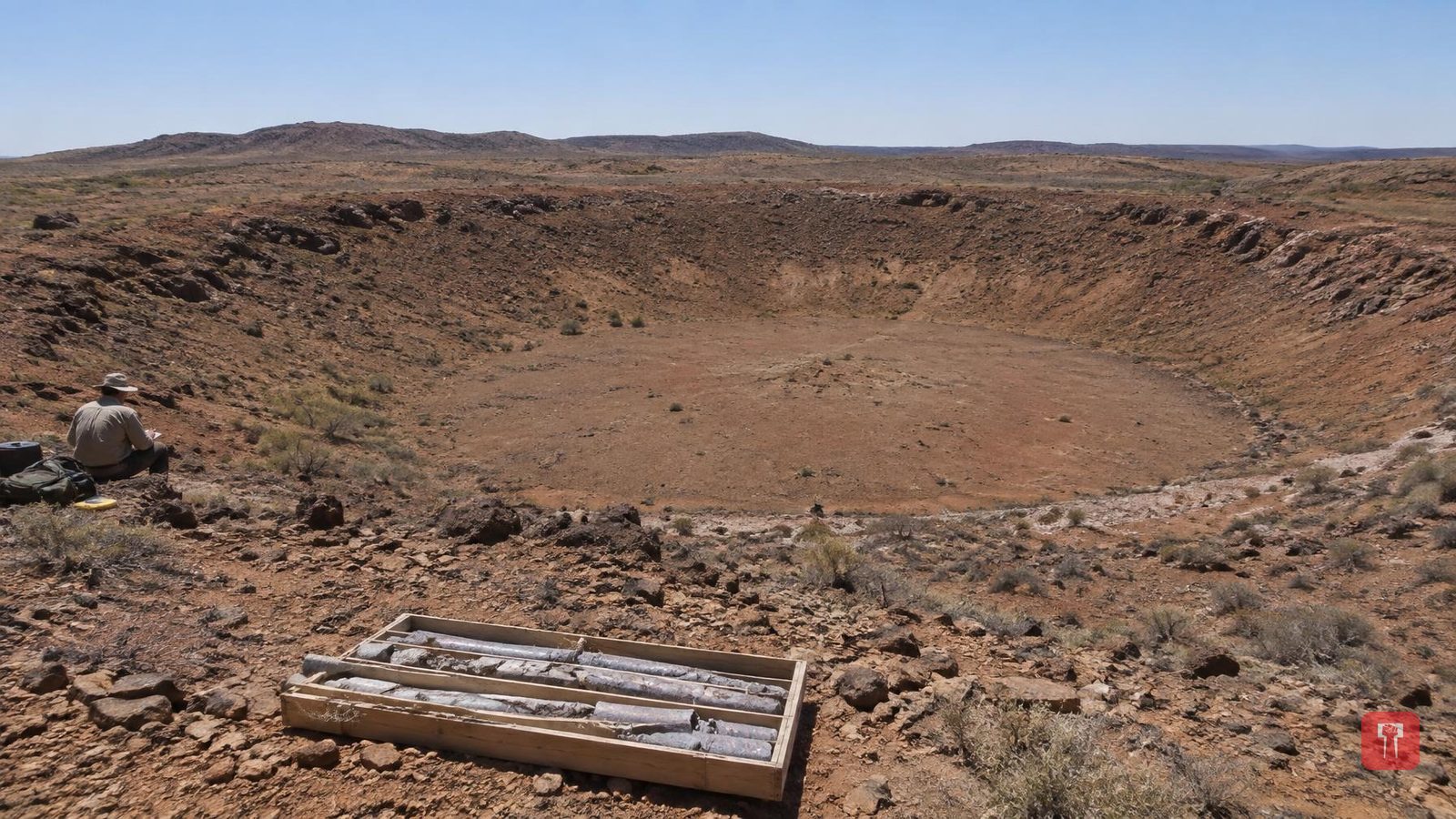
The world can be explored from home through the internet today, but few would have expected an ordinary search on a computer screen to uncover a major secret from space. Australian geologist Arthur Hickman was browsing satellite images on Google Earth, as he usually did, when he noticed an unusual formation on the ground in the Ophthalmia Range, a remote area of Western Australia. It was a complete and precise circle about 850 feet (260 metres) across.
The area is dry and desolate, hundreds of miles from human settlement. A man-made pit so large and so perfectly round was almost impossible, so Hickman's interest grew. He promptly sent the location details and older satellite images to senior officials and geological bodies.
After Hickman's alert, a research team of senior scientists and geologists reached the remote spot in Western Australia. They were astonished to find a huge crater there. After initial studies, the scientists announced that it was not man-made but was formed by the impact of a large meteorite from space. In recognition of the discoverer's contribution, the crater was informally named Hickman Crater.
According to a research paper published in the Australian Journal of Earth Sciences, it is the newest meteorite crater found in Australia. Hickman Crater is considered small next to the world's other large craters, yet it was formed by an extremely fast and destructive event from space.
Scientists Glikson, Hickman and Vickers carried out detailed research on the crater. They estimate it was formed roughly 10,000 to 100,000 years ago, in the Late Pleistocene. A very fast-moving iron or rock meteorite about 10 metres wide entered the Earth's atmosphere and struck here.
The impact was so violent that the 10-metre meteorite dug a pit about 80 metres deep on landing, and the volcanic rocks around it were shattered and thrown out. The obstruction caused by the impact also changed the course of a small river flowing near the crater's southern edge. Scientists could estimate the crater's age from the geological study of this river.
To confirm whether the crater was formed by a meteorite impact or some other geological cause, a major scientific project was carried out in 2012. The Geological Survey of Western Australia, which comes under the Department of Mines, Industry Regulation and Safety (DMIRS), drilled into Hickman Crater together with Atlas Iron. Scientist P. W. Haines presented the results in a widely discussed research report titled Collaborative Scientific Drilling at Hickman Crater. According to the report, a vertical hole 64.7 metres deep was drilled through the centre of the crater.
The drill core showed that the top 48.4 metres were silt and soil that built up over thousands of years after the crater formed. Between 55.1 and 64.7 metres, however, scientists found the bedrock, rhyolite, badly fractured and broken by intense pressure. Such fracturing of rock is possible only through the powerful impact shockwaves of a meteorite striking at high speed. The drilling established that Hickman Crater was formed entirely by a meteorite impact. The unravelling of an ancient secret of space with an ordinary digital tool such as Google Earth is regarded as a remarkable event for astronomy and geology.
