

Fadnavis tells World Bank, IFC team water projects need land, cheaper power and treated-water buyers
Chief Minister Devendra Fadnavis said land, right of way and permissions must be in place, power costs cut, and users for treated sewage water fixed in advance.
 Images are not validated/verified
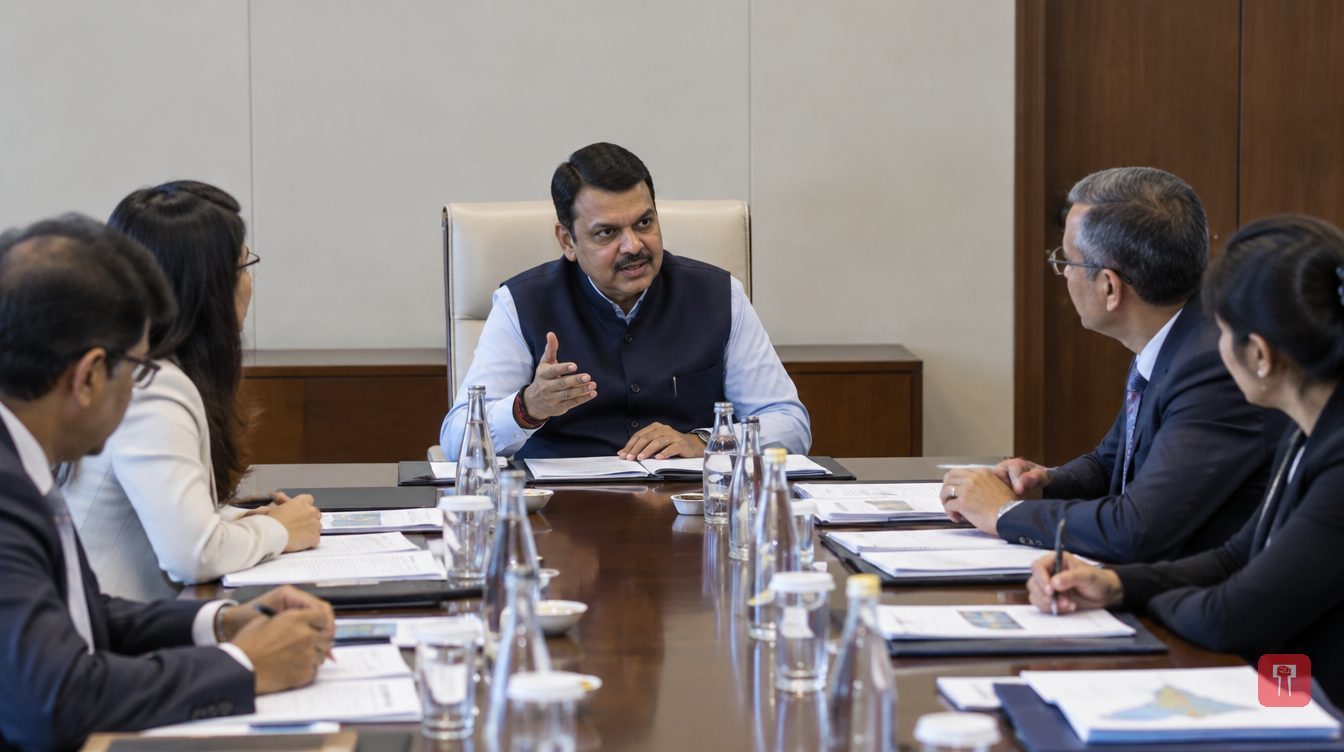
Chief Minister Devendra Fadnavis said in Mumbai that if water projects are to be economically viable and long-lasting, certain things must be settled in advance. The land required for a project, the right of way and the other permissions should already be in place. Technologies such as solar power and battery storage should be adopted to cut electricity costs. Customers who will use treated sewage water should also be identified beforehand so that the projects become financially strong, he said.
He was speaking at a review meeting at the Chief Minister's official residence. The meeting was held with a delegation of the World Bank and the International Finance Corporation (IFC) and was chaired by Fadnavis. The discussion was on Maharashtra's urban infrastructure and water projects. Issues raised included project implementation, financing, technical measures and completing work within the stipulated time.
The World Bank delegation included Mara Warwick, regional director for South Asia, and William Rex, water sector manager for India. The IFC was represented by Nuru Lama, infrastructure sector manager in its South Asia department. Harsh Goyal, Neeraj Gupta, Lalita Srinivas and other senior officials also came with them.
Fadnavis said cooperation with the World Bank is not limited to financial assistance. It is also important in bringing institutional and systemic change. The Bank's contribution is significant in building modern technology, better working practices and systems that will serve coming generations. The state has worked with the Bank in several sectors earlier and this cooperation needs to be expanded further, he said.
On delays, the Chief Minister said a project is often sanctioned but work starts one to two years late because land is not available or because of other hurdles. The projects chosen for financing should therefore be fully ready for actual investment, he said. He said small cities, too, have a great need for such facilities. If available resources are used together and different agencies coordinate, the cost of financing can be reduced, and the projects will then be financially strong and long-lasting, he said.
On electricity costs, Fadnavis said they make up a large part of the daily running of water projects. In many projects, work stalls not because of technical faults but because paying the power bill becomes a heavy burden. It is therefore necessary to calculate operating costs from the planning stage itself. The emphasis should be on cutting power costs through solar power projects, battery storage and available modern technology, which would improve the projects' financial viability and help them run for a long time.
The Chief Minister said the effective reuse of water obtained after treating sewage is equally important. Identifying industrial and other customers who will use this water should be part of project planning itself. This would create demand for the water, promote reuse and make it possible to recover part of the investment. Policies already exist for supplying treated water to industrial areas and power-generating projects. He said these policies should be updated in their implementation and the necessary arrangements put in place to increase reuse.
Fadnavis said the timelines of the projects presented at the meeting are ambitious, but can be achieved with proper planning and coordination. He asked all the agencies concerned to work to the set timelines and implement the projects quickly. He expected that the projects already planned would first be run effectively and that such projects would then be expanded on a large scale.
Chief Secretary Rajesh Agarwal, Praveen Pardeshi, chief executive officer of the Maharashtra Institution for Transformation (MITRA), Urban Development Department Principal Secretary Naveen Sona, Finance Department Additional Chief Secretary Vikas Chandra Rastogi and Urban Development Secretary K. Govindraj were among the senior officials present.

Comments
No comments yet. Be the first.