

China leads flying taxi race as two Indian firms enter the field
 Images are not validated/verified
Electric air taxis are advancing in China, the US, Japan, the UK and India, but only China's EHang holds all three approvals needed to carry passengers.
Everyone stuck in a traffic jam has at some point wished their vehicle had wings. Flying-vehicle technology is now advancing quickly in China, the US, Japan, the UK and India. Big automobile and aviation companies around the world are investing crores of rupees in it. Some companies have completed successful test flights, and some are in the last stage of government approval.
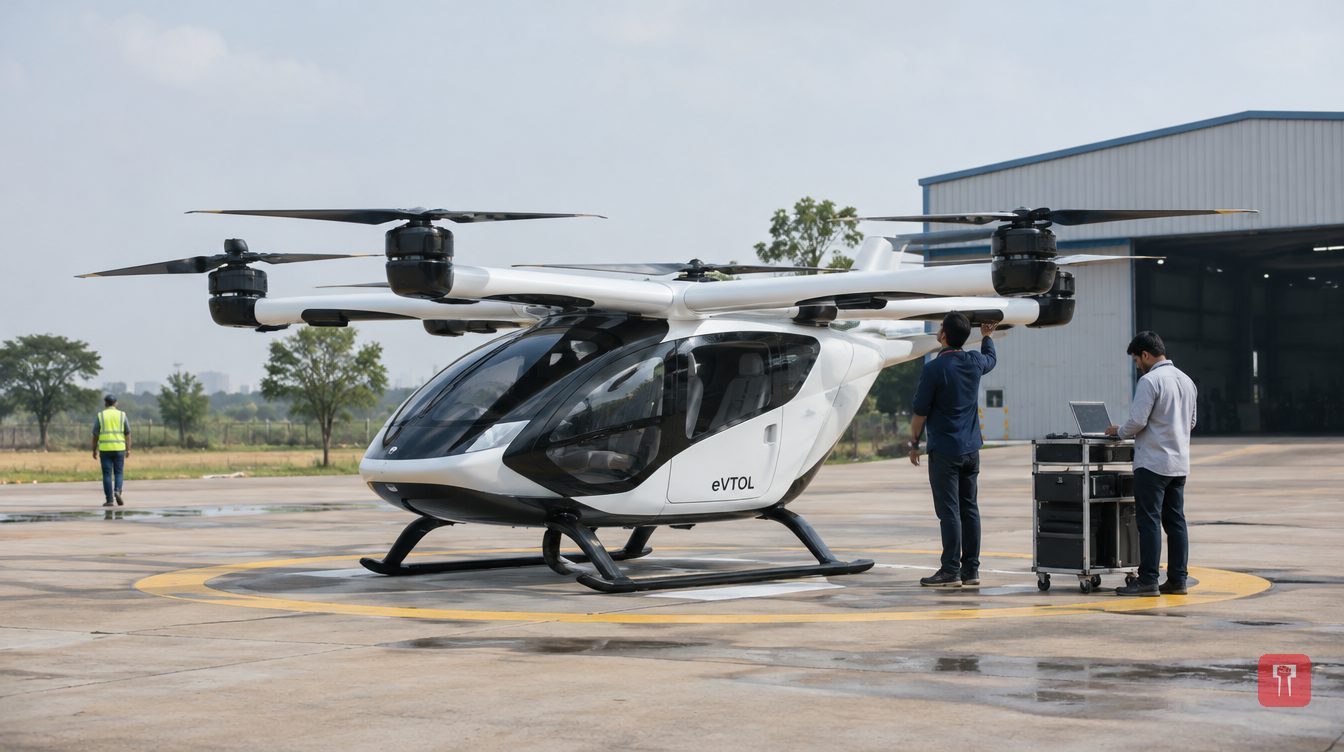
The vehicles being developed are not cars that run on the road and suddenly spread wings. They are electric air taxis known as eVTOL, or electric vertical take-off and landing, aircraft. They run entirely on electricity and do not need a long runway to take off. Like a helicopter, they rise straight up from one spot and then move forward in the air like an aeroplane. They can usually seat one pilot and two to five passengers.
China is furthest ahead in the race. The EH216-S of the Chinese company EHang is a two-passenger aircraft that needs no pilot and is fully automatic. Chinese authorities approved its design in October 2023, its production in March 2024 and two operators to begin passenger services in March 2025. Test flights ran for 17 months in Guangzhou and Hefei up to August 2026. Passenger service on air routes within the city is now being tested in Guangzhou.
AutoFlight, another Chinese company, flew its five-passenger Prosperity aircraft 50 km between Shenzhen and Zhuhai in February 2024. In November 2026, five of the company's eVTOL aircraft flew together for 47 continuous minutes and covered more than 133 km. The test was meant to check the aircraft's coordination and the pilotless system. Another Chinese company, XPeng, is preparing to bring its two-seat electric flying car to market in 2027.
In the US, Joby Aviation's S4, which can carry one pilot and four passengers, is drawing attention. By 4 November 2026, Joby had completed three of the five stages of the US aviation regulator FAA's difficult licensing process. The fourth stage will involve technical checks and the fifth a final safety confirmation. Tests with a pilot on board are likely to begin in the first half of 2027. Joby has made successful flights in Texas and Florida, and its second air taxi station in Dubai is ready, where tests will begin by the end of the year.
Archer Aviation's Midnight air taxi received a special flight permit from the FAA on 9 November 2026. This will allow the company to test with a pilot in the skies over Los Angeles. The company hopes to offer air taxi service to spectators during the 2028 Los Angeles Olympics.
On 16 October, Tesla unveiled the second-generation Roadster supercar, built with the help of SpaceX engineers. The company claims the car can go from 0 to 97 km/h in 0.81 seconds. It is fitted with cold-gas thrusters and high-pressure air tanks, which let the car leap into the air and also land safely. Commercial production will begin in 2028.
Japan's SkyDrive had completed 300 test flights of its SD-05 by June 2026. The aircraft can fly at 100 km/h. In March 2026 the company signed an approval framework with Japan's civil aviation authority, and it has said the air taxi will be seen in Japan's skies by 2028. Britain's Vertical Aerospace successfully tested its Valo aircraft in April 2026. The aircraft took off like a helicopter, travelled like an aeroplane and landed safely. The test was held under the supervision of Britain's civil aviation authority, and the company is trying to obtain full approval by 2028.
In India, Bengaluru's Sarla Aviation and Chennai's The ePlane Company have drawn notice. Sarla Aviation completed tests of a half-scale prototype of its Zela aircraft in July 2026. The model weighs about 700 kg, underwent more than 500 tests and flew for more than 18 hours. The company's main goal is to build Shunya, an indigenous aircraft with a capacity of six passengers. In August 2026 the Directorate General of Civil Aviation (DGCA) granted Sarla Aviation approval as an official design organisation.
The ePlane Company has unveiled e200X, its full-size prototype aircraft, which can seat one pilot and two passengers. The company wants to use it first as an air ambulance in medical emergencies and then begin regular passenger service. By August 2026 the company had reached the second stage of the DGCA's four-stage approval process. It aims to begin actual flight tests in April 2027.
The challenges ahead are also big. The biggest problem is the weight of the battery and limited range. Because batteries are heavy, the aircraft cannot stay long in the air. How passengers would land safely if a technical fault developed in the air is a major safety question. Special vertiports will have to be built in cities for air taxis to land and take off. Low-noise systems, safe air corridors and cheap charging stations are also needed. As of December 2025, there was a plan to build charging stations for electric aircraft at 47 airports in the US, of which 43 were small or less crowded airports.
To begin passenger service, any company has to obtain three difficult approvals: for design safety, for good production and for passenger operations. At present only China's EHang holds all three, while the rest of the world is moving towards targets for 2027 and 2028.
Reach readers on the ward they actually live in.
Advertise with Prime Time 24Reach readers on the ward they actually live in.
Advertise with Prime Time 24Reach readers on the ward they actually live in.
Advertise with Prime Time 24Choose primetime24.com as a preferred source on Google Google shows more stories from your preferred sources in Top Stories.
Reach readers on the ward they actually live in.
Advertise with Prime Time 24
Comments
No comments yet. Be the first.