

Uttarakhand man with no engineering degree test-flies battery-powered single-seat flying vehicle
Ravi Tamta of Almora built the HAPIDA SKYNeX over about 13 years; its August 2026 test flight was successful, but its technical specifications are yet to be checked.
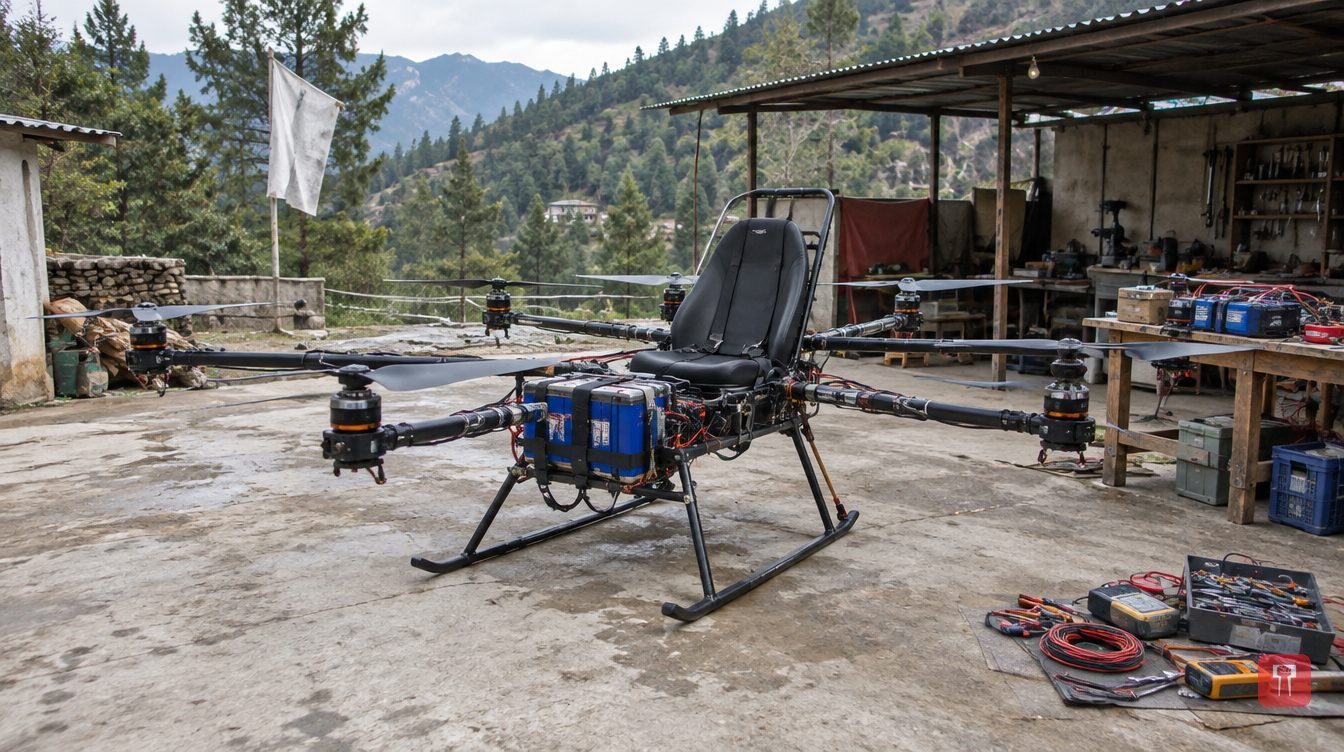 Images are not validated/verified
A young man from Uttarakhand has drawn attention through sheer persistence. Ravi Tamta has no formal engineering degree. Yet he is said to have built a single-seat electric flying vehicle named 'HAPIDA SKYNeX' using information from the internet and his own experiments. After about 13 years of effort, a test flight of the vehicle was successful in August 2026.
Experiments in electric cars and flying vehicles are under way across the world. Ravi's name has come up in discussion in this context.
Ravi is from Kafalikhan village in Uttarakhand's Almora district. He spent his childhood in the Jageshwar Dham area. He saw the difficulties of travel in hill areas at close quarters: narrow roads, winding routes and the time it takes to reach a hospital in an emergency. Seeing all this, he came up with the idea of a vehicle in which one could travel by air.
According to available reports, Ravi began work on the idea in 2015. His father, Harish Ram, is a mechanic. Ravi has a BA degree in arts from Nainital. Despite having no background in science or engineering, he relied on the internet, online tutorials and his own experiments for technical knowledge.
The HAPIDA SKYNeX is a single-seat, battery-powered experimental aerial vehicle. Like a multirotor drone, it has several motors and propellers. It therefore does not need to pick up speed on a runway the way an older aircraft does. The vehicle is based on the idea of lifting straight off the ground.
In building such a vehicle, challenges such as weight, lift, stability in the air and control are crucial. Merely getting into the air is not enough. It must also be tested whether the vehicle can fly safely in different conditions.
Ravi's HAPIDA SKYNeX prototype made a test flight in Almora in August 2026. The flight took place under the supervision of the local administration. According to reports, the vehicle stayed in the air for about one minute during the test. This gave Ravi's years of struggle an important milestone.
However, the successful test does not mean the vehicle is ready for commercial use. Technical details such as battery capacity, the distance it can cover on one charge, top speed, the weight or number of passengers it can carry and flight time have not yet been separately verified.
In future, such air vehicles could be used for movement in hill areas, reaching remote villages and delivering help in medical emergencies. But for this, the vehicle's safety will have to be proved and more tests carried out. The necessary approvals of applicable regulatory bodies, including the Directorate General of Civil Aviation (DGCA), will also have to be obtained.
On the whole, Ravi Tamta's story is an example of persistence, self-learning and experimentation. Despite having no engineering degree, he has shown that he could build an experimental flying vehicle. All eyes are now on whether the idea becomes a safe, reliable technology that is actually used.

Comments
No comments yet. Be the first.