

A dance journey that began in a Nagaland studio, and reached the stage with his son
A writer recounts how a family holiday dance class in Nagaland grew into a yearly tradition of performing with his wife, sisters and now his son
It was the summer of 2024. The writer was posted in Nagaland at the time, living away from his family, while his wife and children were in Maharashtra. Holidays were hard to come by and travelling to and from Nagpur was not easy. But that summer, by coincidence, everything fell into place. The children were free, his wife got leave too, and the three of them came to Nagaland. For a while, the whole family was together again.
The trouble was that life in Nagpur was packed with school, office, housework, friends and classes. In Nagaland, there was suddenly more time together, but fewer things to fill it with. The writer did not want these days to become just another holiday. He wanted something that would combine fitness, entertainment and, most importantly, quality time together. That is how the family ended up at Lamgrace Dance Studio.
None of them had a natural sense of dance, and their hands and feet often moved in different directions. Lamgrace worked hard with them; it took time to learn but she did not give up, and the family kept practising too. Gradually, that one hour a day stopped being just exercise and came to include learning, laughter and new friendships. The choreographer became a friend, and her assistant choreographer did too. The dance studio became the family's small social world in Nagaland.
One interesting thing happened along the way. Lamgrace was comfortable teaching energetic, more masculine moves, but for some delicate feminine moves, especially for Sonal, she felt she needed another hand. So she called in Priya Bareil, who was petite, cheerful, energetic and highly expressive, to help Sonal. This taught the writer a small lesson: not everything needs to be done alone; sometimes it is better to call in someone else who can do that part better.
In the end, four short dances were ready, each about a minute to a minute and a half long. They were not professional or perfect, but they were their own. Lamgrace filmed them, and even today watching those videos takes the family back to Nagaland, the studio, that summer and those friends.
Back in Nagpur, the writer was keen to perform what they had learned, but Sonal's interest in practising the Bollywood-style routines gradually faded. She began to prefer Garba and was in any case looking forward to Navratri. Rather than pressure her, the writer said he would like to do this with his sisters instead. His younger sister Jui and cousin Harsha happily joined in the practice. The team changed, but the dancing continued.
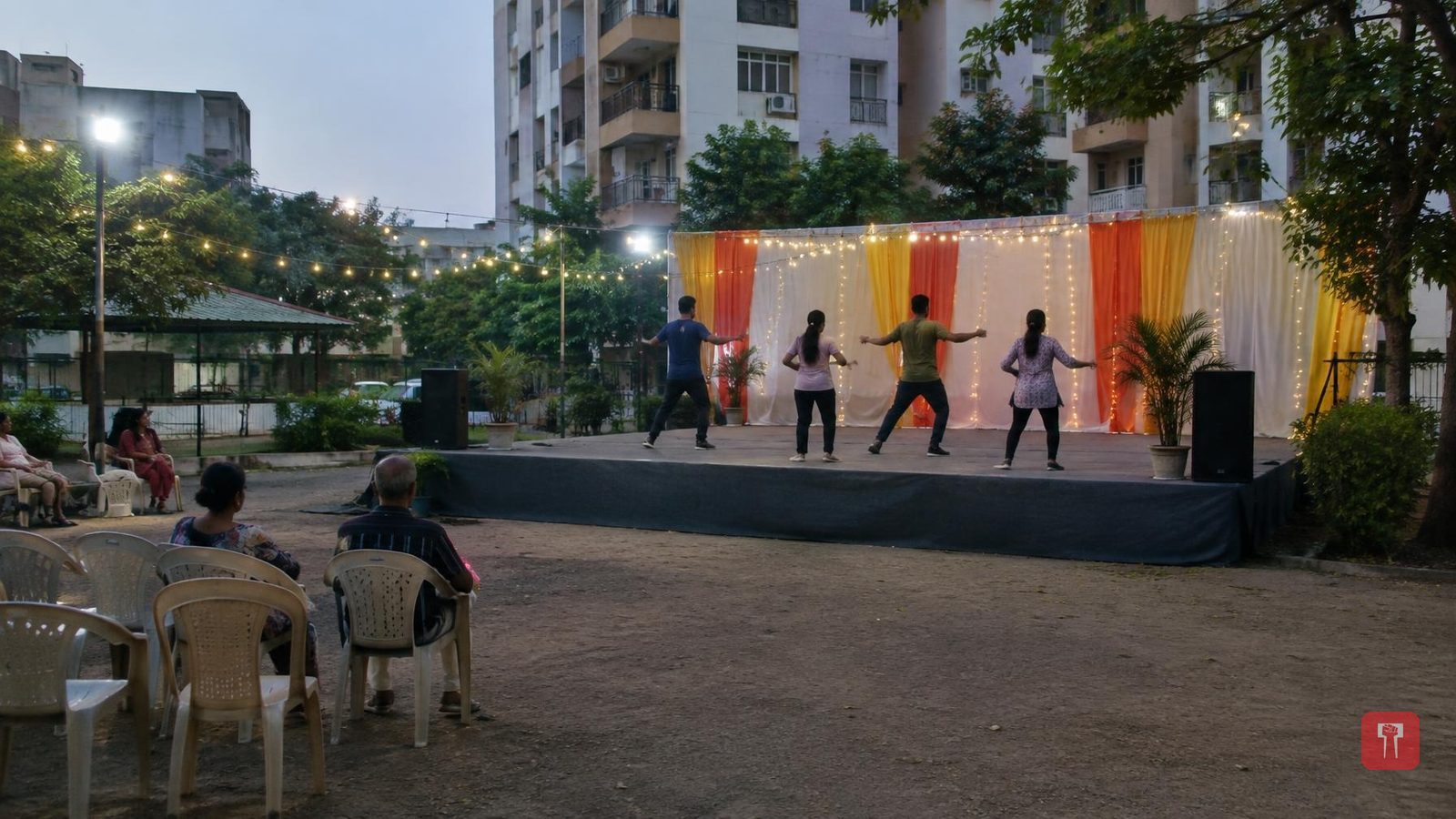
The first performance in Nagpur took place in August 2024 during Ganesh festival, at their Rachana Sayantara Society. Instead of the latest Bollywood songs, old evergreen numbers were chosen: "Aajkal Tere Mere Pyaar Ke Charche Har Juban Par" and "Gustakh Dil Tere Liye Betab Hai O Janeja". In between, the writer got chikungunya, in which joint pain can be very painful, and practice continued on doses of paracetamol. He took the last dose about half an hour before the performance, and along with the excitement, it got him through. The society's senior citizens particularly enjoyed the performance; for them, these songs were not just songs but memories of youth, romance and another era.
In August 2025, more popular Bollywood songs were chosen this time: "Soniya Dil Se Milade Dil - Just Chill Chill" and "Neend Churai Meri Kisne O Sanam". The energy this time was completely different. The writer also saw it as a chance to show off his fitness, wearing Sonal's tight black T-shirt and jeans, and doing more than 30 push-ups just before the performance so his chest and arms would look pumped up on stage. The muscles were ready, but the lungs were not; he was out of breath by the time the dance started. The choreography had been rehearsed well enough that the steps had become almost automatic and his body knew what to do.
There was a small family story behind this too. The whole dance journey had begun with Sonal and the writer together in Nagaland, so there was perhaps a small possessiveness somewhere inside him that "we started this together"; not serious jealousy, just a sweet feeling.
The next chapter began with his son Kedar. In 2025, Kedar decided to take part in a solo dance competition at his school. The writer would take him to evening dance classes and wait during practice. The effort paid off and he won a prize. In 2026, the writer asked Kedar if he would like to perform again; the answer came immediately: "Yes!" This time, the two of them decided to practise together: he would perform alone at school, and the two of them would perform together at the society's Ganesh festival.
This time the inspiration was quite different: the character of Tanhaji Malusare, played by Ajay Devgn. The choreography was energetic, heroic and warrior-like. They rehearsed fully with proper warrior costumes and armour. The dance was performed to the energetic beats of "Ghamand Kar". Kedar looked like a cute, bouncy little warrior, while the writer perhaps took his own role a little too seriously, going all out with a sword and armour. A small boy sitting in the front row got up and moved away after seeing the sword and the intense performance, which became the funniest memory of the evening. But what stayed with them was not the applause, but the time spent with his son.
Through this whole journey, the writer began to look at dance differently. It is often said there is "no time" for things: work needs time, so does family, children, fitness, learning and social life, and a day still has only twenty-four hours. Perhaps there is another way: instead of adding activities, combine them. That one hour in Nagaland was exercise, family time, learning and social interaction all at once. Practising with Kedar was father-son time, preparation for school, a performance and memory-making, all together. One activity, several outcomes, the same hour, no extra hour needed. The writer sees this as a different way of thinking about productivity: not always about moving faster, but sometimes about getting more out of the same activity.
Performing in the society also has a particular value of its own. The people there know that everyone involved is a working professional, finding time between children, office and home responsibilities, so they do not compare the performers to Bollywood stars or professional dancers, but see the effort behind those few minutes. The writer says the reason for going to that dance studio in Nagaland was simply to find something the family could do together, but what they gained was far more: fitness, friendship, laughter, community, memories, and chances to dance with his wife, sisters and son. He hopes there will be at least one dance on stage every year, not to become a professional dancer, not for a perfect performance, but so that looking back one day, those few minutes will remind them that they made time for each other.
