

JEE Main 2027 Session 1 is 90 days away: Pune coach's plan for the final stretch
 Images are not validated/verified
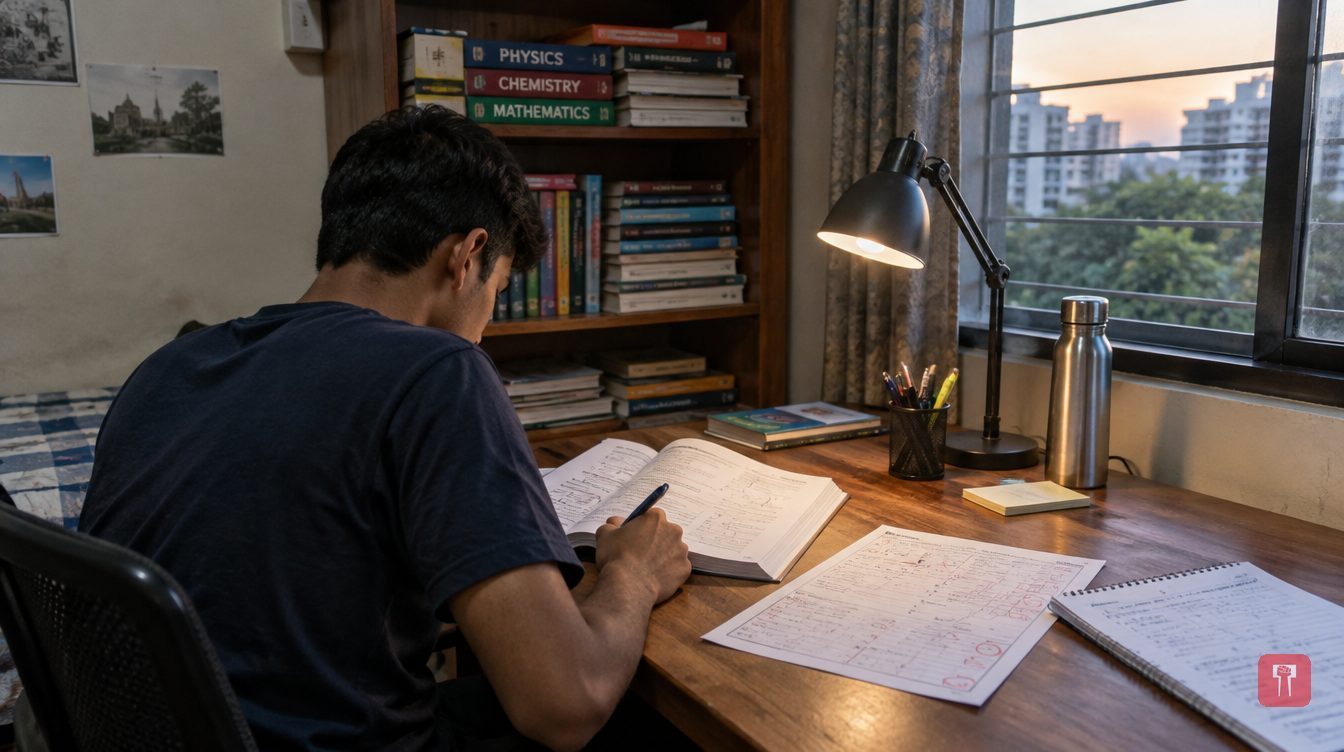
Lalit Kumar of Prime Academy, Pune, says the last 90 days reward students who hunt for their next 20 marks, not those who finish the most syllabus.
Pune, October 29, 2026: Somewhere in Pune tonight, a Class 12 student is likely looking at a list of unfinished chapters and doing the grim sums: too many chapters, too few days. Session 1 of JEE Main 2027 begins on January 22, which leaves less than 90 days. Lalit Kumar, founder of Prime Academy, Pune, says the biggest improvement in these last 90 days comes to the student who asks where his or her next 20 marks are hiding, not to the one who gets through the most syllabus.
According to him, a JEE score matters, but it is neither a verdict on a student's ability nor a prediction of the future. The real change comes from preparation: understanding one's strengths and weaknesses, knowing where one stands, managing limited time, making a plan, acting on it and changing course when things go wrong, while staying away from distractions such as social media. Kumar says these habits stay with a student long after the syllabus is over. Graduates of the IITs have built companies such as Flipkart, Ola and Zomato, some became IAS and IPS officers and some reached Bollywood. What went with them was not a formula sheet but a way of working.
He advises students not to make "finishing the syllabus" the aim of the next three months. The question should be how to turn the next 90 days into the highest possible JEE Main score. The answer will differ for every child. A student scoring 180 needs a different plan from one scoring 100, and a student strong in physics but weak in chemistry needs a different approach from one in the opposite position. In more than two decades of teaching JEE, he has seen that the big gains in the final phase come from small, well-thought-out changes: correcting repeated mistakes, choosing questions better and using mock-test analysis to decide what to study next.
He suggests dividing the syllabus into three groups. Group A holds chapters a student understands well and which carry weight in JEE. Modern physics and thermodynamics are examples, since they appear in both physics and chemistry and have often produced fairly easy questions. These should be revised well and small gaps filled. Group B holds chapters that have been studied but are not solved correctly every time. Effort pays off most here, so students should use previous years' questions (PYQs), targeted practice and teachers' help. Group C holds weak or uncomfortable topics. Spending hours on them can upset the schedule and shake confidence, and under exam pressure students often skip these questions anyway. So the aim should be to pick up as many marks as possible from the manageable parts. A student uneasy with rotational motion, for instance, can prepare questions on moment of inertia, the parallel and perpendicular axis theorems, torque, angular momentum and the formulae for rotational kinetic energy. The goal is not to turn every weakness into a strength, but to turn some weaknesses into chances to score.
Students should fix a time for each topic and finish within it. Staying on a topic until full confidence arrives may work early in preparation, but not close to the exam. Say a student sets aside six hours for electrostatics and spends ten making it airtight. Those four hours look small, but they push back every later topic, and the exam date will not move. In six hours, the student should revise the concepts, solve the essential questions, note the important variations, clear major doubts and move on. A timetable does not predict every hour; its job is to make sure important work gets its share.
Students should not wait to "feel ready" before taking tests. Tests are part of preparation, not just a way of measuring it. They build exam skill, which is different from understanding concepts. Even with a formula known, marks can be lost to question selection, time management, calculation or pressure. Many students plan to finish the syllabus and then begin full tests, but at the JEE level complete mastery of every topic is an illusion. Some avoid tests for fear of a poor score. Kumar advises starting tests even when parts of the syllabus remain.
The real value of a test lies in its analysis, which can take longer than the test itself. Taking fewer tests and analysing them well is better than taking test after test and leaving them unexamined. Each question should be placed in a category: solved correctly and confidently; correct but took too long; wrong because of a concept error; wrong because of a calculation error; skipped though the concept was known; skipped for lack of confidence; and solvable but missed under pressure. Students should consult notes where needed, since many concept gaps close quickly this way. They should then examine their state of mind. Was the student thinking about the previous question while reading the next? Did one hard question disturb focus for the next few? Did a run of skipped questions make the student careless on easy ones? If so, the student should decide in advance either to pause for 30 seconds, breathe and reset, or to switch subjects to regain pace.
Questions left unattempted at the end deserve a look too. If five were left and three were easy, the problem was strategy, not knowledge. One method is to sort questions into three kinds as one goes. Sure questions are those that can be solved quickly and confidently. Doable questions can be solved but will take time. Time-risk questions are those where the method is not apparent or which will consume too much time. In the first pass of the paper, the student should look at everything and solve all the sure questions along with a few doable ones that look easy. The aim is to reach the end of the paper without leaving any easy marks behind. In the second pass, the student should pick the doable questions with the best chances. Time-risk questions should be attempted only if time remains and there is a clear reason. This also prevents a common mistake: turning a good score into negative marking by turning aggressive in the last 20 minutes. The principle is to understand what went wrong, decide what to change and try it in the next paper. The aim is not to stop making mistakes but to stop repeating the same one.
The most effective way to revise, he says, is to return to important questions already solved in class. They are familiar, so the concepts come back quickly. A good teacher covers several important variations of a concept while teaching, so revisiting these questions revises the concept, the variations and their application in very little time.
Previous years' questions should be used wisely. Often a student knows the concept but loses confidence after getting stuck on an odd variation that JEE rarely asks. Solving real JEE questions brings reassurance that the student can handle what the exam asks. Students should not merely count how many PYQs they have done. They should ask which concepts keep recurring, which kinds of questions are repeatedly got wrong and which are now solved quickly. A few carefully examined questions are worth more than hundreds solved blindly.
Students should also keep an error log, recording plainly: repeated concept mistakes, formulae that get forgotten, calculation errors, questions that take too long, options chosen wrongly despite knowing the concept, and exam habits that cost marks. They should read it before every mock test so that the next test differs from the last.
As the board exams draw near, many students swing between the two and lose focus on both. Where possible, they should carry both together, because strong JEE concepts help in board answers and board revision firms up the JEE foundation. One good method is to start each topic from the board side, revising formulae and definitions and practising writing as the board demands, and then solve a few JEE-level questions on the same topic. The balance depends on the school schedule and the level of preparation.
Session 1 should not be treated as a rehearsal. Percentile is relative: it is the share of candidates who score equal to or less than you, so the pool of candidates matters. Many students and teachers observe that the same performance often earns one to two percentile points more in Session 1 than in Session 2. One reason is that some who do badly in Session 1 do not return for Session 2, and those who do come back have had a few more weeks of preparation, so competition in Session 2 is on average tougher. A good Session 1 also gives a mental edge, as the student can move towards JEE Advanced without the pressure of improving the Main score. Students should therefore prepare for Session 1 with full seriousness and treat Session 2 as an extra chance.
One timetable does not fit everyone. Two children in the same class may need completely different things. One needs revision and testing, another has gaps in concepts, and a third knows the syllabus but loses marks by choosing the wrong questions or panicking. A single crash-course schedule, however good, cannot serve all three. With this thinking, Prime Academy has designed its crash course this year. Students attend regular classroom lectures and also have one-on-one sessions with faculty. To make these sessions effective, AI built by Autonise analyses each student's tests and shows where marks are going, so that the teacher spends time on the changes most likely to raise that particular student's score. The AI shows the way, the decision stays with the teacher and the effort is the student's.
Instead of repeatedly asking "Is the syllabus done?", students should ask: What are my strongest scoring areas? In which topics can I really improve? Where am I losing marks needlessly? Which mistakes do I keep repeating? How do I perform under exam pressure? What am I doing that eats time but does not raise my score? And the most important question: what can I do today to be better prepared than yesterday?
The next 90 days will not go exactly to plan. Some tests will go badly, some targets will be missed and some hard chapter will take longer than expected. That is normal. The best strategy is not one that never changes but one that can be adapted without losing direction. The message for every JEE Main 2027 candidate is simple: do not panic, but do not drift either. Know where you stand, protect your strengths, improve what can be improved, guard your time, test yourself, analyse every test, revise wisely and keep going. The next 90 days are not for becoming a perfect student, but a more effective one.
Lalit Kumar studied at IIT Bombay and is the founder of Prime Academy, Pune. He has taught for 24 years and has mentored more than 3,000 IIT students.
Reach readers on the ward they actually live in.
Advertise with Prime Time 24Reach readers on the ward they actually live in.
Advertise with Prime Time 24Reach readers on the ward they actually live in.
Advertise with Prime Time 24
Comments
No comments yet. Be the first.