

Buldhana farmers warned of pod borer threat to tur crop as weather turns cloudy and cold
 Images are not validated/verified
The agriculture department has urged tur growers in Buldhana to inspect fields regularly and adopt integrated pest management as the crop flowers.
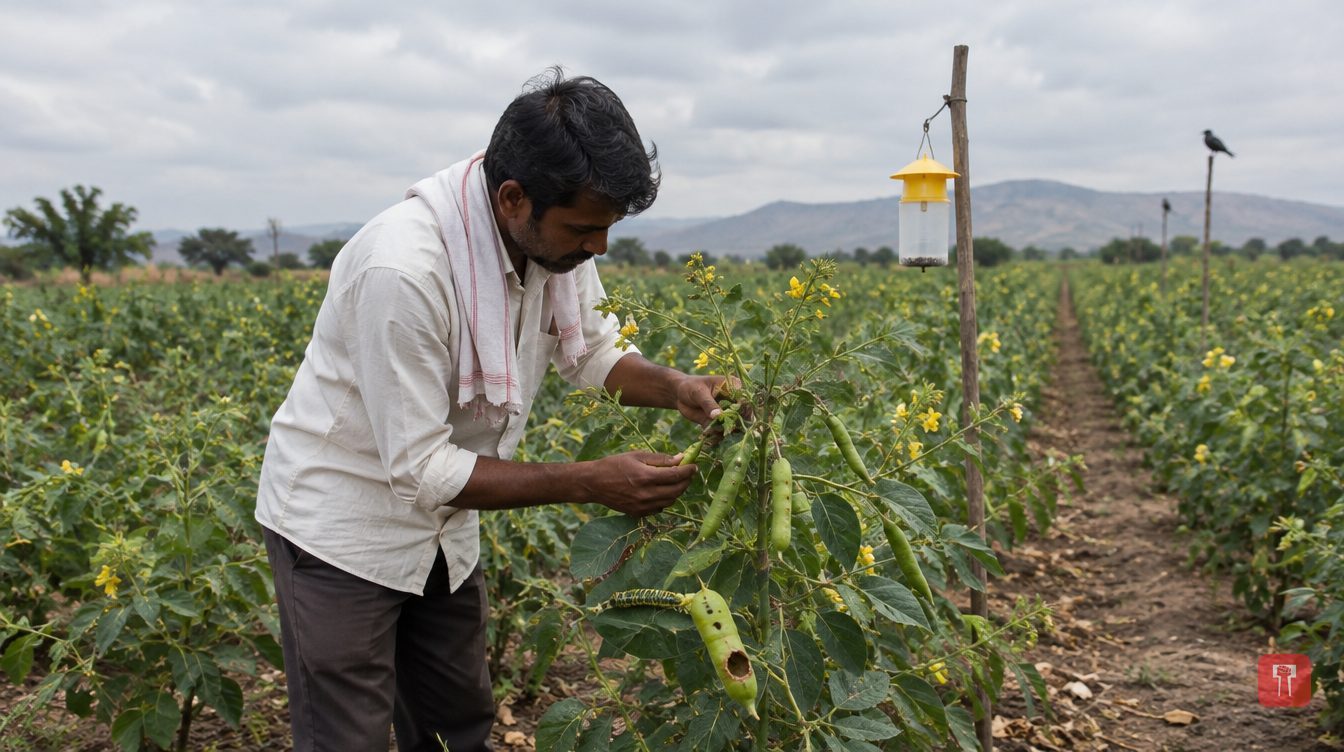
Cloudy weather, dry winds and cold nights in Buldhana have raised the likelihood of a pod borer outbreak in the tur (pigeon pea) crop. The crop is now at the flowering stage, so an insect attack could hurt yields. The District Superintending Agriculture Officer has appealed to farmers to inspect their crop regularly and adopt integrated pest management measures to avoid possible losses.
Three pests mainly attack tur: the pod borer caterpillar (Helicoverpa), the plume moth and the pod fly. The female pod borer moth lays eggs on buds, flowers and pods. The caterpillars that hatch first feed on buds and flowers. Later they bore into the pods and eat the grains inside. The plume moth caterpillar scrapes the pod husk and damages the grains, while the pod fly caterpillar stays inside the pod and gnaws the grains. This can reduce both the quality and the yield of the grain.
To check the pests, the agriculture department has asked farmers to put up 20 bird perches per hectare. Birds help control the caterpillars naturally. Farmers have also been advised to set up 20 pheromone traps per hectare to monitor the pod borer.
Control measures should begin when a trap catches 5 to 6 moths in two to three days, when one caterpillar is seen on a plant, or when damage reaches 5 to 10 per cent. For the plume moth, finding 5 moths in 10 plants, and for the pod fly, 5 to 10 per cent of grains being spoilt, are also key signs of an outbreak.
A second spray is to be applied 15 days after the first, depending on the pest infestation. Farmers should use any one of these insecticides: emamectin benzoate 5 SG at 60 grams per acre, lambda-cyhalothrin 5 per cent EC at 200 ml per acre, ethion 50 per cent EC at 500 ml per acre, or chlorantraniliprole 18.5 per cent SC at 60 ml per acre.
Before spraying, farmers should check the instructions on the product label, its approval for use on tur and the recommended dose. Only one option should be used at a time. Farmers should wear protective gear while spraying and take care not to harm bees and other beneficial insects. The agriculture department said regular inspection of the crop and timely, correct action can avert the possible losses.
Reach readers on the ward they actually live in.
Advertise with Prime Time 24Reach readers on the ward they actually live in.
Advertise with Prime Time 24Reach readers on the ward they actually live in.
Advertise with Prime Time 24
Comments
No comments yet. Be the first.