

State asks BMC to halt construction near defence sites approved without local military NOC
 Images are not validated/verified
The Maharashtra urban development department has told the BMC to stop work where approvals were given without the Local Military Authority's NOC, drawing warnings from housing groups.
The Maharashtra government's Urban Development Department (UDD) issued an urgent directive on November 4, 2026, asking the BMC to stop construction immediately at sites near defence establishments where municipal approval was given without the required No Objection Certificate (NOC) from the Local Military Authority (LMA). The directive reiterates that national security takes precedence over development approvals.
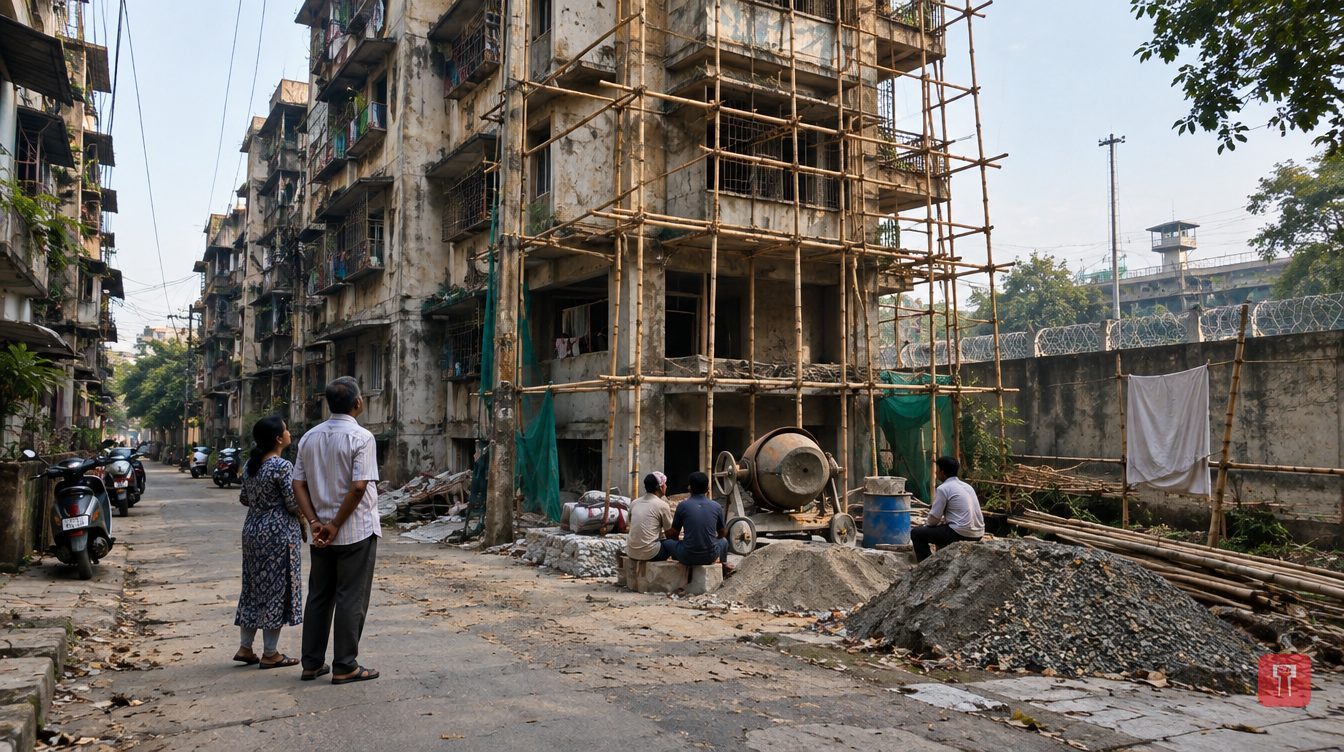
No one disputes the need to protect strategic military installations. But real estate experts, architects and representatives of cooperative housing societies warn that the directive could create a humanitarian and economic crisis. Thousands of families living in old buildings, stalled redevelopment projects and displaced homebuyers could be caught between conflicting government policies, they say.
The action follows correspondence between the state UDD and the Union Ministry of Defence (MoD). In letters of August 10 and October 27, 2026, the state had sought clarification on the conflicting policies. The Advocate General of Maharashtra had earlier opined that the MoD's circular of May 18, 2011 had been superseded by a circular of December 23, 2022, which was later put in abeyance on February 23, 2023. This created uncertainty over the rules. Planning authorities working under DCPR-2034 were concerned that insisting on a defence NOC could lead to litigation over denial of development rights. On November 4, 2026, the MoD clarified that the guidelines of May 18, 2011 are in force and legally binding.
The November 4 directive has three points. First, work will stop immediately where approvals were given without an LMA NOC. Second, all planning authorities, including the BMC, will strictly follow the May 18, 2011 guidelines for pending and incoming applications. Third, the security of armed forces establishments will rank above earlier municipal approvals.
Industry representatives and housing bodies have appealed to the state government, the MoD and civic bodies to set up a joint inter-departmental mechanism to clear pending applications, introduce a TDR policy with compensation, and provide time-bound single-window approvals. They say this would let development proceed without compromising national security or the lives and livelihoods of residents.
A senior BMC official familiar with the matter said: "The state UDD will take up the matter with the MoD, and we will wait for further instructions. The recent November 4 letter from the UDD, which has been sent to the BMC, also does not give any permanent direction. It speaks only of construction under approvals given earlier." Attempts to reach UDD Additional Chief Secretary Asim Kumar Gupta were unsuccessful.
Advocate Shriprasad M. Parab, expert director at the Maharashtra State Co-operative Housing and Apartment Federation Ltd, said: "A housing society cannot be expected to demolish its building relying on municipal approval and then have another authority say the construction cannot proceed. Thousands of families waiting for a safe home now face financial ruin. National security is paramount, but it must go hand in hand with safe housing through a transparent single-window approval system that distinguishes between highly sensitive areas and ordinary civilian areas. Approved projects must be saved. Administrative ambiguity must not obstruct citizens' fundamental right to shelter."
Ramesh Prabhu, founder-president of MahaSEWA, said: "Many redevelopment projects near defence establishments are stalled because of the NOC requirement, which applies at distances from 100 to 500 metres. There is no clarity between the state planning department and the Ministry of Defence. In the name of national security, old housing societies cannot redevelop, and the state has no TDR policy for the affected plots, while political pressure works in slum redevelopment projects."
Yomesh Rao of PEATA India said: "The guidelines, with restrictions of 500 metres (2011), 10 metres (2016) and 50 metres (2022/2023), have in effect become a ban on construction, because the LMA rarely issues NOCs. Hundreds of buildings constructed in the 1970s and 1980s are stuck midway. Displaced residents are forced to live in unfinished structures because developers can no longer pay rent. Executive guidelines should not operate like law unless the Works of Defence Act, 1903 (WoDA), which provides for compensation, is amended. The Bombay High Court has held in Techno Freshworld vs MHADA that the right to construct is protected under Article 300A. Homebuyers invest relying on approved plans, so security concerns should be raised before approval is granted. Also, the recent WoDA notification for Juhu reduced the distance in the Juhu defence zone from 500 yards (457 metres) to 100 metres, while the LMA restriction exists only as guidelines, with no notification under WoDA."
Reach readers on the ward they actually live in.
Advertise with Prime Time 24Reach readers on the ward they actually live in.
Advertise with Prime Time 24Reach readers on the ward they actually live in.
Advertise with Prime Time 24Choose primetime24.com as a preferred source on Google Google shows more stories from your preferred sources in Top Stories.
Reach readers on the ward they actually live in.
Advertise with Prime Time 24
Comments
No comments yet. Be the first.