

Mumbai wildlife experts raise alarm over rising trend of keeping exotic pets
 Images are not validated/verified
After 50 exotic birds were rescued from a Wadala East flat, experts said the fashion for exotic pets often overrides the animals' basic needs.
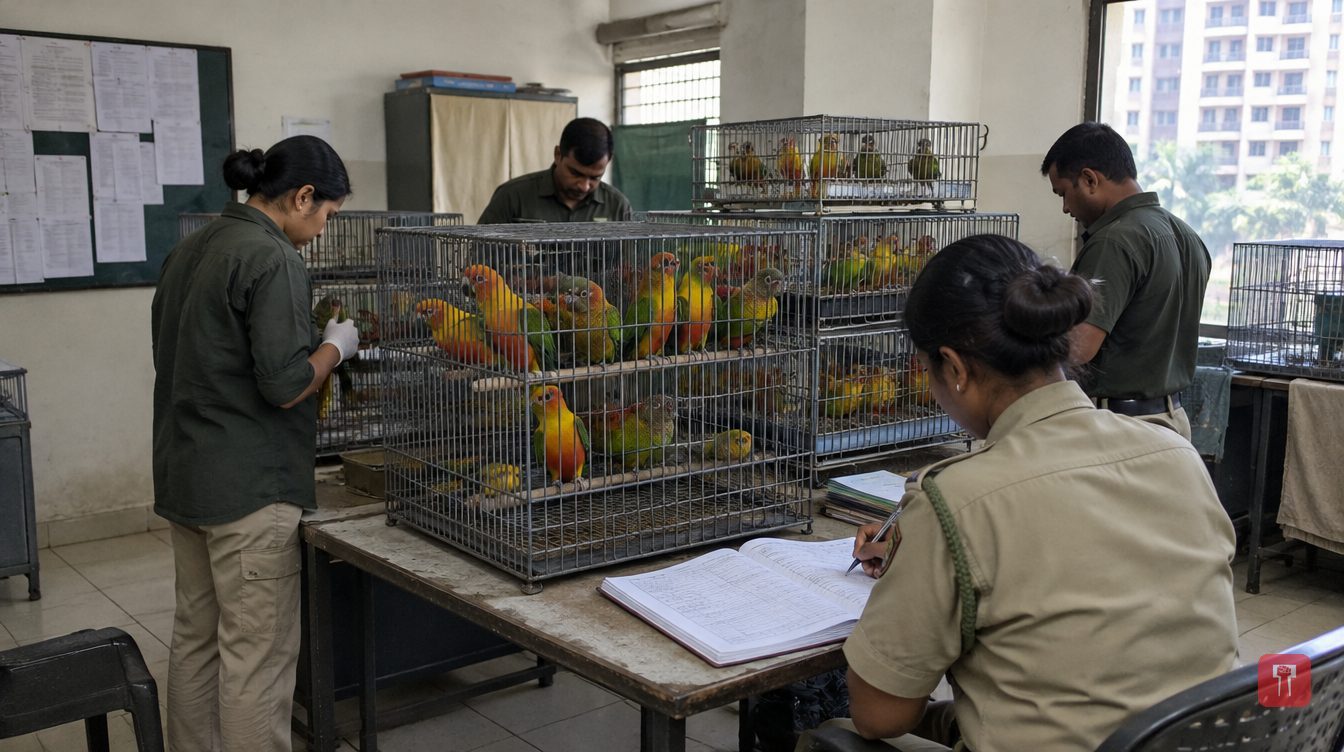
Fifty exotic birds were recently rescued from a flat in Wadala East, Mumbai. The flat was infested with cockroaches. Following the incident, wildlife experts have said plainly that the urge to keep unusual animals often overrides their basic needs. Colourful parrots and exotic reptiles may look attractive, but little is said about their specialised care, the conditions needed to keep them and the effect on the environment when they are abandoned.
The action took place on October 18. The Mumbai range of the Thane Forest Division (Territorial), with help from a wildlife conservation NGO, inspected a house in Bhakti Park, Wadala East, on suspicion that exotic birds were being kept illegally. The birds rescued were 18 sun conures, three cockatiels, 28 green-cheeked conures and one pineapple green-cheeked conure. The Forest Department has registered a forest offence against the person concerned under the Wildlife (Protection) Act, 1972, as amended in 2022.
Experts say the concern is not about one case alone. The real issue, they say, is the growing demand for exotic species as pets. Advocate Pawan Sharma, honorary wildlife warden of Mumbai and president of the wildlife conservation NGO RAWW, said: "The dark side of the exotic wildlife trade is an extremely complex crisis. It is not merely cruelty but a sophisticated ring of organised crime. By buying, selling or swapping exotic wildlife, people unknowingly fund illegal networks that threaten national security and global peace."
Sharma's organisation is working with the Forest Department to spread awareness of the risks of keeping exotic animals. According to him, rising demand has also encouraged unregulated breeding and sale. He also warned against capturing animals from their natural habitats and against tampering with their genes to obtain unusual colours. Such colour variants are called morphs. Sharma said buyers should understand the legal rules on keeping and selling such wildlife. Which provision applies depends on the species, its legal status and the circumstances in which it is kept or sold. The Wildlife (Protection) Act and its 2022 amendments added provisions for regulating and reporting certain exotic species, including those covered by CITES. CITES is the international treaty on trade in endangered species.
Sharma said the impact does not end with owners. When animals grow large, become hard to handle or demand more care than expected, some people abandon them or release them into the wild. If such non-native species establish a population, they compete with local species for food and shelter, or bring pathogens into the local ecology. Non-native species such as red-eared slider turtles and alligator gar are reported to be present in Powai Lake, raising fears for the local turtles and fish. Sharma said: "Non-native species can carry infections or diseases that can spread to local wildlife. If an introduced species gets established in an ecosystem, it also competes with local animals and can disrupt the food chain." He warned that releasing an unwanted exotic pet into a forest or water body is not a responsible alternative to keeping it in captivity.
Dr Preeti Sathe, an independent veterinarian and associate veterinarian with RAWW, said the biggest problem is the gap between the appeal of exotic pets and an understanding of their care. She said: "Exotic species look easy to keep, but people do not realise that in captivity they need a great deal of care, such as enrichment, physical and additional needs, and treatment." Sathe said an animal's quality of life depends on several things: the size and suitability of the enclosure, opportunities for enrichment, a specialised diet, extra nutrition and supplements, and proper veterinary care. She said: "Most pet owners do not know their animals' needs and do what is convenient for them."
Sathe also said some owners, fearing legal scrutiny, do not take their exotic pets to a doctor and treat them on their own. In her words: "Many people know that laws apply to these pets, so they avoid going to the vet and treat the animals themselves, which is completely illegal and unethical." She said the result can be prolonged suffering, incomplete treatment and a decline in the animal's quality of life.
Experts say the conversation must begin before purchase. Prospective owners should understand the animal's lifespan, diet, space needs, behavioural needs and the availability of specialised veterinary care, and should check the applicable legal rules before bringing in any species.
Conservation filmmaker Trishla Ashok said the biggest misconception is that an animal that can be kept at home can also be cared for properly. She said: "Social media has normalised keeping exotic animals. We see people unboxing rare animals, dressing them in clothes, handling reptiles for videos and treating wildlife like accessories. What we do not see is what happens behind the scenes, where these animals come from, what their lives are like and whether their needs are being met. Many of them have very specific needs for temperature, humidity, diet, space and behaviour. Even with good intentions, people may not understand what it takes to care for them for decades. And when the novelty wears off, some are abandoned, handed over or, in the worst cases, released into the wild."
Ashok said the effect of this demand goes well beyond a single animal. "As long as there is a market for exotic wildlife, there will be people to supply it. This demand can fuel wildlife trafficking, put pressure on wild populations and, when non-native animals are released into the environment, give invasive species a chance to take hold." She also said: "A parrot is not a decoration. A ball python is not an accessory. A sugar glider does not need a sweater. These animals evolved over thousands of years with specific habitats, behaviours and adaptations. And please, never release an exotic animal into the wild under the illusion of freeing it. It may not survive, may spread disease and may become an invasive species that harms local wildlife."
For information: under the EXIM policy, the import of live animals listed in the Wildlife (Protection) Act, 1972 and CITES is strictly controlled. Import of such animals is prohibited without a valid CITES export permit, a DGFT licence, a no-objection certificate from the Chief Wildlife Warden and the Ministry of Environment, Forest and Climate Change (MOEF&CC), and an animal quarantine certificate. Commercial trade in species listed in Appendix I of CITES and Schedule IV of the Wildlife (Protection) Act, 1972 is also prohibited.
Reach readers on the ward they actually live in.
Advertise with Prime Time 24Reach readers on the ward they actually live in.
Advertise with Prime Time 24Reach readers on the ward they actually live in.
Advertise with Prime Time 24
Comments
No comments yet. Be the first.