

19% of Mumbai still outside sewerage network; BMC to hire consultants for expansion roadmap
 Images are not validated/verified
Nearly ten years after the Mumbai Sewerage Improvement Programme began, the BMC has not reached 100% coverage and plans to appoint consultants to prepare a detailed project report.
Nearly ten years have passed since the Mumbai Sewerage Improvement Programme (MSIP) began, but the Brihanmumbai Municipal Corporation (BMC) has still not achieved its target of 100% sewerage coverage across the city. About 19% of the city's population still has no sewerage network. The BMC is now planning to appoint consultants who will prepare a roadmap to expand and strengthen the network.
According to BMC data, Mumbai currently has 2,080.279 km of working sewerage network. It covers 85.74% of the city's geographical area and serves 81.28% of the population.
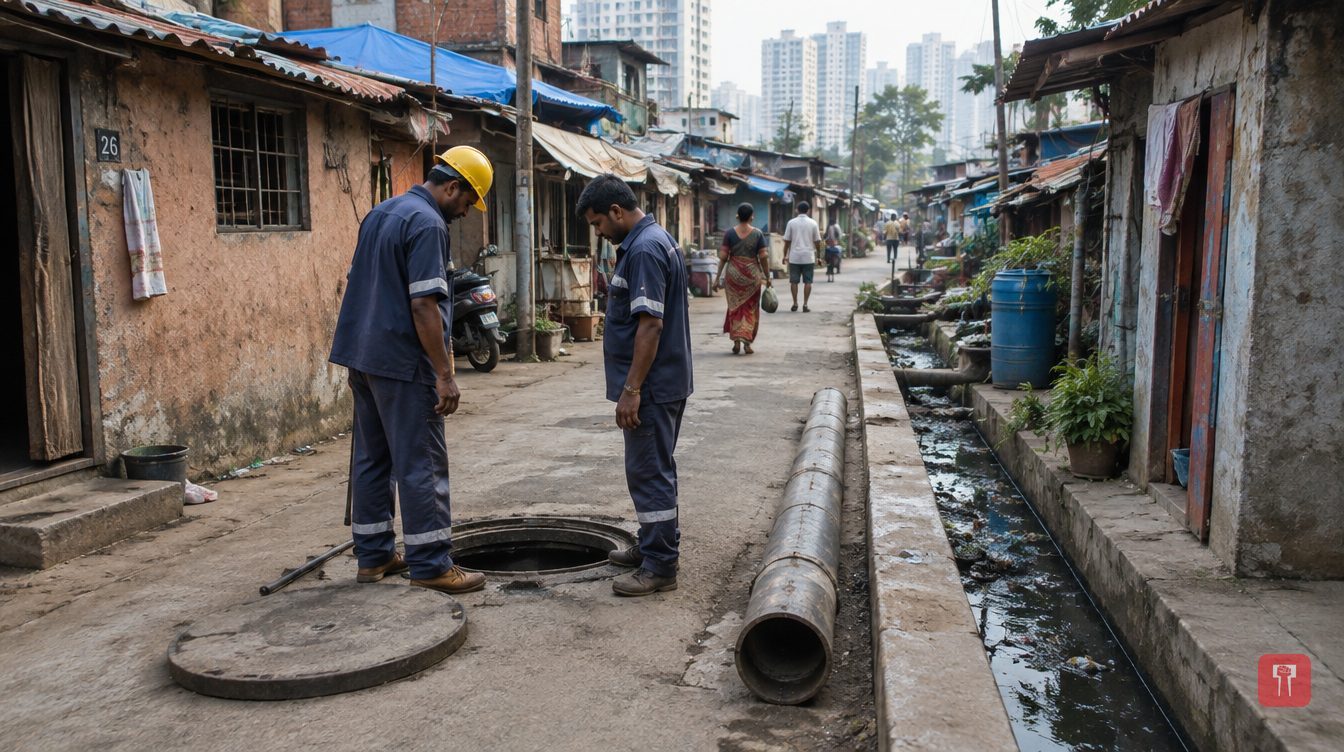
The biggest gap is in slums, which have no underground sewage lines, so many households have to depend on septic tanks. About 60% of Mumbai's population lives in slums, and the shortfall in sanitation infrastructure has become a major public health concern. If septic tanks are not properly maintained, poisonous gas can build up in them, leading to dangerous explosions and fatal accidents. The lack of sewage connections has also affected efforts to build household toilets under the Swachh Bharat Abhiyan, especially in dense settlements where space is already scarce.
In many areas, untreated wastewater from slums and industrial sites flows directly into nearby rivers, nullahs and storm-water channels, polluting the water. In the next phase of the MSIP, the BMC plans to divert this flow of wastewater towards the sewerage network. A plan to revive a river has also been prepared to end pollution from sewage.
The proposed expansion will also cover areas that fall under other authorities such as MHADA, the Airports Authority, the railways and the Mumbai Port Authority. To make infrastructure work easier at these sites, the BMC is also considering changes to rules.
There are several reasons the project has slowed: difficult geography, uncertain underground conditions, shortage of land and delays in getting legal clearances. Laying sewer lines through CRZ areas, forest land and property controlled by various government departments requires many permissions.
To deal with these hurdles, the BMC has decided to appoint consultants to prepare a detailed project report (DPR). A list of 12 consulting agencies is reported to have been shortlisted.
Mumbai's sewerage system is more than 130 years old. When the MSIP began in 2016-17, the city had about 1,830 km of sewer lines, which have now grown to 2,080.279 km. Even so, the target of 100% coverage is still some way off. The upcoming DPR is expected to identify gaps in infrastructure. It is also expected to outline measures to take sewerage services to underserved areas, reduce the discharge of untreated wastewater and improve sanitation across Mumbai.
Reach readers on the ward they actually live in.
Advertise with Prime Time 24Reach readers on the ward they actually live in.
Advertise with Prime Time 24Reach readers on the ward they actually live in.
Advertise with Prime Time 24Reach readers on the ward they actually live in.
Advertise with Prime Time 24
Comments
No comments yet. Be the first.