

Why Saptashrungi Devi is called an Ardha Shaktipeeth, and the belief around her 18-armed idol
As Navratri nears, devotees head to the Saptashrungi shrine near Nashik, counted among Maharashtra's three and a half Shaktipeeths.
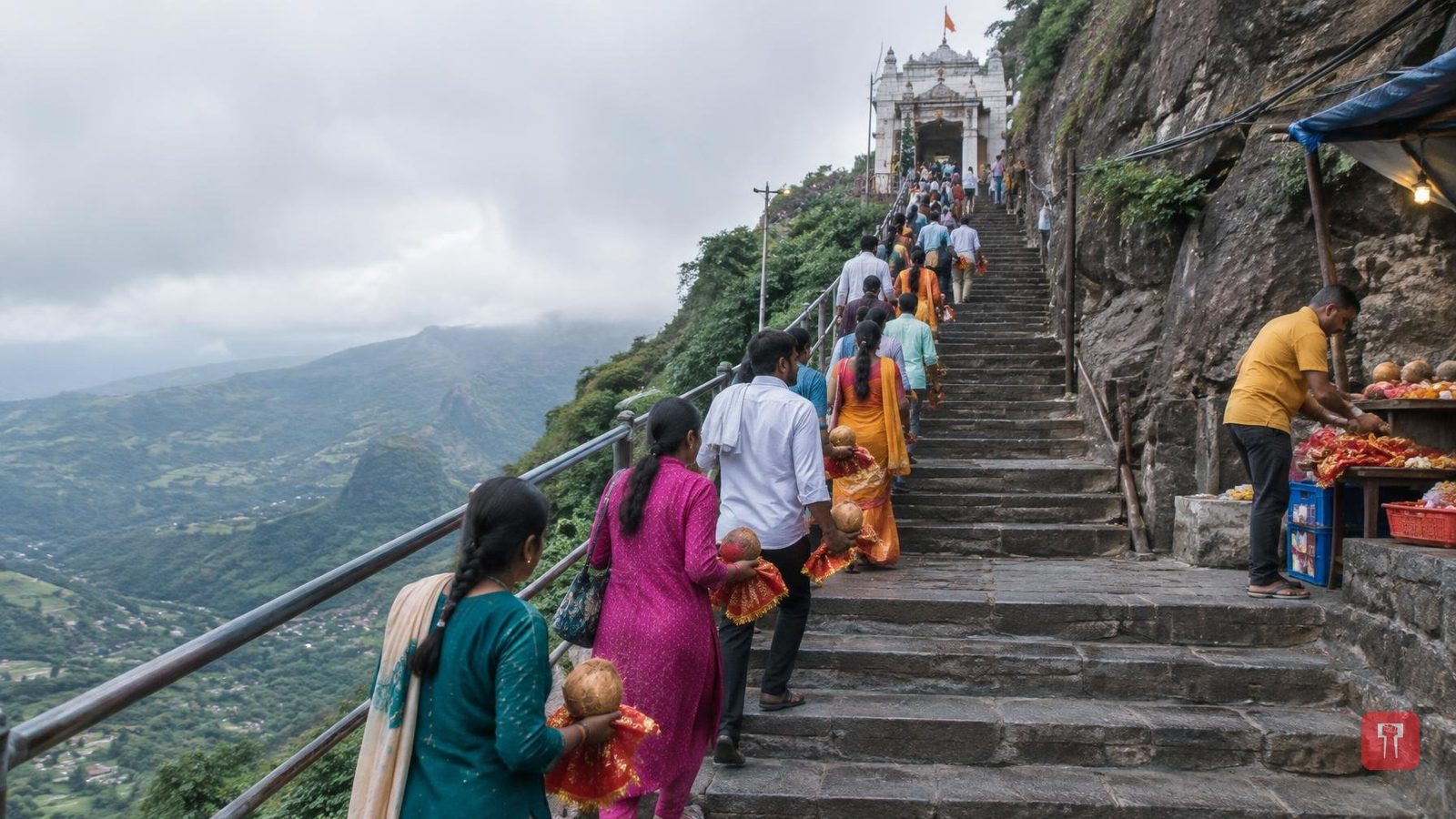
Preparations for Navratri have begun across the country. This year, Shardiya Navratri begins on Sunday, October 11. During these days the goddess is worshipped in her different forms, and devotees visit Shaktipeeths for darshan. The Saptashrungi Shaktipeeth, one of the country's 51 Shaktipeeths and counted among Maharashtra's "three and a half Shaktipeeths", is among the places that draw large numbers of devotees.
Saptashrungi is called an Ardha Shaktipeeth, or half Shaktipeeth. In Maharashtra's tradition of three and a half Shaktipeeths, three seats are considered complete and Saptashrungi has the status of a half seat. Tulja Bhavani of Tuljapur, Mahalakshmi of Kolhapur and Renuka Mata of Mahur are considered full Shaktipeeths. Saptashrungi Devi is enshrined here in the Kumarika form, that of a young girl, which is why it is called a half seat.
It is believed that Goddess Sati's right arm fell here. The legend is linked to the well-known story in the Shiva Purana and the Devi Purana, in which Lord Shiva grieves after Sati gives up her life in the sacrificial fire and parts of her body scatter to different places.
According to the legend, King Daksha held a yajna but did not invite Lord Shiva and Sati. Sati went there uninvited. Daksha then insulted Lord Shiva. Unable to bear the insult, Sati leapt into the sacrificial fire and gave up her life.
Enraged at Sati's death, Lord Shiva lifted her body on his shoulder and began a destructive tandava across the universe. To save the world from destruction, Lord Vishnu began severing parts of Sati's body with his Sudarshan Chakra. It is believed that at that moment her right arm fell on the peak of Saptashrung, the seven mountains in the Vani area near Nashik in Maharashtra. For this reason the place holds a special position among the 51 Shaktipeeths and Maharashtra's three and a half Shaktipeeths.
According to the Bhagavata Purana, Goddess Durga was extremely wrathful while slaying Mahishasura. To calm that fierce form and rest, she came to live on these seven peaks of the Sahyadri. Devotees here see only a gentle, half portion of her full fierce form.
It is also believed that Sage Markandeya composed the Devi Mahatmya at this place. The neck of the goddess's idol is slightly tilted to one side. According to legend, when Sage Markandeya sat on the mountain opposite and recited the "Durga Saptashati", the goddess leaned slightly in that direction to listen closely to the words of his prayer.
According to the Markandeya Purana (Devi Mahatmya), composed by Sage Markandeya, this idol of Saptashrungi Devi is a manifestation of Mahalakshmi herself. The 18-armed goddess is called "Ashtadashabhuja", though some references also describe her as the eight-armed Ashtabhuja. The idol is about 8 feet (2.4 metres) tall and, being entirely covered in vermilion, appears deep vermilion (saffron) in colour.
The goddess's hands are believed to hold weapons and objects given by different deities. These include Lord Shiva's trident, Lord Vishnu's Sudarshan Chakra, Varuna's conch, the flames of Agni, Vayu's bow and arrow, the vajra, Indra's bell, Yama's staff, Daksha's akshamala (a string of beads), Brahma's kamandalu (water pot), a symbol of the Sun god's rays, Kali's sword and shield, Vishwakarma's parashu (axe), and Kubera's wine cup and mace.
Saptashrungi Devi is enshrined on the 4,800-foot-high Saptashrung mountain, about 65 km from Nashik. The temple has a deep gorge on one side and a high mountain on the other. Devotees climb about 472 steps to reach the main temple. Darshan of the goddess is had in the cave through three doors: the Shakti Dwar, Surya Dwar and Chandra Dwar.
During Navratri, the traditions of the goddess's Gondhal and god bharai (the offering of the lap) are observed. To fill Saptashrungi Mata's lap, devotees bring coconuts, chunris, sarees, bangles, vermilion, flowers and sweets. It is believed that the goddess blesses her devotees here with 18 hands. Puran poli is given as prasad.
