

Why a QR code has large boxes in only three corners
 Images are not validated/verified
Three large squares are enough for a scanner to read a QR code's size and orientation, and a fourth would take up space meant for data.
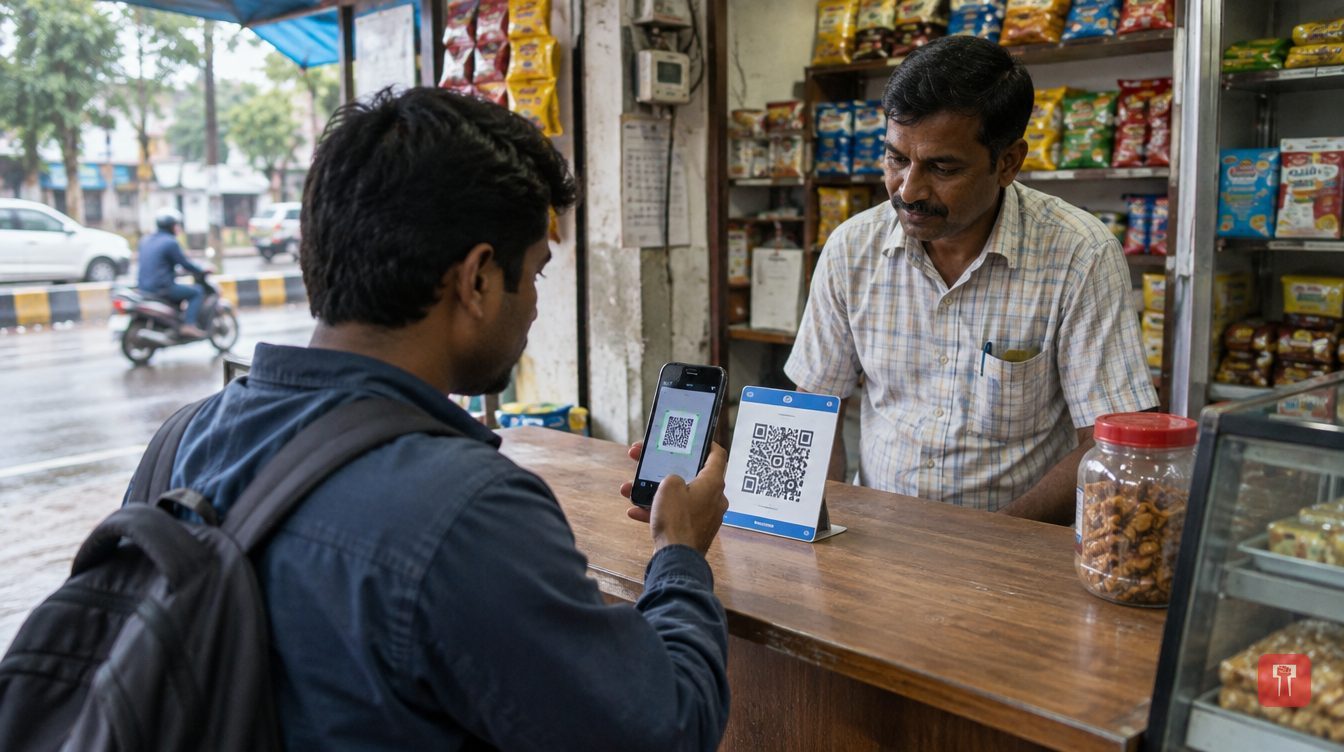
From digital payments to restaurant menu cards and railway and bus tickets, QR codes are now used everywhere. Hold a phone camera in front of one and the information you need appears within seconds. Yet have you noticed that three corners of a QR code carry large square boxes, while the fourth corner is left blank or holds only small designs? There is an interesting technical reason behind it.
First, what are these large boxes? The big squares seen in the two upper corners and the lower left corner of a QR code are called "Finder Patterns" in technical language. Each has a black box on the outside, a white portion inside it and a black square exactly in the middle.
When we bring a phone camera towards a QR code to scan it, the camera first looks for these three markers. From the distances between the three and their positions, the scanner can work out precisely the size of the code and its orientation. It can also tell whether the code is held upright or upside down. This is why a phone scans a QR code quickly even when it is tilted.
The question then arises: if these boxes are so important, why is a similar box not added in the fourth corner for security or convenience? There are two main technical reasons.
The first is saving space and data storage. The small black and white squares (modules) inside a QR code hold the website link, payment details or text. If a large box were placed in the fourth corner as well, there would not be enough room left to hold the information.
The second reason is that an additional box is simply not needed. Three points are enough for a scanner to understand the direction and size of the code. Under the rules of geometry, the exact position and orientation of an object can be fixed from three points. So there is no need for a fourth box.
In other words, the three large boxes of a QR code serve to identify it, while the rest of the code and the small squares inside it hold the actual information. This technology has made the exchange of information much easier and faster today.
Reach readers on the ward they actually live in.
Advertise with Prime Time 24Reach readers on the ward they actually live in.
Advertise with Prime Time 24Reach readers on the ward they actually live in.
Advertise with Prime Time 24Choose primetime24.com as a preferred source on Google Google shows more stories from your preferred sources in Top Stories.
Reach readers on the ward they actually live in.
Advertise with Prime Time 24
Comments
No comments yet. Be the first.