

Two special educators start Rashi POS Foundation for children with special learning needs
Radhika Bhave and Shilpa Kulkarni, former special educators in mainstream schools, run a foundation with an individual learning plan for each child.
 Images are not validated/verified
Every child is different. Children learn in different ways, understand at different levels and progress at their own pace. Within a school's fixed structure of teaching, some children are unable to move ahead as expected, and are often labelled weak in studies, inattentive or disruptive in class. Radhika Bhave and Shilpa Kulkarni say that if the difficulties of such children are understood and they are given the right teaching and support, their potential can open up. With this thinking, they started work for children with special educational needs through the Rashi POS Foundation.
Both earlier worked as special educators in mainstream schools. They saw that some children kept moving around the classroom, did not pay attention to lessons or lagged behind other children in learning. Such children were often sent to special educators. But the two realised that the difficulty of these children was not limited to studies, and that their way of learning itself could be different. When they felt the way of teaching them had to change, they decided to work separately, and this is how the Rashi POS Foundation began.
The biggest challenge was winning the trust of parents. Setting up separate teaching arrangements for children with special educational needs was difficult, and explaining their importance to parents was equally challenging. For many parents, it was not easy at first to accept taking a child out of a mainstream school and putting the child in a different kind of education. They worried that the child would fall behind others and what the child's future would be. Radhika and Shilpa tried to assure parents that if the burden of studies is reduced and the child is taught according to need, the child can develop fully.
They said no big advertising campaign was run to reach parents with information about the foundation. At the start, a few parents knew about their work. They began telling other parents about the foundation. In this way the foundation became better known through one another's experiences, and admissions of children also began to rise.
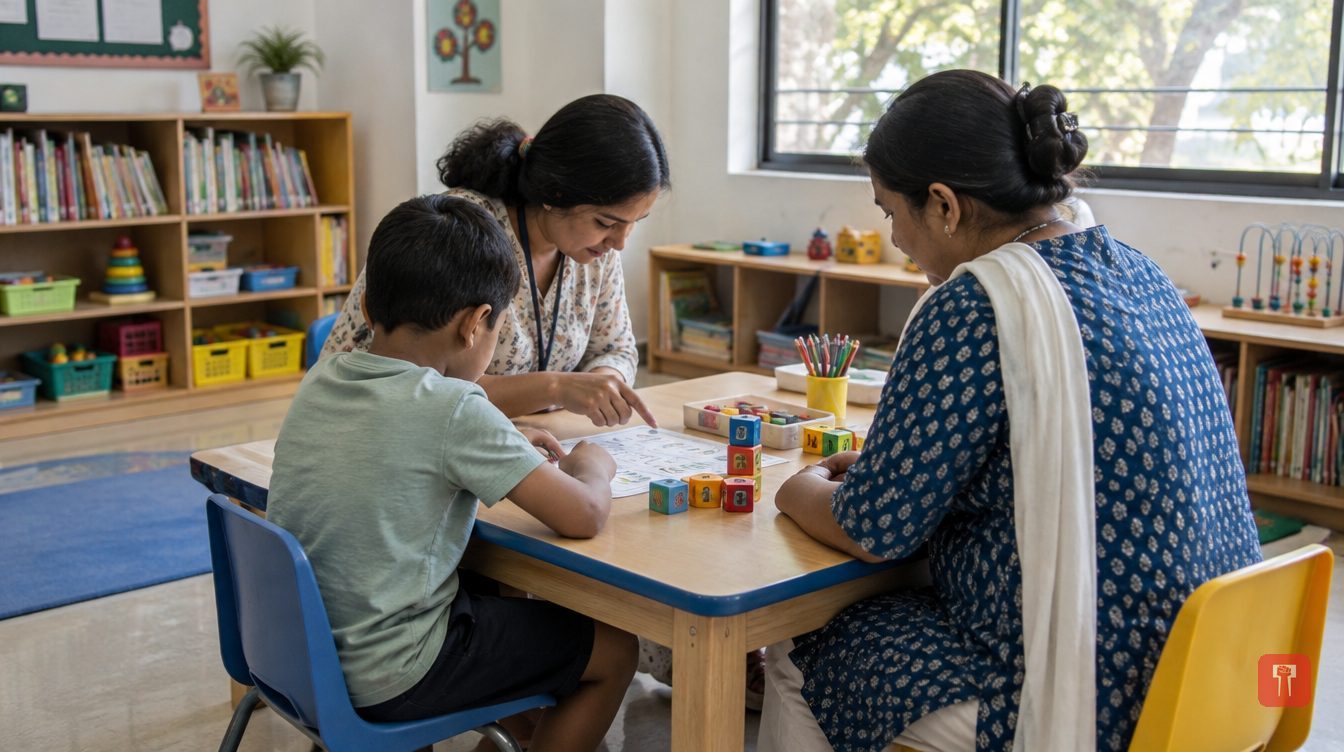
The most important part of the foundation's teaching is a separate plan for every child. Radhika and Shilpa said that every child's difficulties and needs are different, so teaching everyone in the same way does not work. One child may need special guidance for dyslexia, while another may need occupational therapy. Explaining their work, they said, "We do not have 50 children, but 50 different classrooms." This means a separate learning plan is made for each child. Instead of the child fitting into a fixed method, the method of teaching is changed to suit the child's need.
Conditions such as ADHD, dyslexia, dyspraxia and dyscalculia were also discussed. Some children have difficulty concentrating, while others may struggle with reading, writing, mathematics or coordination of movement. Both said that instead of repeatedly underestimating such children, it is important to understand their difficulty. Occupational therapy, special education and regular practice are included according to the children's needs.
The foundation has chosen the system of NIOS, the National Institute of Open Schooling, for these children's education. In mainstream schools, students have to take examinations in several subjects in an academic year. Under the rules applicable in NIOS, subjects and examinations can be planned more flexibly. This can give some students more time to study according to their ability. They said the aim is to reduce unnecessary pressure on children and give them a chance to move ahead with confidence.
A new challenge faced the foundation during the Covid pandemic. Teaching children with special educational needs online was not easy. The entire team of teachers had to prepare afresh. Different tools, presentations, timetables and teaching methods were prepared for online teaching. During this time parents also became more involved in their children's studies. They said that with regular guidance, some children showed improvement in their ability to read, write and study on their own.
The Rashi POS Foundation does not focus only on bookish learning. For the all-round development of children, dance, music and other activities are also given importance. Children are taught dances such as hip-hop and Bharatanatyam. Through dance, children learn to understand left and right, keep their body coordinated, remember sequences of movements and be part of a group. According to Radhika and Shilpa, such activities can reduce children's fear of studies and increase their confidence.
Art activities such as art therapy are also used. Some children find it hard to put their feelings into words. In such cases, drawing and other artistic activities can become a way for them to express themselves. A child may be behind in studies and yet do excellent work in drawing. When the art of such children is encouraged, they experience the joy of success. They said that for children who face repeated failure, even a small success in an activity matters.
The two laid special emphasis on understanding children with affection. In their view, building a child's confidence begins with accepting the child's abilities. It is more important to see what they can do than what they lack. They described as important praising every small progress of the children, understanding their difficulties and giving them a safe environment.
Radhika Bhave and Shilpa Kulkarni take a positive view of special education. Every child's ability is different. Some children take longer to learn and some have to be taught differently. But this does not reduce those children's abilities. If children get teaching according to their needs, the right guidance and a loving environment, their abilities get a chance. This is the message that emerges from the work of the Rashi Foundation.
