

Quad leaders to meet in Manila on November 16, first in-person summit in two years
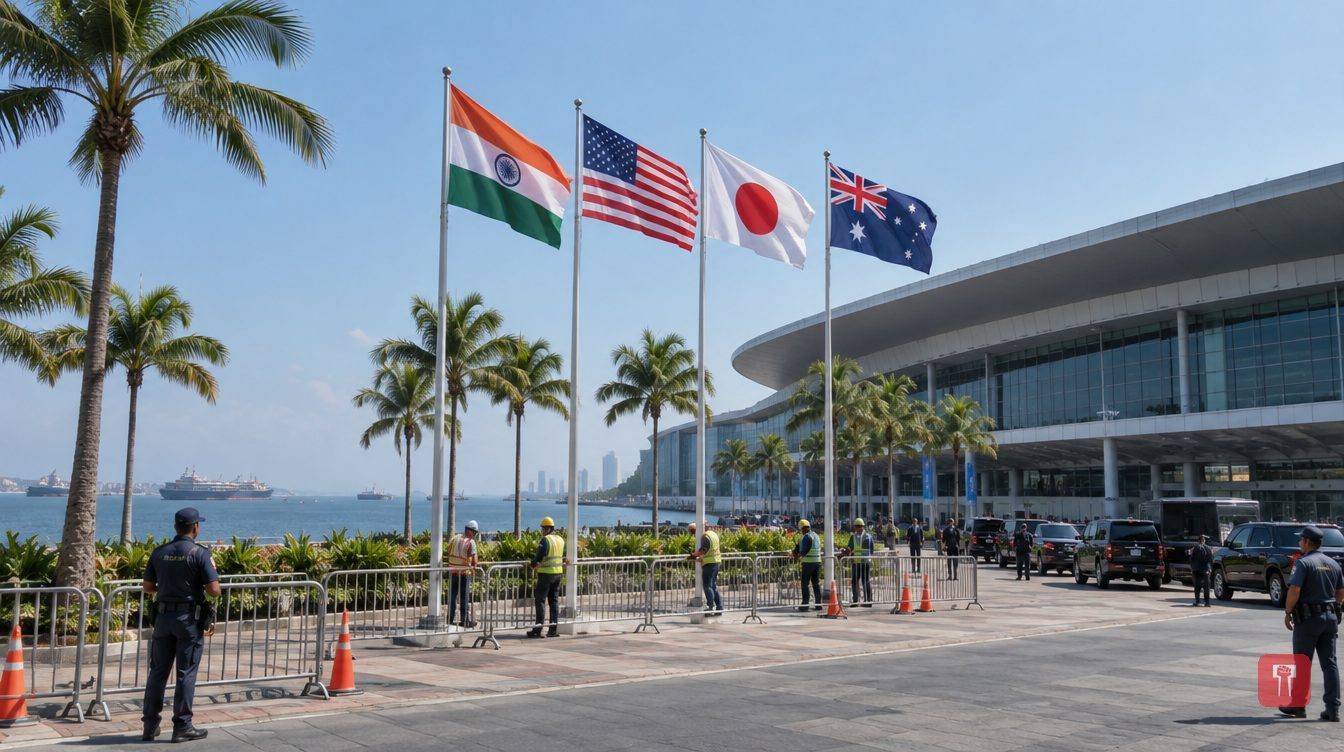 Images are not validated/verified
Leaders of India, the US, Japan and Australia are set to meet in the Philippine capital on November 16, with Prime Minister Narendra Modi likely to attend.
A summit of Quad leaders is scheduled in Manila, the capital of the Philippines, on November 16, 2026. The top leaders of India, the United States, Japan and Australia will sit face to face after a gap of two years, and the world is watching the meeting. Prime Minister Narendra Modi is likely to travel to Manila to attend the ASEAN summit and the Quad meeting. The meeting has stirred Asian politics and has particularly heightened concern in neighbouring China.
It will be the first in-person meeting of Quad leaders during US President Donald Trump's second term. Curiosity has grown further after recent statements by US Secretary of State Marco Rubio. The meeting is expected to clarify what the Trump administration's priorities will be for peace and stability in the Indo-Pacific, and the direction of strategic ties with India, Japan and Australia.
The last major meeting of the Quad's top leaders was held in Wilmington, in the United States, on September 21, 2024. Talks continued afterwards among the foreign ministers and officials of the four countries, but a leaders' meeting could not be held. As per the schedule, India was to host the summit in 2025, but it could not take place because of some technical and international reasons. The Manila meeting is now seen as a major opportunity to speed up pending work and strengthen the credibility of the four countries.
China's growing aggression and expansionist stance in the South China Sea have become a global concern. China has long had a maritime boundary dispute with the host, the Philippines. The sea route is vital for global trade and fuel shipments, so any tension there can shake the world economy. International analysts expect the Quad leaders in Manila to take a firm and clear position on maritime security, adherence to international law, and open and unhindered passage for merchant ships.
Modi's visit is not limited to the Quad; it is also seen as important for India-Philippines ties. The Philippines holds the ASEAN chair in 2026, and the 49th ASEAN summit is being held there from November 13 to 15. Both countries are committed to establishing peace in the Indo-Pacific. Several new agreements between India and the Philippines are highly likely in defence, bilateral trade, advanced technology and maritime cooperation.
Today the Quad is no longer only a security or military grouping; its scope has widened to the economy and advanced technology. The Manila meeting is expected to discuss in depth semiconductor manufacturing, artificial intelligence (AI), digital infrastructure and secure supply chains for rare earth minerals. The four countries are to take concrete steps together to reduce dependence on any single country. These technology agreements will directly benefit India's Make in India campaign and the country's domestic production capacity.
The gathering of Quad leaders in Manila has been described as a major headache for Chinese President Xi Jinping. One important diplomatic factor is that, as soon as the Manila meeting ends, President Trump will attend the APEC summit in Shenzhen, China, where he will meet Xi. The strategic message going out from Manila to China will therefore echo directly on Chinese soil. China has always regarded the Quad as an alliance formed against it, and the meeting has deepened Beijing's unease.
For India, the meeting is a big opportunity to show its global influence. India's firm position is that maritime trade should be safe and open from the Indian Ocean to the western Pacific. India also does not compromise on its independent foreign policy and strategic autonomy. Marco Rubio has made clear that the meeting will not be limited to formal statements but will take concrete decisions that show on the ground, in clean energy, cyber security and disaster relief.
The Quad, or Quadrilateral Security Dialogue, is an informal strategic forum of four major democracies: India, the US, Japan and Australia. The four countries first came together for relief work after the devastating Indian Ocean tsunami of 2004. In 2007, Japan's then Prime Minister Shinzo Abe proposed formalising the grouping. It had cooled somewhat after Australia withdrew in the intervening years, but it was revived in 2017, and regular summits began in 2021.
Reach readers on the ward they actually live in.
Advertise with Prime Time 24Reach readers on the ward they actually live in.
Advertise with Prime Time 24Reach readers on the ward they actually live in.
Advertise with Prime Time 24Choose primetime24.com as a preferred source on Google Google shows more stories from your preferred sources in Top Stories.
Reach readers on the ward they actually live in.
Advertise with Prime Time 24
Comments
No comments yet. Be the first.