

Modi to attend ASEAN-India and East Asia summits in Manila on November 16 and 17
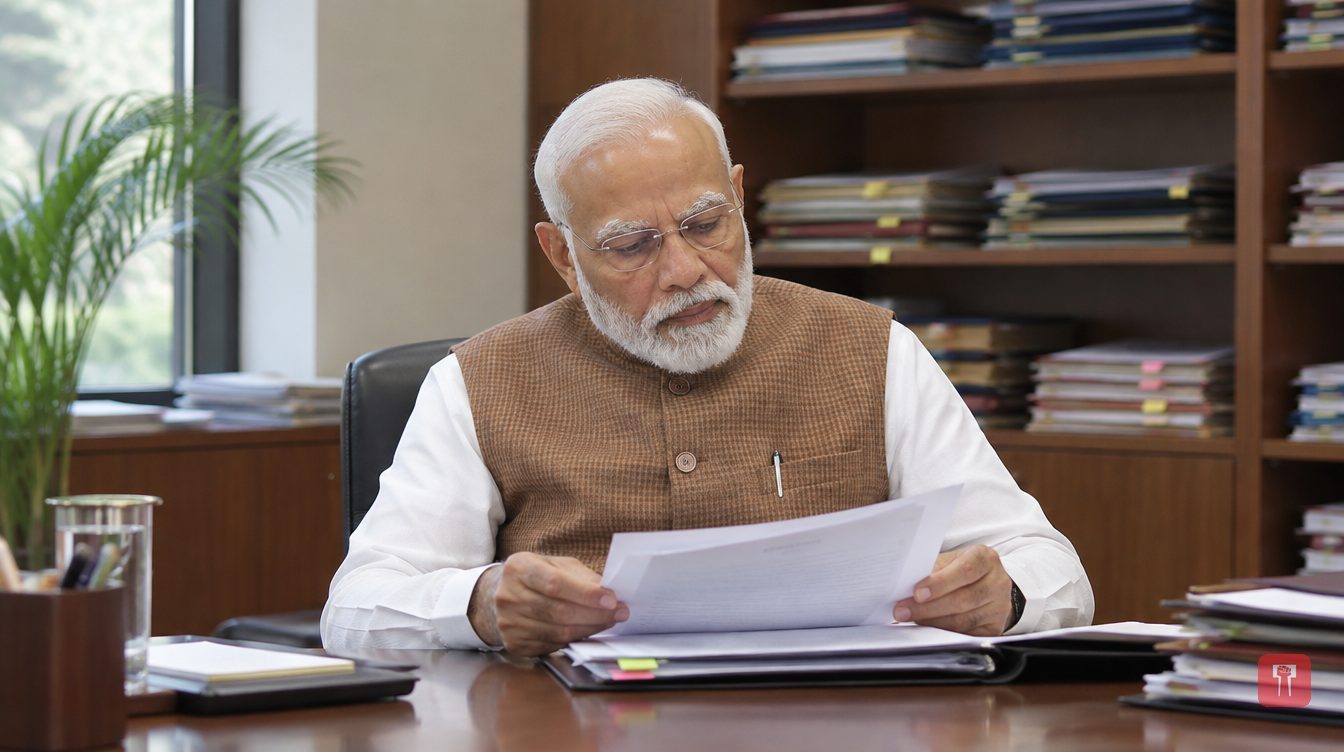 Images are not validated/verified
Prime Minister Narendra Modi will visit the Philippine capital for two days, a trip seen as a milestone in strengthening India's presence in South-East Asia.
Prime Minister Narendra Modi will make a two-day visit to Manila, the capital of the Philippines, on November 16 and 17. During the visit he will take part in the 23rd ASEAN-India Summit and the 21st East Asia Summit. The trip is being seen as a milestone for strengthening India's strategic, diplomatic and economic presence in South-East Asia.
The visit comes at a time when the world is going through a highly unstable and tense phase. The West Asia crisis and the US-Iran conflict have flared up, while in Asia China's growing military and economic ambitions are a major concern for neighbouring countries.
South-East Asia is the backbone of India's Act East Policy and its wider Indo-Pacific policy. But the region is struggling with several internal and external challenges. The growing rivalry between the United States and China, Myanmar's brutal civil war, the border dispute between Thailand and Cambodia and China's aggressive territorial claims in the South China Sea have all left the region considerably unsettled.
The Association of Southeast Asian Nations (ASEAN) was founded on August 8, 1967. To deal with the political instability and rivalry of the superpowers during the Cold War, Indonesia, Malaysia, the Philippines, Singapore and Thailand laid its foundation by signing the Bangkok Declaration. Its main aims were to boost economic cooperation, establish regional peace and maintain stability.
Brunei, Vietnam, Laos, Myanmar and Cambodia later joined. With Timor-Leste joining in October 2025, the number of member countries is now 11. About 693 million people, roughly 69.3 crore, live in the ASEAN countries, and their combined economy is estimated at $4.3 trillion. If ASEAN were treated as a single country, it would be the world's fifth-largest economy, and the bloc aims to become the fourth-largest by 2030. Unlike the European Union, ASEAN has no central authority that imposes decisions on member states. The bloc runs entirely on consensus and the principle of non-interference in one another's internal affairs.
The biggest challenge facing ASEAN at present is China's growing expansionism. Since China began asserting its claims in the South China Sea, there has been a major confrontation between the Philippines and China over maritime boundaries. The navies of the two countries have had several tense clashes at sea. Meanwhile, ASEAN's five-point peace plan has so far failed to bring under control the civil war that began in Myanmar after the 2021 military coup. The border dispute between Thailand and Cambodia has also resurfaced.
ASEAN's importance for India is therefore no longer merely formal; it has become highly strategic and economic. To counter Chinese bullying, India is stepping up defence and maritime security cooperation with South-East Asian countries. India's firm position is that the Indo-Pacific should be open, free and inclusive, and not dominated by any one country.
The Strait of Malacca, regarded as a lifeline of the Indian economy, links the Indian Ocean with the South China Sea. Most of India's international trade and energy supplies pass through this sea route. Naval exercises, maritime surveillance and intelligence sharing with countries such as Indonesia, Singapore, Vietnam and the Philippines are therefore vital to India's security. In view of this importance, 2026 is being observed as the ASEAN-India Year of Maritime Cooperation.
ASEAN is a major trading partner of India. Bilateral trade between India and the ASEAN countries reached an estimated $114 billion in 2025. There is considerable scope for cooperation on both sides in electronics, pharmaceuticals, automobiles and information technology. But the trade deficit is a major concern for India. India and ASEAN signed the goods trade agreement (AITIGA) in 2010. Since it came into force, India's trade deficit has grown from $7.5 billion in 2011 to $44 billion in 2023. In other words, India exports less to the ASEAN countries and imports more from them. For this reason the agreement has been under review since 2020, and India wants Indian products to get more opportunities in markets such as Vietnam and Indonesia.
Connectivity is another important aspect of the partnership. Two ambitious projects have been taken up to link north-east India directly with South-East Asia: the India-Myanmar-Thailand Trilateral Highway and the Kaladan Multi-Modal Transit Transport Project. Myanmar's civil war and instability have caused some delay in their work.
India has made a big leap in defence. By supplying indigenously built, modern BrahMos missiles to the Philippines, India has achieved a historic milestone in defence exports. This has increased pressure on China, and India's military exercises and defence cooperation with Vietnam, Indonesia, Singapore and Malaysia are also growing rapidly.
At the 23rd ASEAN-India Summit in Manila, Prime Minister Modi will review the comprehensive strategic partnership between India and ASEAN. The meeting will emphasise working together on maritime security, bilateral trade, investment, defence cooperation and new areas such as digital technology and artificial intelligence (AI).
At the 21st East Asia Summit, Modi will get an opportunity to talk directly with the heads of state of major countries such as the United States, China, Japan, Russia, Australia and South Korea.
Reach readers on the ward they actually live in.
Advertise with Prime Time 24Reach readers on the ward they actually live in.
Advertise with Prime Time 24Reach readers on the ward they actually live in.
Advertise with Prime Time 24Choose primetime24.com as a preferred source on Google Google shows more stories from your preferred sources in Top Stories.
Reach readers on the ward they actually live in.
Advertise with Prime Time 24
Comments
No comments yet. Be the first.