

How Kojagiri Purnima is celebrated across India, from Maharashtra to Bengal, Gujarat, Odisha and Braj
The full-moon festival of the month of Ashwin, also called Sharad Purnima, is marked with different customs in different regions, from spiced milk to rasa garba.
 Images are not validated/verified
Kojagiri Purnima is celebrated on the full-moon day of the month of Ashwin. It is also known as Sharad Purnima and Kojagara Purnima, and has different names in different regions. It falls when the monsoon ends and autumn begins, the full moon shines in the sky, the night is bathed in moonlight and milk kept in the moonlight is made into prasad. For these reasons the festival has a special significance.
In Indian culture, festivals are not only about religious importance. Social, cultural and spiritual traditions are attached to them as well. Kojagiri Purnima is one such festival.
According to religious belief, on this night Goddess Lakshmi asks, "Ko jagarti?", meaning "Who is awake?" It is believed that devotees who keep a vigil and worship Lakshmi on this night receive the goddess's grace. In Maharashtra the vigil is kept while enjoying boiled, thickened milk, while in other parts of the country Lakshmi puja, rasa garba, kumarika puja and Sri Krishna's Raslila are held.
The day is marked with particular enthusiasm in Maharashtra. In some places there is a tradition of Lakshmi puja and Indra puja at night, in which Indra is worshipped seated on Airavata. Homes are cleaned and lamps are lit to welcome Lakshmi.
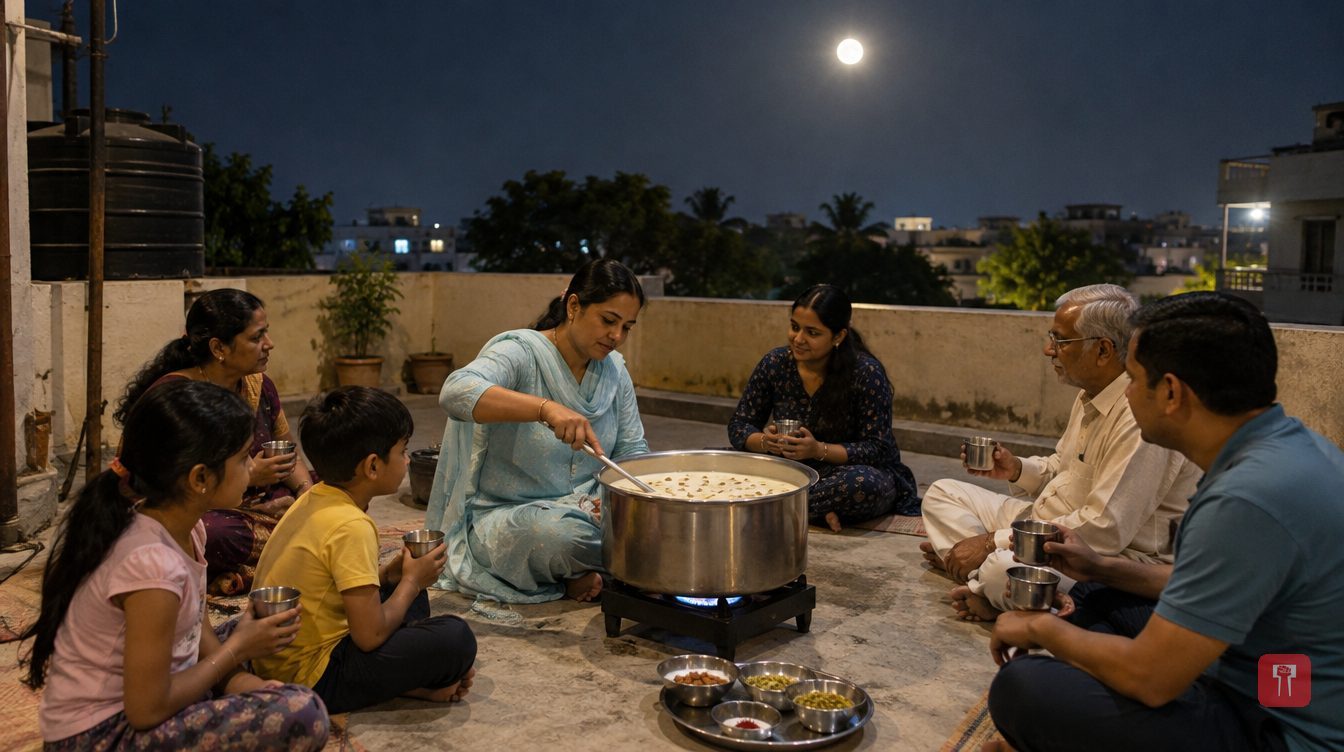
The biggest attraction of Kojagiri is the thickened milk. The milk is boiled down and sugar, saffron, cardamom, almonds and pistachios are added. It is kept in the moonlight and later taken as prasad. Traditional belief holds that milk kept in moonlight is good for health.
In cities, families and friends gather on terraces, in courtyards or in open spaces. The night is spent awake with songs, bhajans, chatting and all kinds of games. In many places Kojagiri is held collectively and milk prasad is given to everyone. In this way, in Maharashtra the festival has become a symbol of family bonds and social unity along with religious devotion.
In West Bengal it is called "Kojagari Lakshmi Puja" or "Lokkhi Pujo". Worship of Goddess Lakshmi on this day holds special importance in Bengali society. Many families hold Lakshmi puja on this full moon, which comes after Durga Puja ends. The house is cleaned and a beautiful "alpona" is drawn in rice flour from the door to the family shrine. Auspicious symbols and the goddess's footprints are drawn in this traditional rangoli. The idea is that the goddess should come into the home and bring the family happiness and prosperity. The goddess is offered fruit, sweets, kheer and other items. In some families khichdi is also part of the offering.
In Gujarat the festival is known as "Sharad Poonam". The moon is considered especially important on this day, and the main attraction is the tradition of playing rasa garba in the full-moon light. In many places rasa garba is held in temple courtyards, public grounds and the courtyards of homes. Women and men in traditional dress dance together to the beat. Devotional songs, folk songs and traditional music fill the whole area with enthusiasm. In some places there is a tradition of eating milk and "pauna", that is, poha, in the moonlight. The Rasotsav linked to devotion to Sri Krishna is also given importance.
In Odisha, Kojagiri Purnima is called "Kumar Purnima". It has a special place in the lives of unmarried and young girls. On this day girls wear traditional dress and perform various religious rituals. In some traditions a fast is kept from sunrise, and after the moon appears it is worshipped and an offering is made. In some places there is a practice of praying for a good life partner and a happy life ahead. An offering of "khai", that is, puffed rice, along with jaggery, coconut, banana and a variety of fruits, is made. The festival is observed with traditional songs, dance and games.
In north India, Sharad Purnima has special religious significance in Mathura, Vrindavan and Braj Bhoomi. This full moon is linked to the divine Raslila of Lord Sri Krishna and the gopis. According to religious belief, Lord Krishna performed the Maha Raas with the gopis in the light of the Sharad Purnima moon. So on this day Krishna temples in Vrindavan and Braj hold special puja, bhajans, kirtan and Raslila programmes.
Idols of Radha and Krishna are decorated with beautiful clothes and jewellery. In some temples white clothes are especially favoured. This decoration, matching the white light of the moon, stirs devotion in the hearts of devotees. On this night devotees give special importance to recalling Sri Krishna's leelas, joining in bhajan and kirtan, and having darshan. This tradition conveys a spiritual message of love, devotion and union with the Supreme.

Comments
No comments yet. Be the first.