

Greenwich line set the world's time: 1884 conference laid basis for GMT and time zones
 Images are not validated/verified
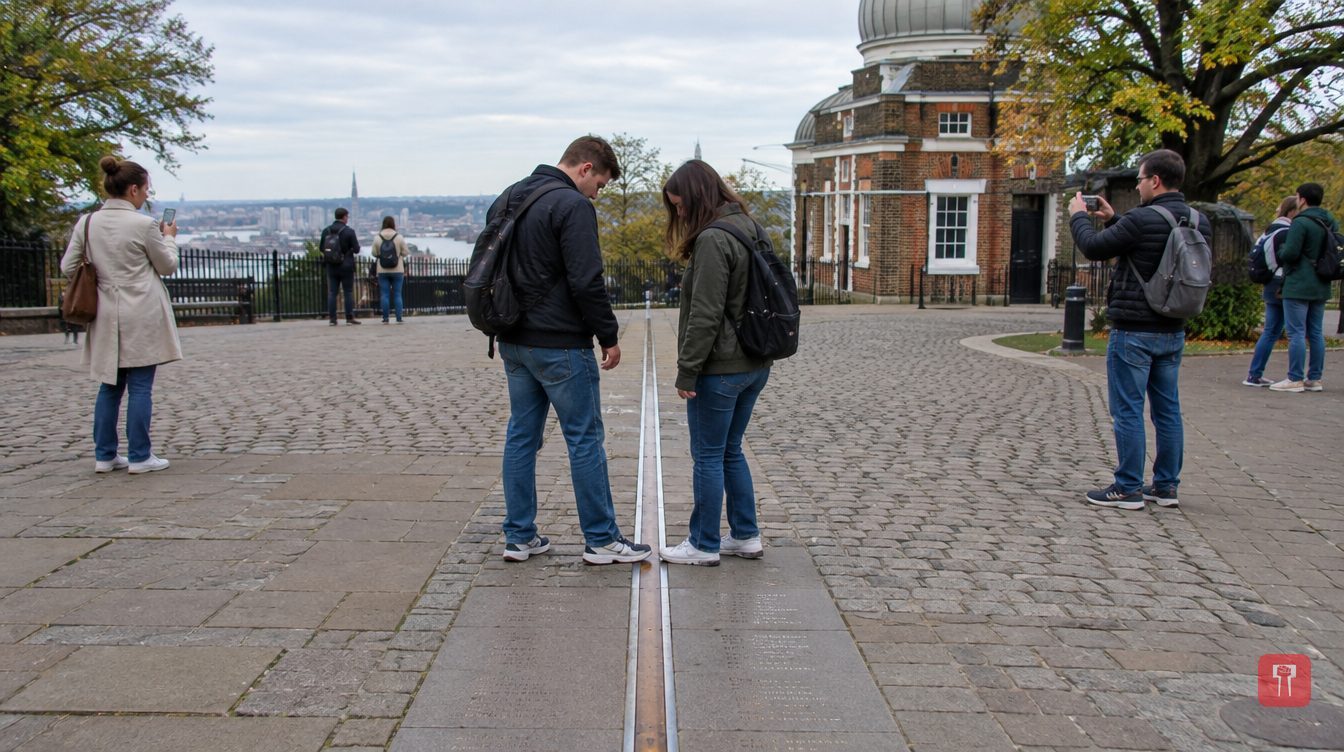
The 1884 International Meridian Conference in Washington adopted the line through Greenwich's Royal Observatory as the Prime Meridian, the basis of GMT; 1 November is marked as Prime Meridian Day.
Reading a clock, matching time across countries or flying from one continent to another is part of everyday life. Yet how time stays coordinated across the world is rarely considered. Behind it lies an imaginary line, in whose memory Prime Meridian Day is marked. The day is not only about a concept in geography; it is also a golden chapter in human history, scientific precision and global cooperation.
At the International Meridian Conference held in Washington, D.C., in 1884, the line passing through the Royal Observatory at Greenwich, near London, received official recognition as the zero-degree longitude, or the Prime Meridian. The day of 1 November is regarded as special in memory of this historic decision. This one imaginary line changed completely the way the world looks at time and the map.
Imaginary lines running vertically and horizontally have been drawn on the Earth, called longitudes and latitudes respectively. Among latitudes, the Equator is regarded as the main line, dividing the Earth into the northern and southern hemispheres. For longitude, however, there was no natural midpoint of this kind.
In the latter half of the 19th century, different countries counted time from different places, as suited them. This caused serious confusion in international travel, maritime trade and railway timetables.
To resolve this, the International Meridian Conference was convened in Washington, D.C., in the United States in October 1884. Representatives and scientists from 25 countries took part. After considerable debate and discussion, a historic resolution was passed by majority to treat the line passing through the Royal Observatory at Greenwich in London, Britain, as the zero-degree longitude (Prime Meridian). The resolution received its final seal on 1 November 1884, which is why the day is known as Prime Meridian Day.
The most important function of the Prime Meridian is to provide Greenwich Mean Time (GMT), the global standard time. The line divides the Earth into two equal parts, the Eastern Hemisphere and the Western Hemisphere. The way time changes as one moves east or west of this line has been fixed by calculation.
The Earth rotates 360 degrees on its axis and takes 24 hours to complete one turn. That means it passes 15 degrees of longitude in an hour, or takes 4 minutes to turn 1 degree. Going east from Greenwich, time moves 4 minutes ahead for every degree, while going west it falls 4 minutes behind. For instance, Indian Standard Time (IST) is based on 82.5 degrees east longitude, so India's time is 5 hours 30 minutes ahead of Greenwich time (GMT +5:30).
Smartphones, GPS (Global Positioning System), Google Maps and air traffic systems all run on this longitude. In today's digital age, atomic clocks and Coordinated Universal Time (UTC) are used for precise timekeeping, yet its foundation still rests on the Greenwich Prime Meridian.
Had the world not come together in 1884 to adopt a uniform system, international trade, stock markets, telecommunications and space research would today be in great chaos. Prime Meridian Day therefore teaches the strength of science and the value of human cooperation.
Reach readers on the ward they actually live in.
Advertise with Prime Time 24Reach readers on the ward they actually live in.
Advertise with Prime Time 24Reach readers on the ward they actually live in.
Advertise with Prime Time 24
Comments
No comments yet. Be the first.