

Fake owls and predator calls fail to scare birds away from wind turbines, Canadian study finds
A field study near Halifax found that neither a decoy owl nor recorded predator and alarm calls kept birds away from wind turbines.
 Images are not validated/verified
Wind power produces clean electricity, but the huge turbines spreading fast across the world also threaten birds. Every year, thousands of rare and local birds die after colliding with the fast-spinning blades high above the ground.
To address this, many wind energy companies and environmental groups try old methods of scaring birds away. These include decoy owls, models with flapping wings and recorded calls of predators. The question is whether these methods really work. A detailed study by researchers in Canada has answered it, and people in the field are surprised.
Catherine Doucette, Scott Dickey and Tony R. Walker tested bird deterrents at a wind energy project in Nova Scotia, Canada. Their research has been published in the journal Proceedings of the Nova Scotian Institute of Science. The result was clear: neither the decoy owl nor the frightening calls of predators could keep birds away from the turbine area.
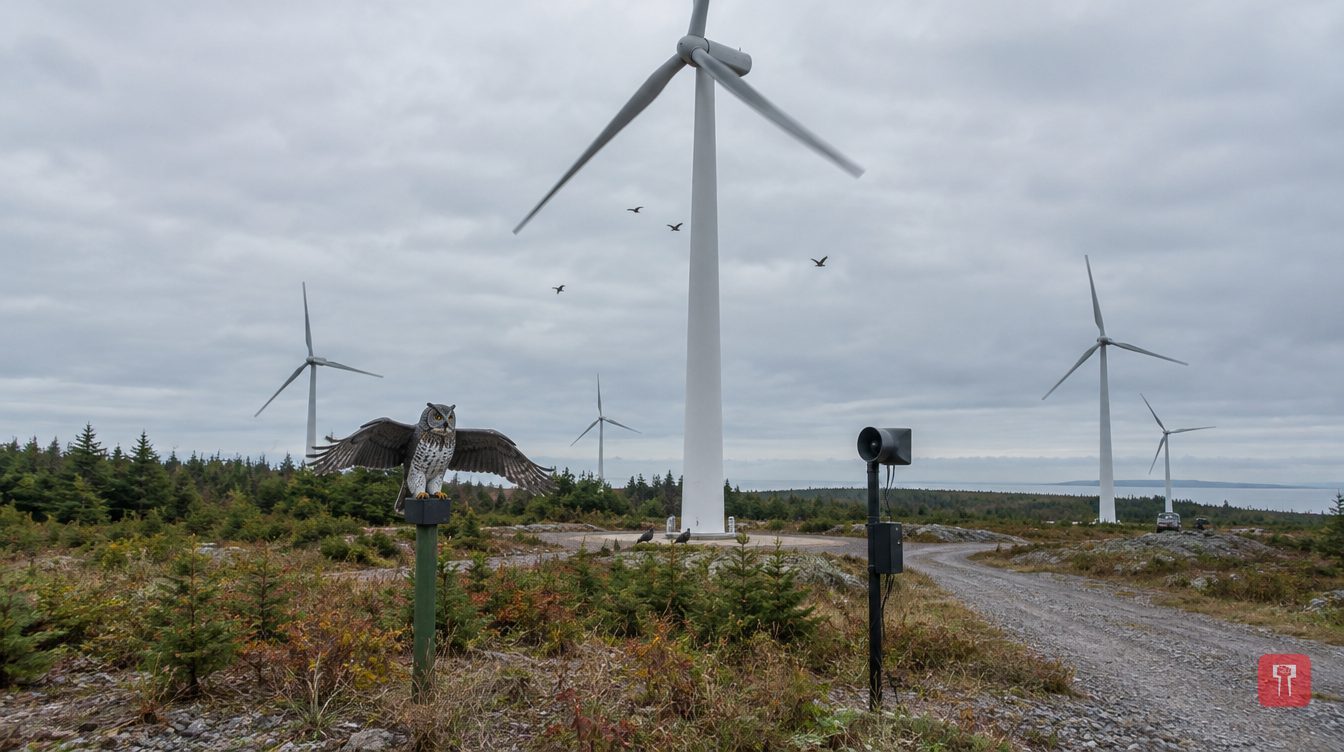
The fieldwork was carried out between August 22 and September 16, 2016, at a wind project with five turbines, 20 km north-west of Halifax, Canada. The aim was to see whether visual and audible cues could change bird behaviour, and whether birds could be kept out of the zone of danger around the turbines.
Two devices were tested. The first was a decoy owl called the Bird-X Prowler Owl, whose wings flap in the wind. It was placed just 50 metres from a turbine so that birds would think a large bird of prey was perched there. The second was a sound system that played a mix of the call of a Red-tailed Hawk and alarm calls of the Ovenbird and the White-throated Sparrow.
The researchers closely compared bird movement with and without the devices. This was necessary because birds can also change location for natural reasons such as food availability, weather or season. Four conditions were compared: the owl model alone, the owl model with alarm calls, an operating turbine and a stationary turbine.
Comparison with a control site showed that neither the decoy owl nor the predator calls had any significant effect on the presence of birds or their flight paths. The birds ignored the devices and kept moving around the turbines as usual. Such simple, old methods do not stop birds from entering the turbine area at all.
The study is an eye-opener for wind project operators and wildlife conservation groups. Deterrents sold in the market often make big claims, but according to this research their effect was nil. If birds are not afraid of these things, there is little reason to expect fewer collisions or bird deaths.
Some experts say that differently designed decoys or a different mix of sounds might give a different result. Even so, most of the measures available now are proving ineffective. Wind project operators therefore need to adopt more solid, scientific and new technology to protect birds rather than rely on token measures. Modern options such as radar-based turbine shut-down systems or AI camera detection need to be emphasised now.

Comments
No comments yet. Be the first.