

Devotees urged to visit Gugula Mata temple for Simollanghan in Deulgaon Raja
As the Shri Balaji Maharaj Yatra festival nears, residents of Deulgaon Raja are urged to revive the Dussehra tradition by visiting the restored Gugula Devi temple.
 Images are not validated/verified
The Shri Balaji Maharaj Yatra festival is here again, as it is every year. Much has changed over the last four hundred years. The day after Mandapotsav is the Dussehra festival, the day the Pandavas' exile ended. They had hidden their weapons in an apta and shami tree, and brought them back from the tree to celebrate victory. In the same way, in Deulgaon Raja, Shri Balaji's palanquin completes a circuit of the village by way of the Amna river at night, under the Shravan nakshatra, for Simollanghan, and returns to the temple the next day. On this day, everyone in the village is allowed to touch the original idol of Balaji and take darshan.
Earlier, in the evening, many of the village's young men would go in groups towards the south. Fifty years ago, an old cremation ground lay across the Amna river, and beyond it were the Lanka garden and the Kalunka Mata temple. After darshan, people would go beneath the apta and shami tree, worship it, and carry the leaves home as prasad, treating them as gold and silver. Joshi Brahmins sat under the tree and handed out the plucked leaves. Dressed in new clothes, with caps on their heads and a red tilak on their foreheads, people crossed the village boundary shouting "Bol Balaji Maharaj ki jai, Lakshmi Raman Govinda".
With time, the Amna river ran dry. In those days Balaji's palanquin was immersed in the river at night. There was plenty of water under the bridge, and after much revelry there the palanquin was placed on a platform. It was widely believed that on this occasion Shri Tirupati Balaji and the Balaji of Washim came together with him. Many women and men came even in severe cold, since they could have darshan of all three Balajis. The river then had sand and an open bed. Wrestling arenas were set up there and gunpowder was set off on a large scale. Many people from Kinagaon Raja, Sindkhed Raja, Waghrul Jagir, Limkhed, Sawkhed Tejan and the surrounding villages came in large numbers by bullock cart to watch the Dussehra festival. A dam was built upstream at Sawkhed Bhoi, and the river changed. Now people have the puja done by a Joshi Brahmin on the riverbank and bring back apta leaves in the evening, but their number has dropped sharply.
Everyone agrees it is essential to keep the Simollanghan tradition going. After bringing back the apta and shami, people offer that same gold at the Balaji temple, take darshan and distribute peda and barfi to the deity. On reaching home, married women of the household perform aarti for everyone. The gold is also offered to the household deity. People visit one another's homes for darshan and blessings, and by bowing to elders they find the true joy of Simollanghan.
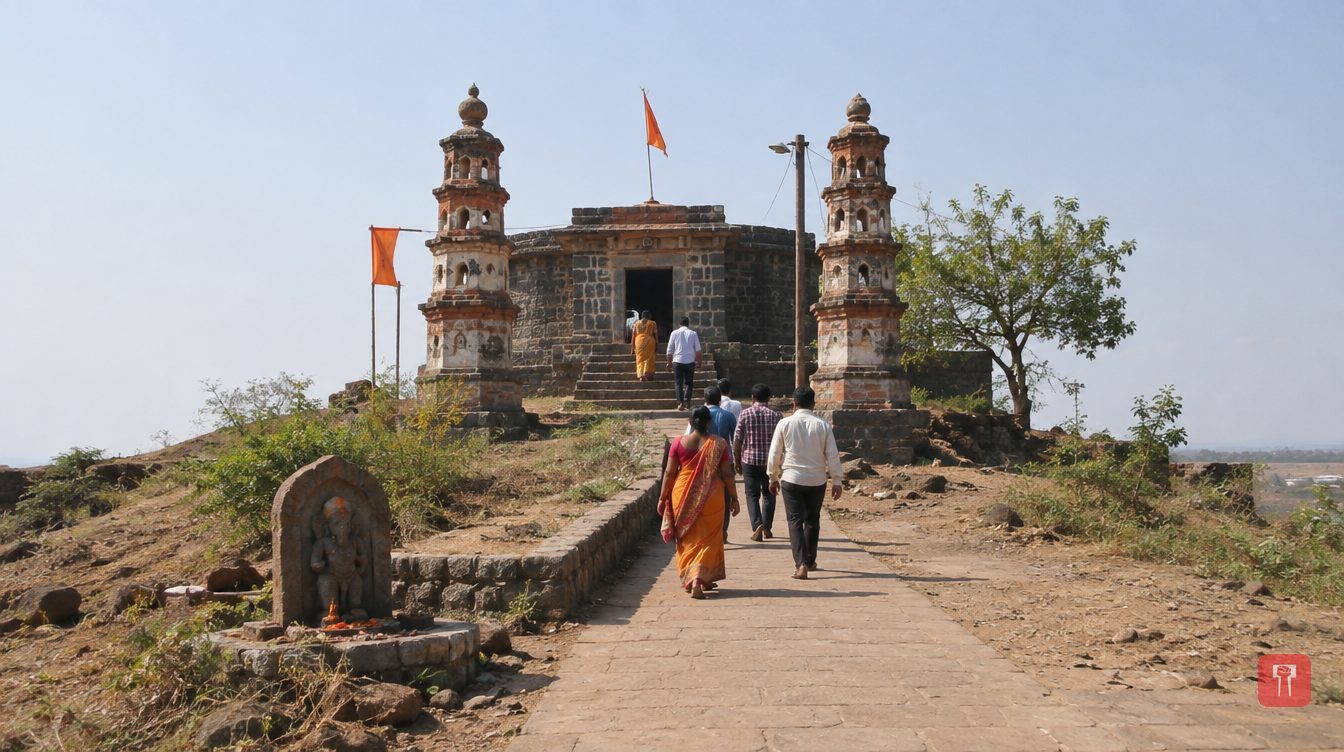
To recover the joy of earlier times, it is now suggested that people take darshan of Gugula Mata instead of Kalunka Mata. The village's limits have grown, vehicles are available and roads have been built. Along with the Maruti darshan at Pimpalner, the Gugula Devi temple on the nearby Giroli Budruk road has been restored. By the grace of Jagdamb, the late Prof Vasantrao Mule, a resident of Giroli and a professor at Deulgaon, went daily to Pimpalner and to the goddess for darshan. He set up the proposed trust, prepared the plan and tried to have the temple repaired. After retiring from Gevrai, Prof Pradeep Minase has held the post of president of the Shri Gugula Devi Sansthan Trust, Giroli Budruk, since 2012.
Gugula Mata is the family deity of many people. A large yatra is held here every year on the full moon of the month of Chaitra, on Hanuman Jayanti. Much improvement has been made here. Two lamp towers of brick and lime and a religious school of brick and lime, both three hundred years old, remain in good condition. At the foot of the Gugula Devi hill there is a stone idol of Maruti. The temple does not yet have a roof. As at the Mahalakshmi temple in Kolhapur, where the sun falls on the face of Mahalakshmi, here too the sun's rays fall on the goddess's face in February, and many people come to see this remarkable event.
On the lines of Shegaon, the trustees are developing the place selflessly with body, mind and wealth. A cow shelter named Shri Krishna Govardhan Trust Gaushala was started there in 2017, and more than 100 cows are cared for there today. Some generous villagers pay thousands of rupees every month towards fodder. Other attractions include a children's garden, Dhyanmandir Vidya Tirth, the Akhand Nandadeep festival, a vow to pull twelve carts, a Navratri homa grove, five-coloured lotus flowers, free meals, a cave temple on the hill, a newly built marriage hall and water games made from tyres. The forest wealth also draws attention, including 3 shami trees and one native apta tree. This has made it the best place to take every family's children each year for Simollanghan. Everyone is urged to use the occasion so that the old tradition begins again.
Gugula Mata, that is, Mahalakshmi Vidyadevi, is her earlier name. Param Pujya Shri Vakratund Maharaj Kavishwar described her in detail more than a hundred years ago, 120 years ago, in the story of the Sanskrit text Devalaya Gram Mahatmya, published in the Manasokta section of the Brahmanda Purana. In such a rich setting, on the day of Simollanghan, visit with your whole family to receive the auspicious blessing of unending prosperity and learning, and earn spiritual merit. Jai Jagdamba.
