

Pimpri-Chinchwad ranked Maharashtra's cleanest city in Swachh Survekshan 2025-26 for 10 lakh-plus category
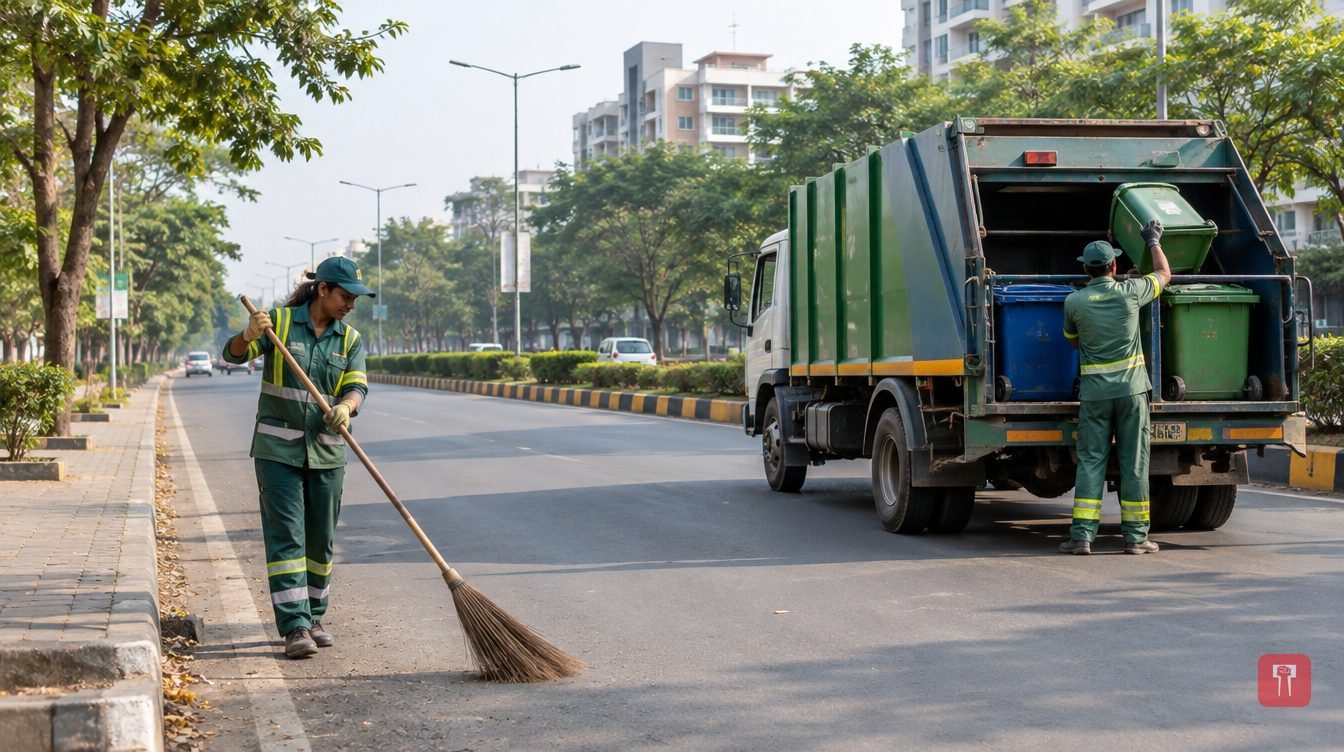 Images are not validated/verified
The Pimpri-Chinchwad Municipal Corporation took first place in Maharashtra among cities with over 10 lakh people and received a national award from President Droupadi Murmu.
The Pimpri-Chinchwad Municipal Corporation (PCMC) has secured first place in Maharashtra in the category of cities with a population of over 10 lakh in Swachh Survekshan 2025-26. This makes it the state's cleanest city in its category. The civic body was also given a national award for improving the city's cleanliness and waste management system.
President Droupadi Murmu presented the award at a ceremony at Vigyan Bhawan in New Delhi on Wednesday. Mayor Ravi Landge and Commissioner Dr Vijay Suryavanshi received it on behalf of the corporation. Additional Commissioner Kuldeep Jangam and Deputy Commissioner Dr Pradeep Thengal were also present. Union Minister for Housing and Urban Affairs Manohar Lal, Minister of State Tokhan Sahu, Secretary Satendra Singh and D Thara, along with several senior Central government officials, attended the ceremony.
The honour was given for efforts to strengthen the city's sanitation system through systematic planning, better waste management, coordination among departments, technological measures and public participation.
The corporation stressed making cleanliness a daily habit of citizens rather than limiting it to cleanliness drives. This included segregating waste at source, regular collection, scientific processing and recycling. Measures were also taken to keep public places clean. Wet, dry, sanitary and household hazardous waste is collected separately and then properly processed and disposed of.
Through Reduce, Reuse and Recycle (RRR) centres, the corporation promoted the reuse and recycling of usable household items and environment-friendly practices. Initiatives to turn waste into useful items were also run. Special attention was paid to cleanliness on roads, in gardens, in public places and around corporation facilities. Awareness campaigns were run with housing societies, non-governmental organisations and other social groups so that people dispose of waste properly.
Besides the health department, the drainage, water supply, civil engineering, electrical, environment and garden departments were also part of the effort. Their joint work helped in maintaining public infrastructure, improving civic amenities, protecting the environment and upkeep of public places. At ward level, assistant medical officers of health, chief sanitary inspectors and sanitary inspectors were responsible for planning and monitoring the work. Sanitation workers played a key role in carrying it out on the ground.
Corporation officials credited the achievement to sanitation workers, who work through the year in difficult weather to keep roads, public places and residential areas clean. According to the civic administration, their sustained effort, administrative planning and effective implementation have improved the city's cleanliness.
Public participation was also seen as an important reason for the success. Citizens were asked to segregate waste at home, not to litter public places, hand over recyclable material properly and take responsibility for cleanliness around them. The corporation worked with housing societies, voluntary organisations and social groups to make cleanliness a shared civic responsibility, so that it would not remain a service dependent only on the civic administration.
Mayor Ravi Landge said first place in Maharashtra recognises the shared effort of the city administration, sanitation workers and citizens. "Cleanliness plays a fundamental role in a city's development, and the active participation of citizens is as important as the administration's efforts. This award, won through the hard work of sanitation workers and public participation, is a matter of pride for the city. We will keep working to set higher standards of cleanliness and to retain this position," he said.
Commissioner Dr Vijay Suryavanshi said the honour reflects the positive changes in the city's sanitation system brought about by sustained efforts and systematic planning. According to him, the corporation focused on segregating waste at source, regular collection, scientific processing, recycling and cleaning of public places. Technological measures, field-level monitoring and coordination among departments were also improved.
Suryavanshi said, "The contribution of the tireless sanitation workers has been extremely important in this entire process. Their dedicated service kept the city's sanitation system running continuously. We also focused on increasing the participation of citizens, housing societies, voluntary organisations and various social groups." He also said the national award, received from President Droupadi Murmu, is an honour for the entire civic administration, the sanitation workers and every citizen who contributed to the cleanliness effort.
He said, "This award is not just a matter of pride, but also a responsibility and an inspiration to build a better sanitation system ahead. We will keep working to make Pimpri-Chinchwad a model city for cleanliness, environment protection and sustainable waste management."
Additional Commissioner Kuldeep Jangam said coordination between planning and on-ground implementation was essential to improve the city's sanitation system. He particularly pointed to the contribution of sanitation workers who keep roads, public places and residential areas clean even in difficult weather. Jangam said, "The national award recognises the hard work of every sanitation worker and the civic administration. It has given fresh inspiration to improve the city's cleanliness standards further."
Deputy Commissioner Dr Pradeep Thengal said the success of any sanitation system rests on the skill of those working on the ground and the cooperation of citizens. According to him, the health department has worked continuously to ensure proper waste segregation, timely collection, upkeep of public places and public awareness.
The civic administration said it will continue to focus on improving cleanliness standards, strengthening sustainable waste management and retaining the city's position in future cleanliness assessments.
Reach readers on the ward they actually live in.
Advertise with Prime Time 24Reach readers on the ward they actually live in.
Advertise with Prime Time 24Reach readers on the ward they actually live in.
Advertise with Prime Time 24Choose primetime24.com as a preferred source on Google Google shows more stories from your preferred sources in Top Stories.
Reach readers on the ward they actually live in.
Advertise with Prime Time 24
Comments
No comments yet. Be the first.