

Laws alone cannot free children from phone addiction; parents must lead, says writer
 Images are not validated/verified
Government rules on online safety have limits, and parents must set screen habits at home, the writer argues, as several countries move to curb children's social media use.
Noted child psychologist and psychiatrist Dr Haim Ginott once said, "Children are like wet cement. Whatever falls on them leaves a mark." The line fits childhood today. Whatever the internet and social media serve up to children, right or wrong, sinks into their impressionable minds, and its effect often sets before anyone notices.
The concern is now global. Australia has moved to keep children under 16 off social media. Several countries, including France, Denmark, Greece, Spain, Norway, Malaysia, New Zealand and the United Kingdom, have introduced or are considering a similar limit at 15 or 16 years of age.
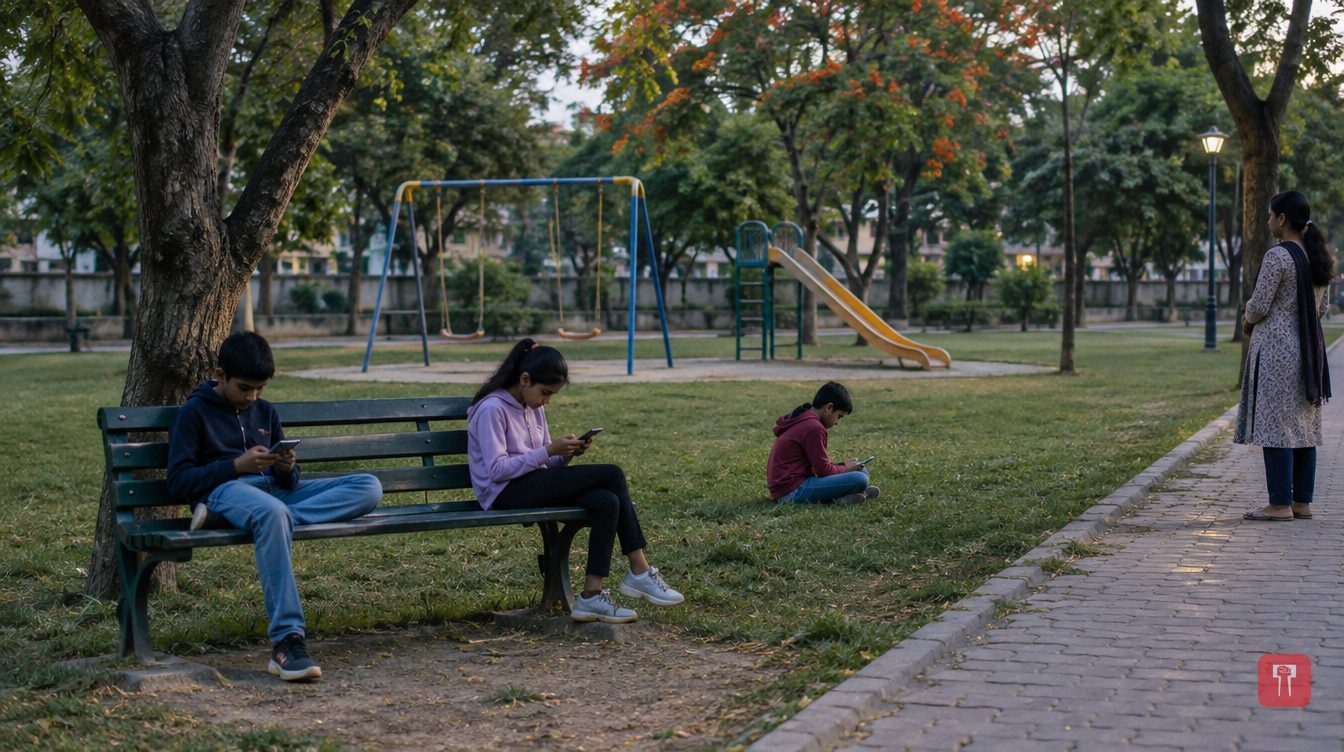
A few days ago, I took my daughter to a park in the evening. I had set aside some time to spend with her amid a busy routine. But the older children around us were not playing. Under the open sky and amid the greenery, most of them were scrolling on their phones. Even sitting in the lap of nature, they were ignoring it.
The same sight was seen in a hospital, where sick children were watching videos on mobile phones while their parents waited for their turn. Some admitted children needed a phone even to eat. The phone, once a means of talking, has become a household necessity and has made children captive. Apart from school and private classes, they get no break from screens. Many parents complain about this, yet they also regard the phone as "cheap entertainment" for keeping children busy while they finish housework or urgent work. They forget that this deepens smartphone slavery, meaning the addiction, digital dependence and loss of self-control that come from heavy use of phones and the internet.
The danger is far greater than lost playtime. Online platforms are useful for study, communication and entertainment, but they also expose children to harmful content, cyberbullying, stalking, grooming and violations of privacy. The government has acknowledged this and has taken several steps to strengthen online safety.
Under the Information Technology (Intermediary Guidelines and Digital Media Ethics Code) Rules, 2021, all intermediaries, including social media platforms, must act against unlawful and harmful content, including obscene material, material linked to child sexual abuse, or material harmful to children. They must run a system to resolve complaints within a set time, remove such content immediately on a court order or government notice, and assist law enforcement agencies.
The Digital Personal Data Protection Act, 2023 goes a step further. It requires verified parental consent before a child's personal data is processed. Tracking, behavioural monitoring and targeted advertising aimed at children are prohibited.
Awareness efforts are also under way. The Ministry of Electronics and Information Technology runs the Information Security Education and Awareness Programme on cyber hygiene. The National Commission for Protection of Child Rights has issued "Being Safe Online" guidelines and added a cyber safety section to its manual on school safety. The commission has also framed guidelines to prevent bullying and cyberbullying, and in 2024 it spoke to platforms such as Meta, Google, YouTube and Snapchat about child sexual abuse material.
Schools are involved too. The Ministry of Education's PRAGYATA guidelines recommend age-appropriate screen time and stress parental involvement, along with a balance between online activity and outdoor play.
These are welcome steps, but laws and guidelines have limits. No government rule can watch a child at the dining table, and no platform filter can replace a parent's attention. Parents must make the start themselves. Children learn what they see, and the child of a parent who scrolls even at mealtimes will do the same. Keeping phones away at mealtimes, fixed screen hours, no devices in the bedroom and outdoor play every day: these small habits make a big difference. Most important, children need conversation more than prohibition, about what they watch and why. Handing over a phone for a few moments of peace is a bargain whose real price is paid years later.
So who will free our children from smartphone slavery? The government can build the fence and schools can teach the lessons, but the key is in the parents' hands. If we do not fill children's childhood with books, games, conversation and open sky, screens will fill it, and the wet cement will set in a shape we never chose.
Reach readers on the ward they actually live in.
Advertise with Prime Time 24Reach readers on the ward they actually live in.
Advertise with Prime Time 24Reach readers on the ward they actually live in.
Advertise with Prime Time 24Choose primetime24.com as a preferred source on Google Google shows more stories from your preferred sources in Top Stories.
Reach readers on the ward they actually live in.
Advertise with Prime Time 24
Comments
No comments yet. Be the first.