

Maharashtra rolls out drug detection machines to test medicines in government hospitals in minutes
The Public Health Department has placed machines in eight divisions that give a preliminary check of medicine samples in two to three minutes, with suspect samples sent to labs.
 Images are not validated/verified
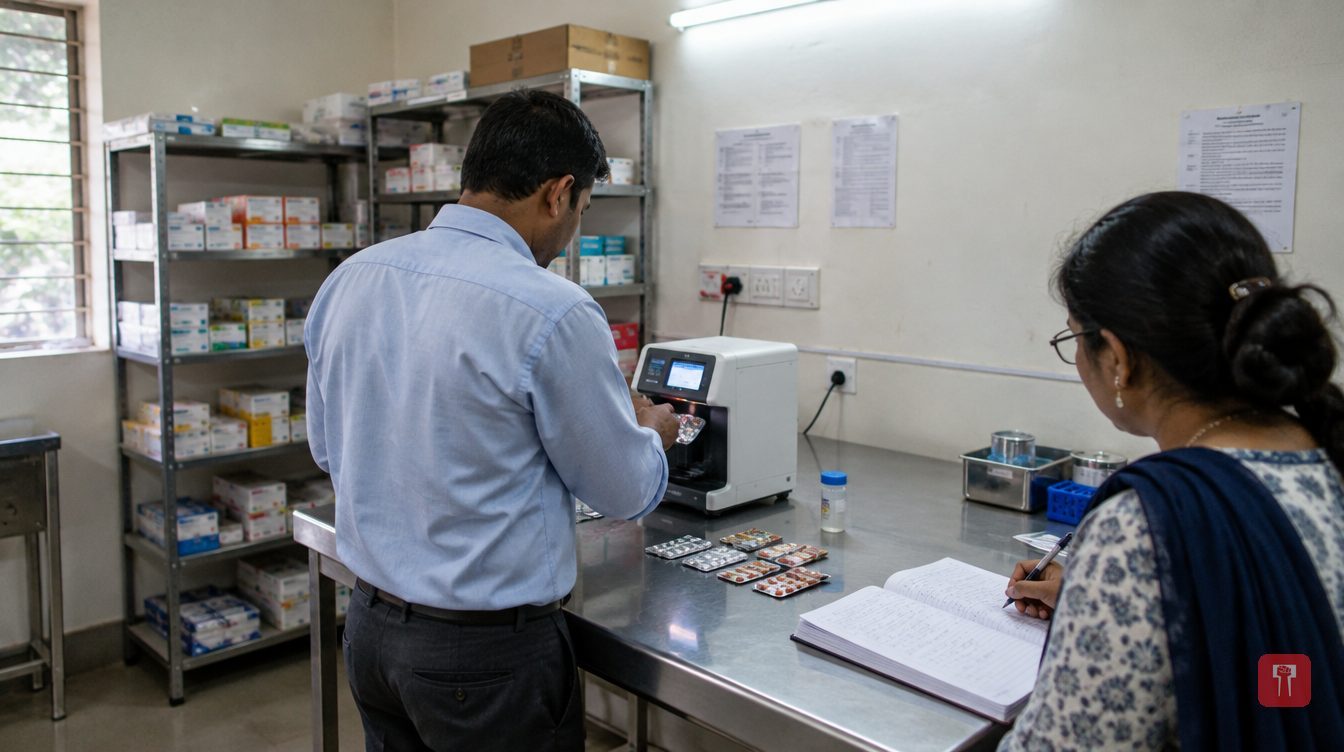
To ensure that every patient visiting government hospitals gets good and reliable medicines, the Public Health Department has begun deploying modern "drug detection machines" in the state. The machines have been delivered to eight divisions of the state. They will allow a preliminary check of medicine samples in just two to three minutes. Samples that come under suspicion will be sent on to a laboratory for further testing. Public Health Minister Prakash Abitkar said this at a press conference at Arogya Bhavan. Public Health Department Commissioner Dr Sanjay Katkar and Dr Sunil Bhokare were present. The machine was also demonstrated. It works on the Raman effect technique, named after Indian Nobel laureate scientist Sir C.V. Raman.
Until now, medicine quality was checked only when a complaint came in. Samples of medicines in government health institutions will now be tested regularly, and surprise checks will also be carried out. The main aim of the initiative is to improve quality control, transparency and accountability across the entire process, from the purchase of medicines to their reaching the hospital. Mr Abitkar said, "It is extremely important that people coming to government hospitals for treatment get good quality medicines. A system of regular and surprise checks has been put in place so that we do not depend only on complaints for medicine quality. With the help of modern technology, samples of suspect medicines can be identified in time and tested in a lab. This will allow more effective monitoring of medicine purchase and supply."
Separate teams of two members each have been formed in all eight divisions, so 16 officers in all will handle medicine testing. All the officers have been trained to operate the machine, and the teams will work under the guidance of the commissioner. Every month, the teams will collect medicine samples at random and test them. These will include medicines from district hospitals, women's hospitals and other health institutions under the Public Health Department. Medicines supplied through the medical goods procurement authority, those received through district-level arrangements, and those bought with local funds or through local purchase will also be tested. One machine costs about Rs 1.20 crore. Because it gives a preliminary report quickly, medicines from different health institutions can be tested faster.
The machine's test is only a preliminary one. If a sample shows a negative or suspect result, it will be recorded and the sample sent to an outside laboratory recognised by the government. According to the department, the state has 12 recognised labs for this testing. The report will arrive about eight days after the sample is sent. Any difference between the medicine samples submitted in tenders and the medicines actually supplied can also be caught by this test. If the lab test finds poor quality, spuriousness or anything in violation of rules, further action will be taken under existing rules. Although the Food and Drug Administration is responsible for regulatory action on medicines, the Public Health Department will pass on information about suspect samples to it and follow up for the necessary action. For now, the testing will be limited to medicines bought for hospitals of the Public Health Department. Matters relating to private hospitals fall under the Food and Drug Administration.
The department said the equipment in this system is made by Thermo Scientific, and that regulatory agencies in various countries use such equipment to test medicines and catch counterfeit ones. It said such equipment is in use in about 50 countries, including the United States, Britain, Germany, Switzerland, Nigeria, Kenya, the United Arab Emirates and Saudi Arabia.
An Arogya Samvad Yatra has also been started to bring the state's health services closer to people and improve them. People at village and settlement level will be spoken to, to find out how much benefit government health services actually deliver, what the gaps in existing facilities are and which improvements are needed. There is a plan to develop about 1,970 primary health centres and 10,846 sub-centres in the state. The effort is to provide essential health services there, including medicines, injections and day-care facilities.
To increase staff in the health system, there is a plan to hand appointment letters to 1,440 doctors together at Yashwantrao Chavan Pratishthan on November 4. In addition, the process of appointing 1,900 community health officers is under way, and appointment letters are expected to be given within eight to 15 days after the examination process is completed. These appointments will strengthen health services in remote, tribal, Konkan and rural areas. Considering the demands of health workers, a decision has also been taken to absorb 15,000 employees against additional posts. On August 15, 125 health institutions were inaugurated, and another 125 are to be inaugurated.
Health services will be reviewed regularly through Arogyavardhini committees formed by taluka and Assembly constituency. MLAs are to inspect health facilities every three months, while a review at the ministry level every six months will decide the necessary improvements. Work is also under way to connect village-level Jan Arogya committees, water supply and sanitation committees, and committees linked to various health institutions online. This will let people register complaints about problems with health services. The target this year is to enrol 10 lakh Jan Arogya committee members, and according to the department about 6.5 to 7 lakh members have joined so far.
There is a plan to include the costly PET scan facility in the Mahatma Phule Jan Arogya Yojana, and the health minister made it clear that hospitals must not charge patients any money for this facility. Action has already been taken against those who committed irregularities in implementing the scheme. Work is also under way to set up an e-Nine system to increase transparency in the department's functioning, including medicine procurement. The emphasis is on making government health services more accountable by coordinating medicine quality, the infrastructure of health institutions, the availability of doctors and health workers, and technology-aided monitoring. Mr Abitkar said the department is implementing several measures so that people get good treatment, out-of-pocket spending on health falls, and trust in the government health system grows stronger.

Comments
No comments yet. Be the first.