

Nagpur groundwater level falls, Kamptee and Parseoni worst hit; Zilla Parishad issues 11-point plan
Nagpur Zilla Parishad has drawn up an 11-point action plan for gram panchayats as groundwater levels fell across the district's talukas.
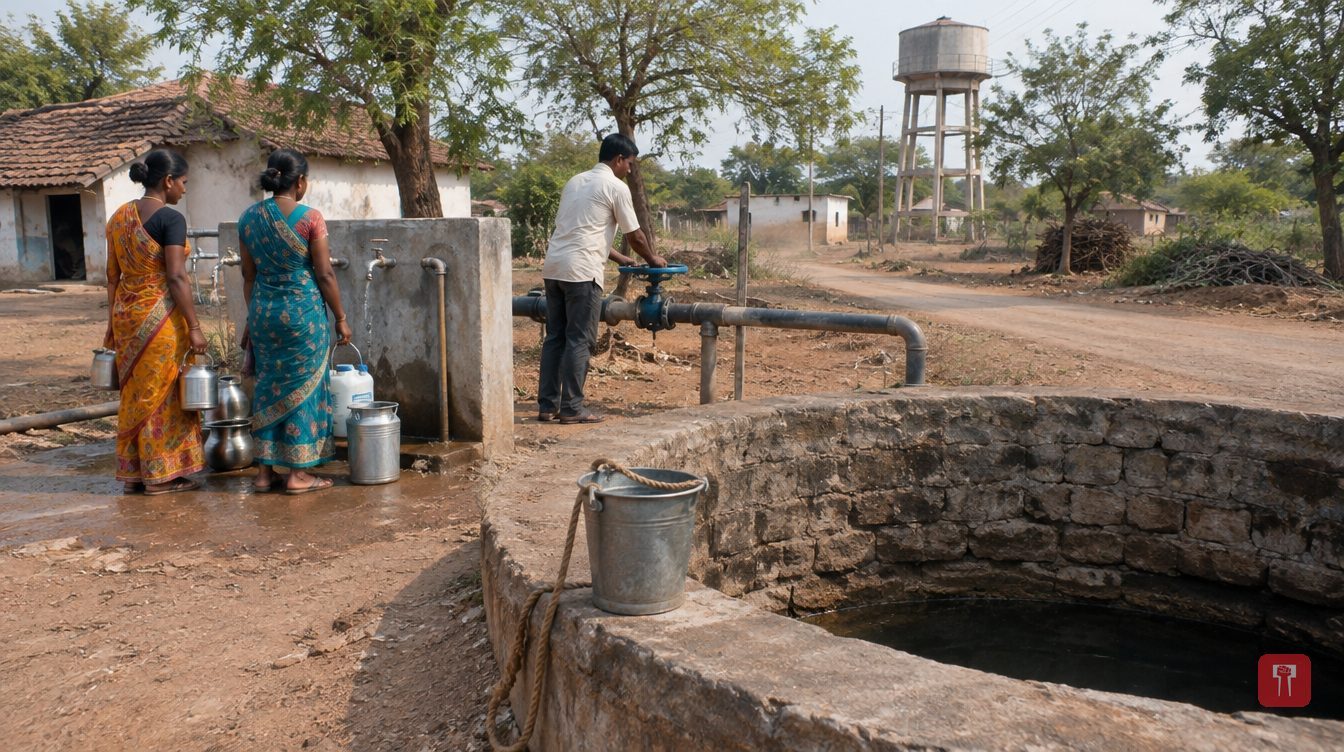 Images are not validated/verified
Drought is intensifying by the day in most districts of the state. To deal with possible water scarcity in Nagpur district too, Nagpur Zilla Parishad has prepared an 11-point action plan for gram panchayats. The plan stresses proper planning of water supply, a review of available water sources, stopping leakages and raising public awareness about saving water.
Meanwhile, groundwater levels in the district have fallen sharply. According to taluka-wise figures, levels have dropped significantly in many talukas. When the groundwater level in September 2026 was compared with the average of the previous five years, the biggest fall was recorded in Kamptee and Parseoni talukas. This has raised concern about water scarcity in the coming period.
According to the available table, the fall is 1.49 metres in Kamptee taluka and 1.02 metres in Parseoni taluka. It is 1.44 metres in Hingna taluka, 1.16 metres each in Narkhed and Saoner talukas, and 1.52 metres in Nagpur taluka. Government figures also show that levels in Ramtek, Katol, Kalmeshwar, Mauda, Umred, Kuhi and Bhiwapur talukas are below the average of the previous five years. The change could affect agriculture, the availability of drinking water and the water levels in wells.
All gram panchayats in the district have been instructed to collect the current state of water supply in their areas and plan the village's water sources. Village-wise water sources, water supply schemes, water stocks, the likelihood of scarcity and possible difficulties are to be reviewed. Each gram panchayat is to fix a proper water supply schedule and supply water accordingly. Directions have also been given to find leaks in water supply pipelines, public taps, valves and water tanks and repair them immediately. This is expected to help prevent wastage of water. Because of the scarcity, gram panchayats have also been told to supply water on alternate days.
To spread the importance of saving water, awareness is to be raised with the participation of gram sabhas, women's self-help groups, schools and local residents. The directions say that fitting a tap on the tap line of every household should be made mandatory and that action, including fines, should be taken against those who break the rules. Plans are to be made to reuse, wherever possible, the water that comes out of RO systems in a proper and safe manner. In villages where scarcity is likely, the emphasis is on taking measures in advance and preparing an action plan for relief from scarcity.
Measures are to be reviewed regularly and a compliance report submitted to the concerned office. For this, instructions have been given to hold a meeting of the block development officer, sarpanch, gram sevak, water supply and sanitation committee, water security guards, police patil and the concerned government employees at the gram panchayat level, and to coordinate. Directions have also been given to prepare a standard operating procedure (SOP) covering all these measures and communicate it to all gram panchayats. The main aim of the plan is to anticipate a possible crisis and plan ahead, and to give citizens a regular water supply, rather than act after scarcity arises.
Rainfall, its geographical distribution, groundwater recharge and rising extraction of water are the key factors behind the fall in groundwater levels. To check the decline, it is therefore necessary to let rainwater percolate into the ground, speed up water conservation works and use groundwater sparingly. Based on these figures, Nagpur Zilla Parishad has issued guidelines to avoid possible water scarcity, after assessing the situation taluka by taluka.
