

Nagpur autos block junctions and lanes, raising questions over smart city claims
Auto-rickshaws crowd junctions from Sitabuldi to Itwari, and citizens are asking who will fix stands, pickup points and enforcement.
 Images are not validated/verified
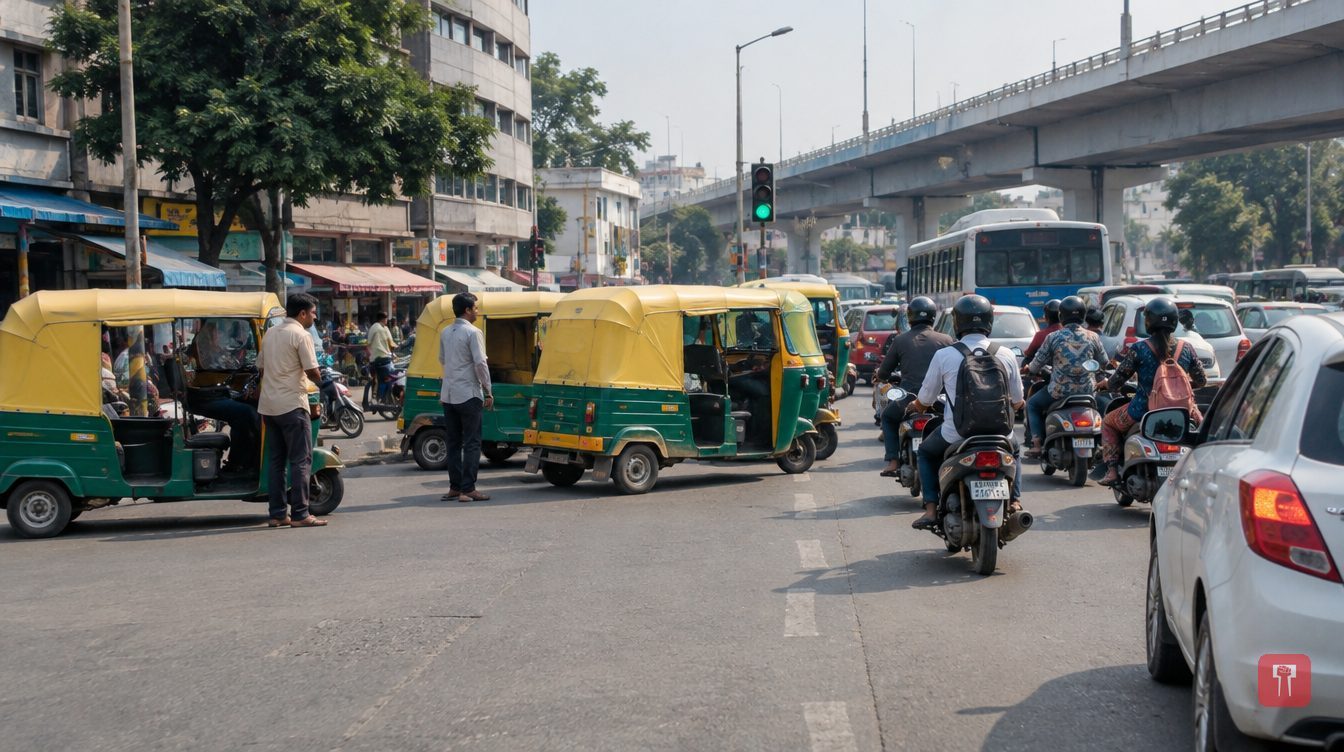
Talk of Nagpur becoming a smart city continues, but the arbitrary conduct of auto-rickshaws on the roads goes on as before. At some junctions autos have taken over the space, elsewhere they compete to pick up passengers in the middle of the road, and elsewhere they stand blocking a lane. From Sitabuldi to Itwari and from Mahal to Medical Square, the same scene is visible, exposing the weaknesses of the traffic system.
People are asking whether the authorities that spend crores of rupees on roads and flyovers do not even have official stands for autos. If stands exist, they ask, why are illegal auto stands allowed to operate on the roads? The issue is not the presence of autos but their unchecked arbitrariness and the laxity of the administration.
Autos and e-rickshaws are an important part of public transport. Their role in taking passengers from home to the main road, the market and the station cannot be denied. But in the name of convenience, they cannot be allowed to occupy the road.
Because official stands and designated pickup points are insufficient, drivers park wherever it suits them. The responsibilities of the Nagpur Municipal Corporation, the transport department and the traffic police also need to be fixed. Who will assess how many stands are needed? Who will decide the locations? Who will enforce the rules? Until these questions are answered, it is futile to expect the disorder at junctions to end.
In busy areas including Sitabuldi, Itwari, Mahal, Medical Square, Cotton Market, Sir Road, Chhatrapati Square, Manewada, Shatabdi Square, Tukdoji Putla, Sakkardara, Nandanvan and Rani Jhansi Square, auto drivers park as they please and pick up passengers. Braking suddenly at junction mouths, stopping in the middle of the road and blocking a lane slow the traffic. Vehicles remain stuck even after the signal turns green, and queues build up in no time.
Whether the road is public or a private stand for auto drivers is a question for citizens who are caught in traffic jams every day. Taking action against those who break the rules is the traffic police's responsibility. But the arbitrariness seen on the road raises questions about how effective that action is.
As the number of autos and e-rickshaws in Nagpur rises, the challenge of traffic control has also grown. Driving the wrong way, cutting in suddenly, dropping and boarding passengers at junctions and carrying more passengers than capacity increase the risk of accidents. Drivers also get into disputes in the race for passengers.
Two-wheeler riders and pedestrians bear the brunt. Especially at busy junctions, autos that stop suddenly are a hazard for vehicles coming from behind. How traffic discipline can be maintained without regular monitoring is also a question.
A smart city is not defined only by cement roads and the height of flyovers, but also by the traffic system on its roads. If auto arbitrariness at every junction and jams on every route have become a daily trouble for citizens, questions about claims of development are inevitable.

Comments
No comments yet. Be the first.