

Learning Japanese can open career doors, says language expert Priyanka Saitavadekar
Priyanka Saitavadekar, who began learning Japanese during her Class 12 holidays, explains how to pick a foreign language and build a career with it.
 Images are not validated/verified
Everyone today wants to do something different in their career. The question is whether learning a foreign language can give a career a new direction. Young people are increasingly drawn to languages such as Japanese, German, French and Korean. Japanese language expert Priyanka Saitavadekar answered questions on where to begin, which language to choose and what job opportunities it can bring.
Priyanka began learning Japanese casually during her Class 12 holidays and later gave her career a new direction through it. At the start she had no big career plan. After her Class 12 examinations ended, she and a friend decided to learn something new during the holidays. They went to a language training institute that offered German and Japanese. Without thinking much, they chose different languages: the friend took German and Priyanka took Japanese. The idea was that after finishing the basic course, each would teach the other her language. Her interest in Japanese kept growing. What began only as a pastime proved important in her life.
Many people believe Japanese is extremely difficult. According to Priyanka, some features of Japanese grammar may be useful for Marathi speakers. The two languages are somewhat similar in how sentences are built, so Marathi speakers may find Japanese sentence structure relatively easy to grasp. As an example, she said "Watashi wa Priyanka desu" means "I am Priyanka", and "Watashi wa sensei desu" means "I am a teacher".
Japanese has no articles such as "a", "an" and "the", as English does. Many nouns also have no grammatical gender. For this reason, early study can seem easy. However, regular practice is necessary to learn the writing system, vocabulary and the rules of honorific language.
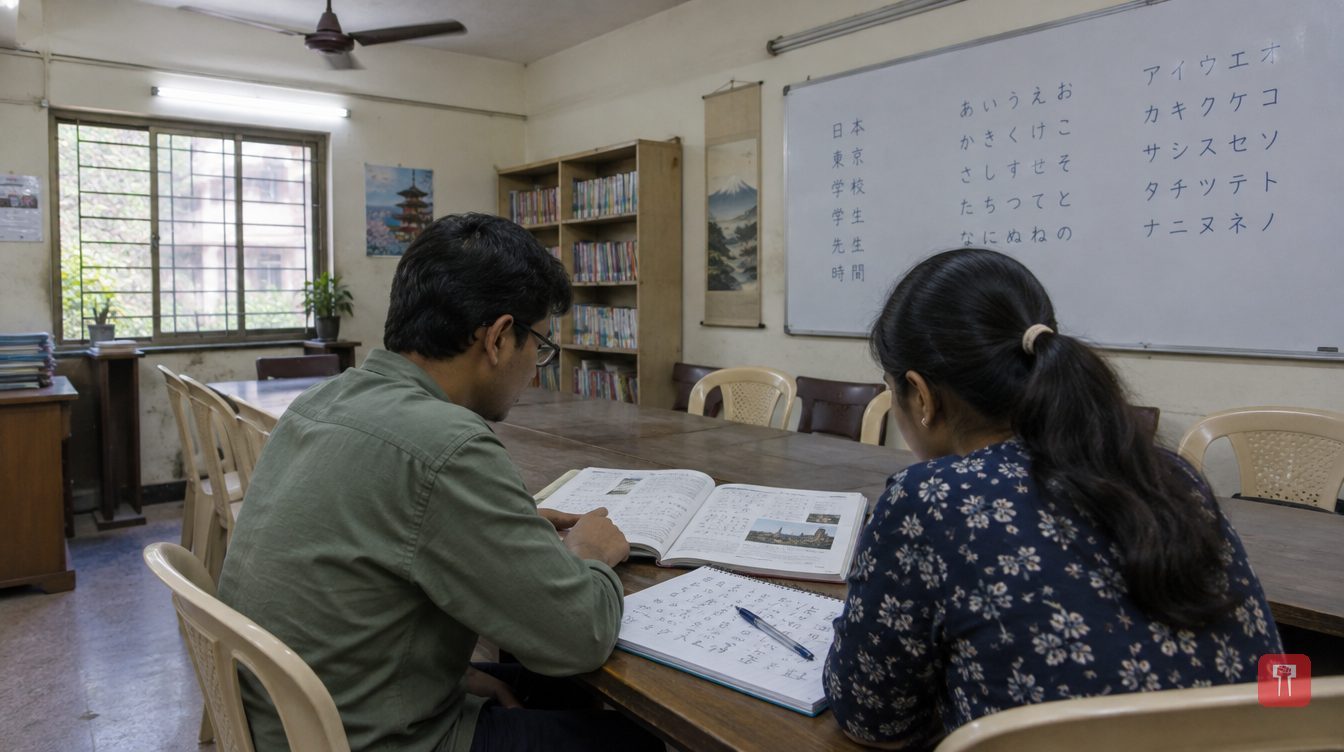
Japanese has three main scripts: kanji, hiragana and katakana. Kanji uses characters that carry meaning. Hiragana is used to write Japanese words and parts of grammar, while katakana is mostly used for words borrowed from other languages and for foreign names. The three scripts may seem hard at first, but Priyanka said studying them is interesting.
Priyanka made clear that rather than stopping at learning a language, it can be more beneficial to add knowledge of a foreign language to one's main field of study. For example, a student who has studied IT or engineering and also knows Japanese may find work with Japanese companies. In Japan there is work in many fields, including technology, automobiles, information technology, digital marketing and animation. Candidates who know the language may also have an advantage with Japanese companies operating in India. A foreign language can be useful in translation, document translation, business communication and various project work.
Many students are troubled by which language to learn: Japanese, German, Korean, French or Spanish. According to Priyanka, one should first consider one's field of study, interests and career goal. For those building careers in IT and automobiles, Japanese or German can be useful. Korean can be an option for those interested in entertainment, digital content, television serials and translation. Students interested in art, literature and culture may benefit from learning French. Her advice was not to learn a language merely because it is in demand, but to choose according to one's interest and professional needs.
The Japanese Language Proficiency Test (JLPT) is considered important for assessing knowledge of Japanese. It has five levels. N5 is the elementary level, N4 is the next level of basic knowledge, N3 is intermediate, N2 is advanced and N1 is the most advanced. Priyanka said students should study according to their ability and career goals, and that learning Japanese requires constant practice and actual use of the language.
Japanese anime and the entertainment world inspire many young people to learn the language. But Priyanka said the language of anime differs from the Japanese spoken in the workplace. Anime often features colloquial words, distinctive styles of speech and short sentences, while in office work polite and formal language is valued. Japanese has a respectful style called "keigo". Watching anime can help build vocabulary, but studying standard language and formal speech is also necessary for business communication.
The growing use of artificial intelligence (AI) is bringing big changes to translation. The time once needed to translate a document has now been reduced by AI tools. Priyanka said she uses AI in her own work and acknowledged that it brings speed and convenience to translation. In her view, as the use of technology grows, it may be important to combine language knowledge with other professional skills. She advised not limiting oneself to translation, but building knowledge of a foreign language alongside the skills of one's core field.
Consistency is very important when learning any foreign language. Marathi, Hindi or English are spoken daily, so they are remembered easily. But if a foreign language such as Japanese is not used regularly, there is a risk of forgetting the words and sentence structure learned. So even after finishing a course, it is necessary to stay connected to the language through reading, listening, conversation and real work, Priyanka said.
Priyanka's message for young people was that one need not go to a country to learn its language. Even while living in India, one can look for career opportunities through the language, and options to work with foreign companies may also open up. If a language matching one's studies, skills and interests is chosen, new career paths can open. Her journey shows that a decision taken casually during the Class 12 holidays can give life a different direction.
