

Alapalli event on Ambedkar's Dhamma revolution stresses education, equality and social service
At a Varshavas discourse at Sanghamitra Buddha Vihar in Alapalli, Suryabhan Dongre said the Dhamma revolution must be taken to society's grassroots.
 Images are not validated/verified
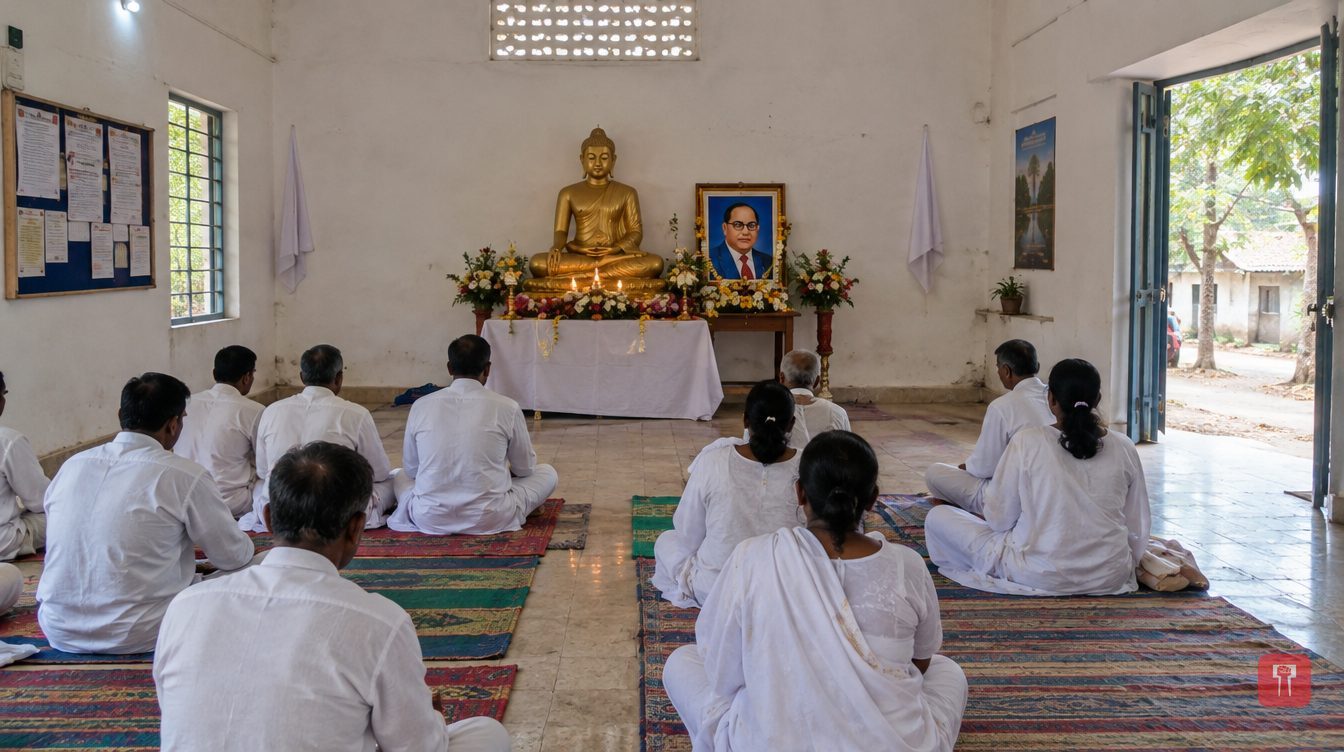
The 18th programme in the Varshavas discourse series was held with great enthusiasm at the Sanghamitra Buddha Vihar in Alapalli, marking Ashoka Vijayadashami and Dhammachakra Pravartan Din. At the programme on Tuesday, October 20, Suryabhan Dongre spoke on the topic "How can Dr Babasaheb Ambedkar's Dhamma revolution be made more dynamic?"
Dongre said that to take the idea of the Dhamma revolution to the grassroots of society, broad change was needed with the help of education, wisdom, equality, fraternity, moral conduct and social service.
The programme was organised jointly by the Bharatiya Bauddha Mahasabha and various social organisations. These included the Dr Babasaheb Ambedkar Smarak Samiti Alapalli, the Bharatiya Bauddha Mahasabha Gadchiroli (South, North), the Mahila Samiti Alapalli, the Bharatiya Bauddha Mahasabha taluka branch Aheri, the Mahamaya Mahila Mandal Alapalli and the Bahuuddeshiya Mahila Mandal Alapalli. There was a detailed discussion on the history of the Dhamma revolution, Buddhist philosophy, today's social challenges and what needs to be done to spread the Dhamma.
The programme began with Buddha Vandana, taking of the Trisharan and Panchasheel, Bhim Smaran and the discourse. B. M. Durgam Sir conducted the proceedings. It concluded with the performance of Bhim songs and a vote of thanks. Buddhist devotees, men and women, from Alapalli and the Aheri area attended in large numbers. Amid slogans of "Namo Buddhay! Jai Bhim!", the message was given that the idea of the Dhamma revolution should reach everyone in society.
It was also said at the event that Babasaheb's ideas should not be confined to jayanti celebrations, festivals or programmes, and that it is important to uphold social commitment in keeping with his philosophy.
Dongre said that by embracing Buddhism, Dr Babasaheb Ambedkar showed Indian society a new path of equality, freedom, fraternity and humanity. This Dhamma revolution, he said, is not merely a religious conversion. It is a broad process that changes a person's thinking, conduct and social relations. Its basic aim is to remove inequality in society, encourage rational thinking and secure for everyone the right to live with dignity. He therefore made it clear that the philosophy of the Dhamma should be put into practice in real life and not left in discourses alone.
Citing "The Buddha and His Dhamma", written by Dr Babasaheb Ambedkar, Dongre explained how the Buddha's philosophy benefits society. The Buddha's Dhamma rests on reason, wisdom, compassion and moral conduct, he said, and he underlined that society should therefore adopt a scientific outlook and stay away from superstition and harmful practices. He also said that carrying this transformative thinking to the new generation is the need of the hour.
Saying that society should make collective efforts to give the Dhamma revolution a wider form, Dongre put forward several points: giving priority to education and building the capacity for critical thinking in the new generation; involving youth in social work by giving them the idea of the Dhamma; securing education, equal opportunity and social standing for women; raising public awareness to eradicate superstition; removing caste inequality and building a society based on equality and fraternity; following the moral values of the Buddha's teaching in daily life; working in an organised manner to solve the problems of deprived sections; and spreading the Buddha's humanist thought at various levels, including globally.
The programme also referred to Yashwant Manohar's thesis "Why did Dr Babasaheb Ambedkar reject Vipassana?" and to ideas from "Who Were the Untouchables?" and "The Buddha and Karl Marx". These prompted discussion on social inequality, the history of untouchability, Buddhist thought and a transformative outlook.

Comments
No comments yet. Be the first.