

Diwali firecrackers worsen air quality as gap between faith and action widens
 Images are not validated/verified
Despite warnings from environmentalists, data from authorities and strict court directions, the harm from Diwali fireworks continues, and the commentary calls for firm action by institutions.
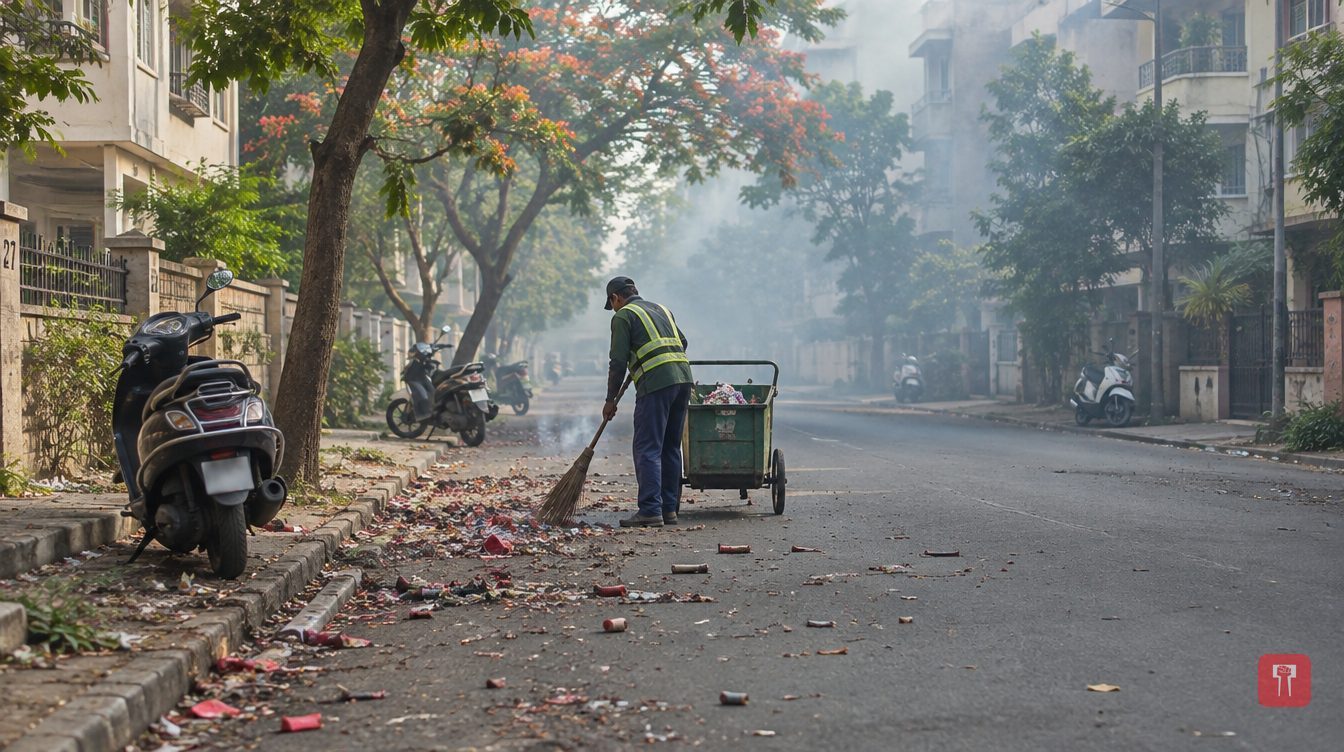
Diwali has long been regarded as a festival of light, joy and spiritual renewal, but its form has changed in a way that deeply troubles many. In an atmosphere already burdened by pollution, the extra smoke from firecrackers during the festival pushes the Air Quality Index (AQI) lower still. This is not the case only in the capital, Delhi, but in countless cities across the country. What was once an emergency lasting a few days has become a routine and unavoidable occurrence. The air we breathe has become a secondary concern before a spectacle of light and noise that lasts a moment.
This has happened despite a clamour of warnings. Environmentalists gave data, the administration released records and the courts issued strict directions. Yet the effect shows neither in the collective understanding of the public nor in the conscience of those in power. There is a deep gulf between the urgency of the scientific facts and the resolve needed to stop the unchecked use of toxic firecrackers. That the problem persists points to a failure of political will, where firm steps are sacrificed at the altar of public convenience.
The most striking thing is the irony around bursting crackers. Any proposal for a reasonable restriction on loud and highly polluting fireworks is often quickly labelled "anti-Hindu". That argument is doubtful on the test of both history and logic. The uncomfortable but necessary question is whether filling the air with toxic smoke was ever a core rule of tradition in celebrating Lord Ram's return to Ayodhya. The association of firecrackers with Diwali is relatively recent, yet it has been turned into a weapon to shut down conversation about the health of the environment.
The irony extends to political debate, where sensitivity to the environment is often viewed through the narrow lens of identity. The incident in Mumbai cannot be forgotten, in which a political leader strongly opposed a film actor's appeal to celebrate the festival thoughtfully and with awareness. The objection did not appear to rest on protecting tradition, but on the fact that the person making the appeal was not a Hindu. The reaction shows a worrying trend: the protection of the environment is being politicised and held hostage to petty communal signals, when it should be treated as a priority for shared survival.
This hypocrisy is not limited to fireworks. There is a deep contradiction in our relationship with nature. We call rivers sacred, yet turn them into drains for the city's sewage. We regard mountains as the abode of gods, yet dig them up, seeing them as stores of mineral wealth. We worship trees, yet in the name of "infrastructure development" we approve the felling of forests in an instant.
The ecological price of such "development" is often heavy. The dispute over the felling of trees for the metro car shed in Mumbai's Aarey Colony shows the tussle between urban expansion and saving the city's green lungs. In the Himalayas, the ambitious Char Dham road project was meant to improve connectivity, but environmentalists have sharply criticised it for large-scale landslides, the clearing of old forests and the threat to the fragile ecology of the hill terrain. One thing emerges from these examples: development is pursued without regard for long-term ecological consequences, as if the land were an endless resource.
It is now clear that we have learnt to live with these contradictory beliefs. We worship, perform rituals and express deep reverence for nature, yet destroy the very things we claim to honour. We have built a society in which the distance between faith and action is an everyday ordinary matter.
The most important question, nevertheless, is whether this vast and growing monster of toxic air will let us continue this dance of contradiction. Diwali is a small picture of this dilemma. Firecrackers offer an instantly visible, momentary spectacle, but their cost to health lasts long and keeps accumulating. Smog does not discriminate; it affects everyone. The worst blow falls on the most vulnerable: children whose lungs are still growing, the elderly and those already struggling with chronic respiratory illnesses.
Importantly, those who enjoy the firecracker spectacle most often do not have to bear the heaviest physical consequences. That is why individual understanding and personal choice, important as they are, cannot be the final answer to protecting the environment. A systemic problem of this scale cannot be tackled by individuals changing alone. What is needed is firm resolve from institutions. It is the responsibility of the state, the judiciary and the executive to place the right to breathe clean air above the fleeting appeal of habits that appear linked to tradition. Festivals can be hoped to turn away from ecological destruction towards their true spirit of life and light only when the action of institutions is strong, enforceable and unwavering.
Reach readers on the ward they actually live in.
Advertise with Prime Time 24Reach readers on the ward they actually live in.
Advertise with Prime Time 24Reach readers on the ward they actually live in.
Advertise with Prime Time 24Choose primetime24.com as a preferred source on Google Google shows more stories from your preferred sources in Top Stories.
Reach readers on the ward they actually live in.
Advertise with Prime Time 24
Comments
No comments yet. Be the first.