

93 of world's 100 most polluted cities on Monday were Indian as Diwali firecrackers worsened air
 Images are not validated/verified
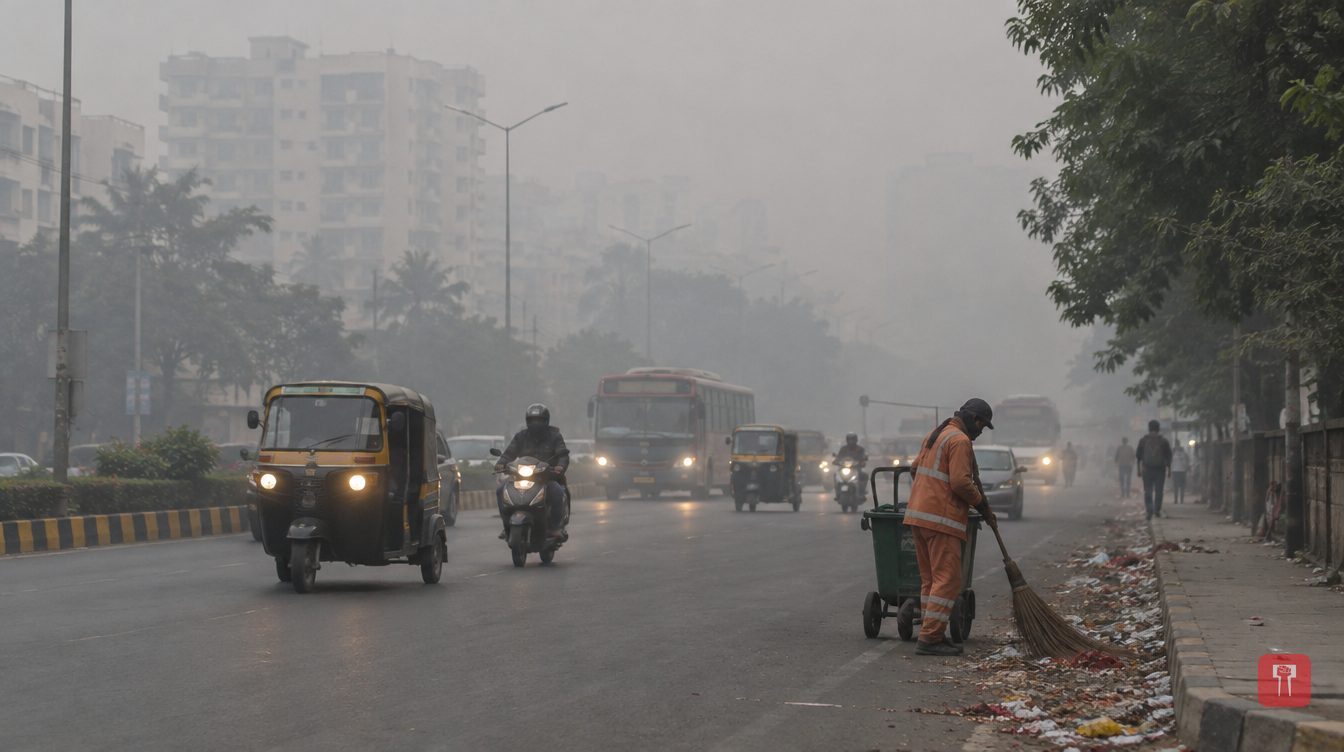
Smoke from Diwali firecrackers pushed air quality sharply down in Delhi and many other cities, with most falling in the 'very poor' category.
Pollution remained serious across the country on Diwali. Smoke from firecrackers sharply worsened air quality in several cities, including the capital, Delhi. In the global AQI ranking on Monday, 93 of the world's 100 most polluted cities were in India. In most cities, the air reached the 'very poor' category.
In Maharashtra, Nagpur was the state's most polluted city on Sunday, with an average AQI of 217. On Monday, Pimpri-Chinchwad took that place, with air quality recorded at 303. Pune came next, with an AQI of 294.
In Mumbai, the average AQI was 172, which falls in the 'poor' category. However, in several suburbs the figure ranged between 200 and 250.
Pune's air reached the 'very poor' category during Diwali. A haze-like pall was visible across the city, while Pimpri-Chinchwad recorded the highest pollution. The air was recorded at three times worse than the standard set by the pollution control board.
The effect of firecrackers was also seen in the Konkan. Air quality worsened in Ratnagiri district. After firecrackers were set off at midnight, the AQI had climbed to 347. It reached 347 at 3.30 am on November 8, a jump from 76 straight to 347. Levels of PM2.5, the extremely fine particles that float in the air, were high. But once the air cleared, the AQI fell back to 89. Air quality in Ratnagiri district is usually around 70 AQI. Winds from the sea quickly blew away the firecracker smoke. The district's air remained polluted by firecrackers for only a few hours. The AQI was poor at night, but the air cleared again after morning. It has emerged that air pollution was widespread over the past two days.
During Diwali two years ago, pollution levels were very poor in 14 cities of the country. This emerged in a study based on ground-based air pollution monitoring stations, satellite data and weather data. According to it, the air contained extremely fine and toxic particles after firecrackers were burst. These are invisible to the eye, yet are more likely to enter the body through breathing. At that time, the amount of harmful particles such as PM2.5 and PM10 in those 14 cities was found to be 3 to 10 times above the permitted limit. In some cities during Diwali, the amount was a further 19 per cent higher.
Reach readers on the ward they actually live in.
Advertise with Prime Time 24Reach readers on the ward they actually live in.
Advertise with Prime Time 24Reach readers on the ward they actually live in.
Advertise with Prime Time 24Choose primetime24.com as a preferred source on Google Google shows more stories from your preferred sources in Top Stories.
Reach readers on the ward they actually live in.
Advertise with Prime Time 24
Comments
No comments yet. Be the first.