

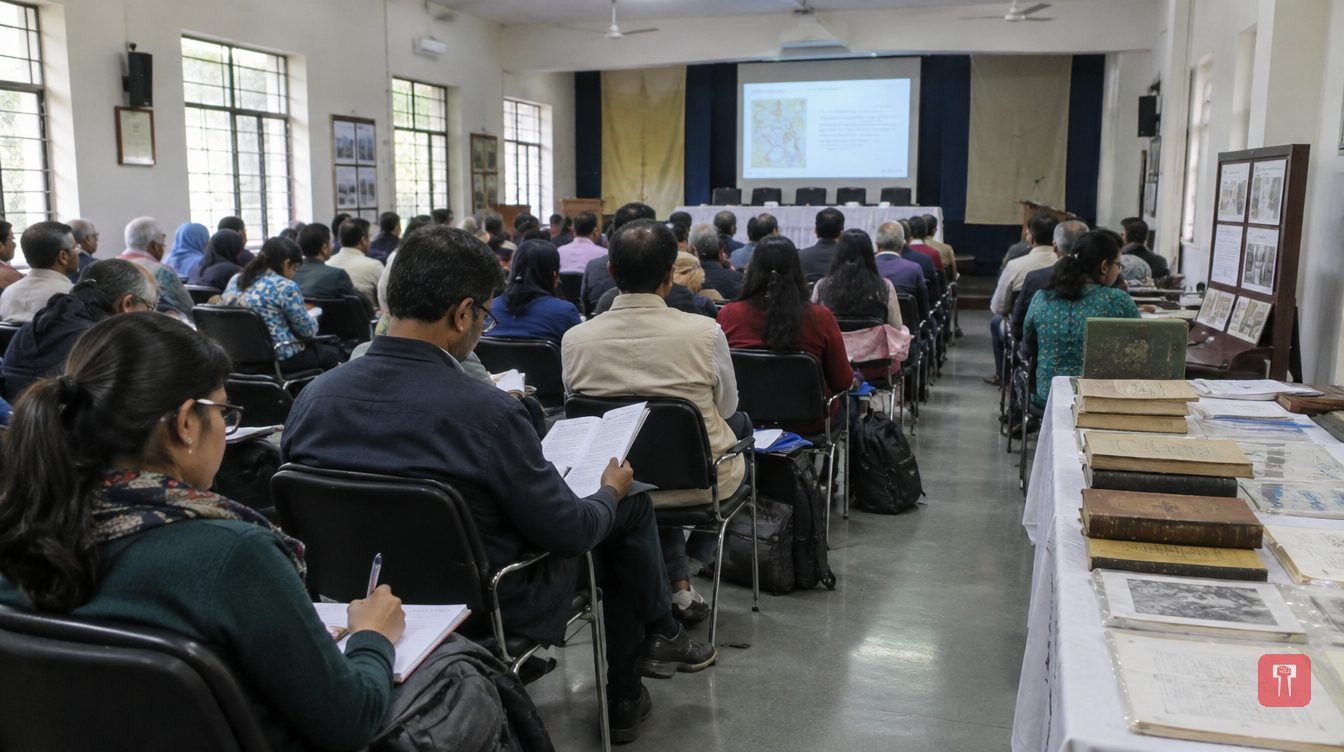
Two-day Bhopal History Conference begins at Saifia College, stresses evidence-based history
 Images are not validated/verified
Historians and academics at the two-day conference in Bhopal said history must be written on documents, archaeological evidence and impartial research, not one community's or ideology's view.
A two-day Bhopal History Conference began at Saifia College in Bhopal on Saturday. Historians, academics and intellectuals gathered for it. They raised questions about the writing of Indian history, the authenticity of historical sources and the changing interpretations of history today.
Speakers said history should be written not from the viewpoint of any one community or ideology, but on the basis of documents, archaeological evidence and impartial research. Concern was also expressed over the distortion of historical events through social media, films and reels.
Conference convener Farogh Jami said it was necessary to bring out those aspects of nearly a thousand years of the country's history that have not received enough space. According to him, historical writing has so far depended heavily on Persian sources. He said the periodisation of history and the interpretations of the medieval period should also be reconsidered afresh. Subjects such as the destruction of Nalanda University need to be understood through a comparative study of different historical sources. Jami said that instead of confining medieval history to conflict and confrontation, the social, educational and cultural contributions of that era should also be brought out.
Speaker Athar Habib said that knowing its history is essential for any country's progress. According to him, history is not merely an account of past events but the collective memory of a society. A society that forgets its history sees its identity weaken gradually. He said India's distinctive strength is its diversity. Despite the arrival of different religions and cultures, the refinement and traditions of many communities exist even today, and this diversity can become India's example to the world.
Shadab Moosa, national convener of the Indian History Forum, said the debate over Indian history is tied to the country's future. He said that in 2024 it was decided, together with historians, to set objective criteria especially for medieval history. He said that today incomplete facts and imaginings are presented as history even in WhatsApp forwards, social media reels and film trailers. He also expressed concern over the removal of some history topics from NCERT textbooks.
Moosa said it is dangerous to build notions based on hatred and communalism in the minds of the younger generation. He cited the participation of people of different religions in the 1857 war of independence and said the contribution of the Muslim community has not received enough space. According to him, it is necessary to close the gap between the knowledge held in research and academic institutions and the history that reaches the general public.
Dr Hameed Beg said history is a trust that must be handed to the next generation without discrimination or prejudice. He asked why different narratives of history are created and what motives work behind them. According to him, attempts are often made to impose a particular ideology on society to maintain power and dominance. Beg said bringing out the contribution of every section, including the Muslim community, to the country's development is a collective responsibility. Children should learn about their ancestors' contributions so that they can become partners in the country's progress with a positive outlook. He also said that renaming cities, roads and buildings, or trying to erase historical buildings, cannot be a measure of development.
Speakers at the conference stressed that written documents, archaeological evidence, literary sources and independent research should be the basis for evaluating history. The aim of the two-day conference is to examine prevailing notions about history against facts and to carry forward academic dialogue on India's shared cultural heritage.
Reach readers on the ward they actually live in.
Advertise with Prime Time 24Reach readers on the ward they actually live in.
Advertise with Prime Time 24Reach readers on the ward they actually live in.
Advertise with Prime Time 24Choose primetime24.com as a preferred source on Google Google shows more stories from your preferred sources in Top Stories.
Reach readers on the ward they actually live in.
Advertise with Prime Time 24
Comments
No comments yet. Be the first.